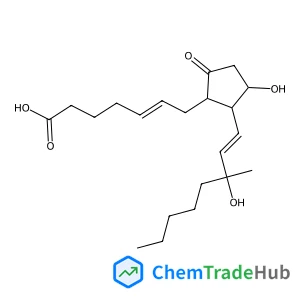
(5Z,11alpha,13E,15R)-11,15-Dihydroxy-15-methyl-9-oxoprosta-5,13-dien-1-oic acid
CAS Number:
55028-70-1
Molecular Formula:
C21H34O5
J. Weißhuhn, T. Mark, M. Martin, P. Müller, A. Seifert, S. Spange
The acid and base catalyzed simultaneous twin polymerization (STP) of various 2,2′-disubstituted 4H-1,3,2-benzodioxasiline derivatives 2a–d with 2,2′-spirobi[4H-1,3,2-benzodioxasiline] (1) are presented in this paper. The products are nanostructured ternary organic–inorganic hybrid materials consisting of a cross-linked organic polymer, silica and a disubstituted polysiloxane. It can be demonstrated whether and in which extent the copolymerization of the two inorganic fragments of 1 and 2 takes place among the STP and how the molar ratio of the two components determines the structure formation of the resulting hybrid material. Steric and electronic effects of the substituents at the silicon center of 2 on the molecular structure formation and the morphology of the resulting hybrid material were investigated by means of solid state CP MAS 29Si and 13C NMR spectroscopy as well as high-angle annular dark-field scanning transmission electron microscopy (HAADF-STEM). The mechanical properties (hardness and Young's modulus) of the hybrid materials were analyzed by means of nanoindentation measurements.

Photochemical & Photobiological Sciences

Environmental Toxicology and Pharmacology

Angewandte Chemie International Edition

Advanced Engineering Materials

Mini-Reviews in Medicinal Chemistry

Green Chemistry

Journal of Enzyme inhibition and Medicinal Chemistry

European Journal of Organic Chemistry

Coloration Technology

Contact Lens & Anterior Eye
E-Jen Teh, Naoyuki Ishida, William M. Skinner, Drew Parsons, Vincent S. J. Craig
DOI: 10.1039/C9CP02797A
Antonio Frontera, Antonio Bauzá
DOI: 10.1039/C9CP03858B
M. P. Dvores, P. Çarçabal, P. Maître, J. P. Simons
DOI: 10.1039/C9CP06572E
Li-Na Wu, Ming-Yue Sui, Song Xiao, Yu-Zhong Xie
DOI: 10.1039/C9CP04903G
Aniruddh Shrivastava, Sizhe Liu
DOI: 10.1039/C9CP04115J
Fuhua Li, Qing Tang
DOI: 10.1039/C9CP03469B
Yongli Shen, Kangjuan Yin, Zihui Xiao
DOI: 10.1039/C9CP03201K
Jean Demaison, Rizalina Tama Saragi, Marcos Juanes, Heinz Dieter Rudolph, Alberto Lesarri
DOI: 10.1039/C9CP02508A
K. R. Nandipati, Arun Kumar Kanakati, H. Singh, S. Mahapatra
DOI: 10.1039/C9CP03762D
When handling 2-Methyl-2-propanyl 5-amino-2-thiophenecarboxylate (CAS: 1498311-5...
5-Bromo-1,2-dichloro-3-fluorobenzene (CAS: 1000572-93-9) is a crystalline solid ...
(2R)-2-Amino-2-(4-bromophenyl)ethanol (CAS: 354153-64-3) should be stored in a c...
Methyl 4-(aminomethyl)tetrahydro-2H-pyran-4-carboxylate hydrochloride (CAS: 3627...
1,4-Dimethyl-1H-pyrazole-5-sulfonyl chloride is primarily used as an intermediat...
Dinaphtho[1,2-b:2',1'-d]furan is generally safe when handled with appropriate pe...
The market for 7-Methyl-7,9-dihydro-1H-purine-2,6,8(3H)-trione (CAS: 612-37-3) i...
2-(4-Chlorophenyl)malonaldehyde (CAS: 205676-17-1) is a colorless or light yello...
2-Methylchrysene (CAS: 3351-32-4) is typically synthesized via the reaction of c...
N-(6-aminopyrimidin-4-yl)acetamide (CAS: 89533-23-3) is generally considered saf...

Polymer Chemistry welcomes submissions in all areas of polymer science that have a strong focus on macromolecular chemistry. Manuscripts may cover a broad range of fields, yet no direct application focus is required.