












An Au22(L8)6 nanocluster with in situ uncoordinated Au as a highly active catalyst for O2 activation and CO oxidation
Literature Information
Publication Date
2019-08-23
DOI
10.1039/C9CP03469B
Impact Factor
3.676
Authors
Fuhua Li, Qing Tang
View Original
Abstract
Ligand-capped gold nanoclusters with atomic precision have attracted great interest as a new type of nanocatalyst to elucidate mechanisms and establish structure–reactivity correlations. In most cases, however, the catalytic activity of fully protected gold nanoclusters is severely hindered due to the blocking effects of the ligands. Alternatively, partially protected gold nanoclusters with the creation of in situ coordination unsaturated (cus) Au are highly promising for nanocatalysis. In this study, via density functional theory (DFT) calculations, we investigated the reactivity of a diphosphine-protected Au22(L8)6 nanocluster using oxygen activation and CO oxidation as the testing probes. The results showed that the cus Au at the interface shows strong adsorption and activation of oxygen, promoting the dissociation of two O2 molecules into fully oxidized Au22(L8)6O4 nanoclusters with a moderate activation barrier (0.6–0.7 eV). The adsorption of additional O2 prefers molecular adsorption and locates at the terminal Au11 unit around the Au–P framework. Furthermore, our results indicate that the Au22(L8)6 cluster shows very high activity and a low energy barrier (0.51 eV) for CO oxidation. The facile O2 activation and CO oxidation over the Au22(L8)6 nanocatalyst will aid the rational design of partially protected metal nanoclusters with coordination unsaturated metal centers in oxidation or other catalytic reactions for important practical applications.
Related Literature
Ultra-low amount Pt-doped Co2P/Ni2P on nickel foam as an efficient electrocatalyst for the hydrogen evolution reaction in an alkaline electrolyte
Xin Xiao, Dongping Sun, Xiaoheng Liu, Bo Qiu
2020-12-28
Paper
DOI: 10.1039/D0SE01679A
The highly selective synthesis of 5-methyl vanillin from the by-product in vanilla industry and the scent influence for vanillin
Haifang Mao, Hongzhao Wang, Ting Tang, Qixuan Shi, Haiyan Yu, Xiaojun Hu, Zuobing Xiao, Pingyi Zhang, Jibo Liu
2021-01-08
Paper
DOI: 10.1039/D1SE00011J
Practical increases in power output from soil-based microbial fuel cells under dynamic temperature variations
Lingling Gong, Mehran Abbaszadeh Amirdehi, Amine Miled
2020-12-18
Paper
DOI: 10.1039/D0SE01406K
The synergistic effect with S-vacancies and built-in electric field on a TiO2/MoS2 photoanode for enhanced photoelectrochemical performance
Jianhua Han, Shaoce Zhang, Qinggong Song, Huiyu Yan, Jianhai Kang, Yanrui Guo
2020-11-23
Paper
DOI: 10.1039/D0SE01515F
Ferrocene-based porous organic polymer derived N-doped porous carbon/Fe3C nanocrystal hybrids towards high-efficiency ORR for Zn–air batteries
Xia Liu, Xiaoming Liang, Han Lou, Huiru Wang, Hui Li, Shujuan Zhang, Shourong Zhu, Weina Han
2020-12-31
Paper
DOI: 10.1039/D0SE01692F
Highly efficient and stable perovskite solar cells produced by maximizing additive engineering
Linlin Qiu, Jiacheng Zou, Wei-Hsiang Chen, Lika Dong, Deqiang Mei, Jieqiong Wang, Pei-Cheng Jiang
2020-11-12
Paper
DOI: 10.1039/D0SE01498B
Morphologically controlled rapid fabrication of rhodium sulfide (Rh2S3) thin films for superior and robust hydrogen evolution reaction
Muhammad Ali Ehsan, Alaaldin Adam, Abdul Rehman, Abbas Saeed Hakeem, Anvarhusein A. Isab
2020-11-16
Paper
DOI: 10.1039/D0SE01423K
Mechanisms of photoredox catalysts: the role of optical spectroscopy
Noufal Kandoth, Javier Pérez Hernández
2021-01-20
Review Article
DOI: 10.1039/D0SE01454K
You might also like
Compound Q&A
What precautions should be taken when handling 2-Methyl-2-propanyl 5-amino-2-thiophenecarboxylate (CAS: 1498311-57-1)?
When handling 2-Methyl-2-propanyl 5-amino-2-thiophenecarboxylate (CAS: 1498311-5...
1498311-57-12-Methyl-2-propanyl ...
Compound Q&A
What are the physical and chemical properties of 5-Bromo-1,2-dichloro-3-fluorobenzene (CAS: 1000572-93-9)?
5-Bromo-1,2-dichloro-3-fluorobenzene (CAS: 1000572-93-9) is a crystalline solid ...
1000572-93-95-Bromo-1,2-dichloro...
Compound Q&A
How should (2R)-2-Amino-2-(4-bromophenyl)ethanol (CAS: 354153-64-3) be stored?
(2R)-2-Amino-2-(4-bromophenyl)ethanol (CAS: 354153-64-3) should be stored in a c...
354153-64-3(2R)-2-Amino-2-(4-br...
Compound Q&A
What regulatory guidelines apply to Methyl 4-(aminomethyl)tetrahydro-2H-pyran-4-carboxylate hydrochloride (CAS: 362707-24-2)?
Methyl 4-(aminomethyl)tetrahydro-2H-pyran-4-carboxylate hydrochloride (CAS: 3627...
362707-24-2Methyl 4-(aminomethy...
Compound Q&A
What are the main uses of 1,4-dimethyl-1H-pyrazole-5-sulfonyl chloride (CAS: 1174834-52-6)?
1,4-Dimethyl-1H-pyrazole-5-sulfonyl chloride is primarily used as an intermediat...
1174834-52-61,4-dimethyl-1H-pyra...
Compound Q&A
Is Dinaphtho[1,2-b:2',1'-d]furan (CAS: 239-69-0) safe?
Dinaphtho[1,2-b:2',1'-d]furan is generally safe when handled with appropriate pe...
239-69-0Dinaphtho[1,2-b:2',1...
Compound Q&A
What is the market or research trend for 7-Methyl-7,9-dihydro-1H-purine-2,6,8(3H)-trione (CAS: 612-37-3)?
The market for 7-Methyl-7,9-dihydro-1H-purine-2,6,8(3H)-trione (CAS: 612-37-3) i...
612-37-37-Methyl-7,9-dihydro...
Compound Q&A
What are the physical and chemical properties of 2-(4-Chlorophenyl)malonaldehyde (CAS: 205676-17-1)?
2-(4-Chlorophenyl)malonaldehyde (CAS: 205676-17-1) is a colorless or light yello...
205676-17-12-(4-Chlorophenyl)ma...
Compound Q&A
How is 2-Methylchrysene (CAS: 3351-32-4) typically synthesized?
2-Methylchrysene (CAS: 3351-32-4) is typically synthesized via the reaction of c...
3351-32-42-Methylchrysene
Compound Q&A
Is N-(6-aminopyrimidin-4-yl)acetamide (CAS: 89533-23-3) safe?
N-(6-aminopyrimidin-4-yl)acetamide (CAS: 89533-23-3) is generally considered saf...
89533-23-3N-(6-aminopyrimidin-...
Source Journal
Physical Chemistry Chemical Physics

CiteScore:
5.5
Self-citation Rate:
10.3%
Articles per Year:
3036
Physical Chemistry Chemical Physics (PCCP) is an international journal co-owned by 19 physical chemistry and physics societies from around the world. This journal publishes original, cutting-edge research in physical chemistry, chemical physics and biophysical chemistry. To be suitable for publication in PCCP, articles must include significant innovation and/or insight into physical chemistry; this is the most important criterion that reviewers and Editors will judge against when evaluating submissions. The journal has a broad scope and welcomes contributions spanning experiment, theory, computation and data science. Topical coverage includes spectroscopy, dynamics, kinetics, statistical mechanics, thermodynamics, electrochemistry, catalysis, surface science, quantum mechanics, quantum computing and machine learning. Interdisciplinary research areas such as polymers and soft matter, materials, nanoscience, energy, surfaces/interfaces, and biophysical chemistry are welcomed if they demonstrate significant innovation and/or insight into physical chemistry. Joined experimental/theoretical studies are particularly appreciated when complementary and based on up-to-date approaches.
Recommended Compounds
![2-Bromo-7-chloro-4H-pyrrolo[2,3-b]pyrazine structure](https://static.chemtradehub.com/structs/115/1150617-58-5-0b0a.webp "2-Bromo-7-chloro-4H-pyrrolo[2,3-b]pyrazine structure")
![1-Oxa-8-azaspiro[4.5]decan-3-ol structure](https://static.chemtradehub.com/structs/757/757239-76-2-a0ec.webp "1-Oxa-8-azaspiro[4.5]decan-3-ol structure")
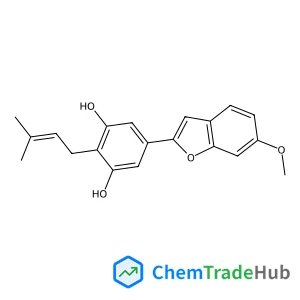
5-(6-Methoxy-1-benzofuran-2-yl)-2-(3-methyl-2-buten-1-yl)-1,3-benzenediol
CAS Number:
1017277-40-5
Molecular Formula:
C20H20O4
Recommended Suppliers



Disclaimer
This page provides academic journal information for reference and research purposes only. We are not affiliated with any journal publishers and do not handle publication submissions. For publication-related inquiries, please contact the respective journal publishers directly.
If you notice any inaccuracies in the information displayed, please contact us at support@chemtradehub.com. We will promptly review and address your concerns.