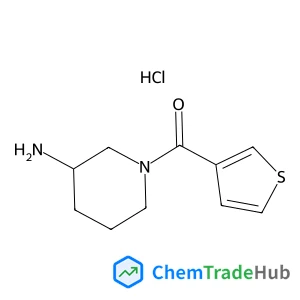
(3-Amino-piperidin-1-yl)-thiophen-3-yl-methanone hydrochloride
CAS Number:
1185316-70-4
Molecular Formula:
C10H15ClN2OS
K. R. Nandipati, Arun Kumar Kanakati, H. Singh, S. Mahapatra
We report photo-isomerization of malonaldehyde in its electronic ground state (S0), mediated by coupled 1nπ*(S1)–1ππ*(S2) excited electronic states, accomplished with the aid of optimally designed ultraviolet (UV)-laser pulses. In particular, control of H-transfer from a configuration predominantly located in the left well (say, reactant) to that in the right well (say, product) of the electronic ground S0 potential energy surface is achieved by a pump–dump mechanism including the nonadiabatic interactions between the excited S1 and S2 states. An interplay between the nonadiabatic coupling due to the conical intersection of the S1 and S2 states and the laser–molecule interaction is found to be imprinted in the time-dependent electronic population. The latter is also examined by employing optimal fields of varying intensities and frequencies of the UV laser pulses. For the purpose of the present study, we constructed a three-state and two-mode coupled diabatic Hamiltonian with the help of adiabatic electronic energies and transition dipole moments calculated by ab initio quantum chemistry methods. The electronic diabatic model is developed using the calculated adiabatic energies of the two excited electronic states (S1 and S2) in order to carry out the dynamics study. The optimal fields for achieving the controlled isomerization are designed within the framework of optimal control theory employing the optimization technique of a multitarget functional using the genetic algorithm. The laser-driven dynamics of the system is treated by numerically solving the time-dependent Schrödinger equation within the dipole approximation. A time-averaged yield of the target product of ∼40% is achieved in the present treatment of dynamics with optimal laser pulses.
Avani Chunduri, Nainesh Patel, Dattatray S. Dhawale, Ajayan Vinu, Hind Aljohani
DOI: 10.1039/D0SE01711F
DOI: 10.1039/D0SE01831G
Mehrdad Vasheghani Farahani, Xianwei Guo, Lunxiang Zhang, Mingzhao Yang, Aliakbar Hassanpouryouzband, Jiafei Zhao, Jinhai Yang, Yongchen Song, Bahman Tohidi
DOI: 10.1039/D0SE01705A
Akbar Mohammadi Zardkhoshoui, Saied Saeed Hosseiny Davarani
DOI: 10.1039/D0SE01665A
Noufal Kandoth, Javier Pérez Hernández
DOI: 10.1039/D0SE01454K
Mohamed R. Rizk, Muhammad G. Abd El-Moghny, Amina Mazhar, Mohamed S. El-Deab, B. E. El-Anadouli
DOI: 10.1039/D0SE01835J
Guiyun Lin, Long Sun, Guocheng Huang, Qiaoshan Chen, Shengqiong Fang, Ling Wu
DOI: 10.1039/D0SE01504K
Qiwei Tan, Kun Han, Wang Zhao, Ping Li, Zhiwei Liu, Shengwei Li, Xuanhui Qu
DOI: 10.1039/D0SE01457E
Luke T. Minardi, Faisal H. Alshafei, Zubin K. Mishra, Dante A. Simonetti
DOI: 10.1039/D0SE01638A
When handling 2-Methyl-2-propanyl 5-amino-2-thiophenecarboxylate (CAS: 1498311-5...
5-Bromo-1,2-dichloro-3-fluorobenzene (CAS: 1000572-93-9) is a crystalline solid ...
(2R)-2-Amino-2-(4-bromophenyl)ethanol (CAS: 354153-64-3) should be stored in a c...
Methyl 4-(aminomethyl)tetrahydro-2H-pyran-4-carboxylate hydrochloride (CAS: 3627...
1,4-Dimethyl-1H-pyrazole-5-sulfonyl chloride is primarily used as an intermediat...
Dinaphtho[1,2-b:2',1'-d]furan is generally safe when handled with appropriate pe...
The market for 7-Methyl-7,9-dihydro-1H-purine-2,6,8(3H)-trione (CAS: 612-37-3) i...
2-(4-Chlorophenyl)malonaldehyde (CAS: 205676-17-1) is a colorless or light yello...
2-Methylchrysene (CAS: 3351-32-4) is typically synthesized via the reaction of c...
N-(6-aminopyrimidin-4-yl)acetamide (CAS: 89533-23-3) is generally considered saf...

Physical Chemistry Chemical Physics (PCCP) is an international journal co-owned by 19 physical chemistry and physics societies from around the world. This journal publishes original, cutting-edge research in physical chemistry, chemical physics and biophysical chemistry. To be suitable for publication in PCCP, articles must include significant innovation and/or insight into physical chemistry; this is the most important criterion that reviewers and Editors will judge against when evaluating submissions. The journal has a broad scope and welcomes contributions spanning experiment, theory, computation and data science. Topical coverage includes spectroscopy, dynamics, kinetics, statistical mechanics, thermodynamics, electrochemistry, catalysis, surface science, quantum mechanics, quantum computing and machine learning. Interdisciplinary research areas such as polymers and soft matter, materials, nanoscience, energy, surfaces/interfaces, and biophysical chemistry are welcomed if they demonstrate significant innovation and/or insight into physical chemistry. Joined experimental/theoretical studies are particularly appreciated when complementary and based on up-to-date approaches.
![3-[7-Amino-3-(3-pyridinyl)pyrazolo[1,5-a]pyrimidin-6-yl]phenol structure](https://static.chemtradehub.com/structs/861/861249-77-6-025b.webp "3-[7-Amino-3-(3-pyridinyl)pyrazolo[1,5-a]pyrimidin-6-yl]phenol structure")