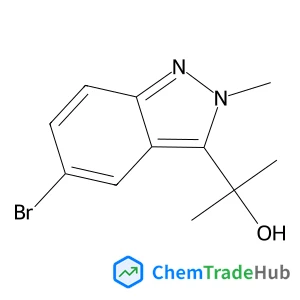
2-(5-Bromo-2-methyl-2H-indazol-3-yl)-2-propanol
CAS Number:
1823787-20-7
Molecular Formula:
C11H13BrN2O
Mokhtar Imit, Patigul Imin, Alex Adronov
Selective interactions between conjugated polymers and single-walled carbon nanotubes (SWNTs) are promising for purifying and isolating electronically enriched nanotube structures. However, the structure–property relationships that dictate the interaction selectivity are still poorly understood. Here, two different fluorene-based conjugated copolymers, poly[(9,9′-dioctylfluorene)-alt-(3,3-didodecyl-3,4-dihydro-2H-thieno[3,4-b][1,4]dioxepine)] (PFO-ProDOT), and poly[(9,9′-dioctylfluorene)-alt-(2,3-didodecyloxyphenazine)] (PFO-DPZ), were synthesized by the palladium-catalyzed Suzuki cross-coupling polymerization. These polymers differ in their structure and electronic properties, with PFO-ProDOT being relatively electron rich, and PFO-DPZ being relatively electron poor. Both polymers were able to form stable supramolecular complexes with SWNTs in common organic solvents, such as tetrahydrofuran (THF), toluene, and xylene. These complexes were characterized by UV-Vis-NIR absorption, Raman, and fluorescence spectroscopy, as well as by thermogravimetric analysis. Analysis of UV-Vis-NIR absorption and Raman data indicates that PFO-ProDOT is more selective for semiconducting SWNTs, while PFO-DPZ exhibits some preference for metallic SWNTs. Thus, a combination of conjugated polymer structure and electronics impacts selectivity for the different types of SWNTs present in commercial samples.
Laura Santagostini, Michele Gullotti, Roberto Pagliarin, Enrico Monzani, Luigi Casella
DOI: 10.1039/B307349A
Akiyoshi Sasaki, Keitaro Matsui
DOI: 10.1039/B212823C
Edmund C. Schwartz, Tom W. Muir, Amy B. Tyszkiewicz
DOI: 10.1039/B304989M
Tomikazu Sasaki
DOI: 10.1039/B212364A
Santos Fustero, Esther Salavert, Juan F. Sanz-Cervera, Julio Piera, Amparo Asensio
DOI: 10.1039/B300796K
Kang Hyun Park, Seung Uk Son, Young Keun Chung
DOI: 10.1039/B304325H
Zhengquan Li, Changzheng Wu, Rong Zhang
DOI: 10.1039/B211996J
R. N. Butler, John C. Stephens, Luke A. Burke
DOI: 10.1039/B301491F
Mamoru Mizuno, Kohtaro Goto, Tsuyoshi Miura, Daisuke Hosaka, Toshiyuki Inazu
DOI: 10.1039/B300682D
Hongchao Li, Jan O. Jeppesen, Eric Levillain, Jan Becher
DOI: 10.1039/B212456D
When handling 2-Methyl-2-propanyl 5-amino-2-thiophenecarboxylate (CAS: 1498311-5...
5-Bromo-1,2-dichloro-3-fluorobenzene (CAS: 1000572-93-9) is a crystalline solid ...
(2R)-2-Amino-2-(4-bromophenyl)ethanol (CAS: 354153-64-3) should be stored in a c...
Methyl 4-(aminomethyl)tetrahydro-2H-pyran-4-carboxylate hydrochloride (CAS: 3627...
1,4-Dimethyl-1H-pyrazole-5-sulfonyl chloride is primarily used as an intermediat...
Dinaphtho[1,2-b:2',1'-d]furan is generally safe when handled with appropriate pe...
The market for 7-Methyl-7,9-dihydro-1H-purine-2,6,8(3H)-trione (CAS: 612-37-3) i...
2-(4-Chlorophenyl)malonaldehyde (CAS: 205676-17-1) is a colorless or light yello...
2-Methylchrysene (CAS: 3351-32-4) is typically synthesized via the reaction of c...
N-(6-aminopyrimidin-4-yl)acetamide (CAS: 89533-23-3) is generally considered saf...

Polymer Chemistry welcomes submissions in all areas of polymer science that have a strong focus on macromolecular chemistry. Manuscripts may cover a broad range of fields, yet no direct application focus is required.