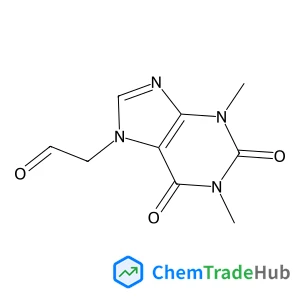
(1,3-Dimethyl-2,6-dioxo-1,2,3,6-tetrahydro-7H-purin-7-yl)acetaldehyde
CAS Number:
5614-53-9
Molecular Formula:
C9H10N4O3
Hongchao Li, Jan O. Jeppesen, Eric Levillain, Jan Becher
Annulation of one TTF unit directly to the porphyrin chromophore produces an almost nonfluorescent species which can be transformed into a fluorescent species by oxidation of the TTF unit.
Xinran Chen, Yang Li, Lu Chen, Lili Cui, Zhiyu Dou, Xingquan He, Meihong Fan, Tewodros Asefa
DOI: 10.1039/D1SE01167G
Dinesh Bhalothia, Yu-Min Yu, Yi-Ru Lin, Tzu- Hsi Huang, Che Yan, Jyh-Fu Lee, Kuan-Wen Wang
DOI: 10.1039/D1SE01331A
Saeed M. Alhassan
DOI: 10.1039/D1SE01134K
Troy R. Hawkins
DOI: 10.1039/D1SE01742J
Yulia Galagan, Hamid Ez-Zahraouy
DOI: 10.1039/D1SE00687H
Bowen Luo, Zhixiang Huang, Riyang Shu, Yu Cheng, Zhipeng Tian, Chao Wang, Ying Chen
DOI: 10.1039/D1SE01403J
Yayun Zhang, Yunfeng Zhao, Moriko Qian, Xiaona Lin, Hanwu Lei
DOI: 10.1039/D1SE01108A
Haruka Momose, Fumiaki Takagi, Sora Fujisawa
DOI: 10.1039/D1SE00914A
DOI: 10.1039/D1SE01193F
Xue Zhang, Lingling Gao, Ruihong Guo, Tuoping Hu
DOI: 10.1039/D1SE01129D
When handling 2-Methyl-2-propanyl 5-amino-2-thiophenecarboxylate (CAS: 1498311-5...
5-Bromo-1,2-dichloro-3-fluorobenzene (CAS: 1000572-93-9) is a crystalline solid ...
(2R)-2-Amino-2-(4-bromophenyl)ethanol (CAS: 354153-64-3) should be stored in a c...
Methyl 4-(aminomethyl)tetrahydro-2H-pyran-4-carboxylate hydrochloride (CAS: 3627...
1,4-Dimethyl-1H-pyrazole-5-sulfonyl chloride is primarily used as an intermediat...
Dinaphtho[1,2-b:2',1'-d]furan is generally safe when handled with appropriate pe...
The market for 7-Methyl-7,9-dihydro-1H-purine-2,6,8(3H)-trione (CAS: 612-37-3) i...
2-(4-Chlorophenyl)malonaldehyde (CAS: 205676-17-1) is a colorless or light yello...
2-Methylchrysene (CAS: 3351-32-4) is typically synthesized via the reaction of c...
N-(6-aminopyrimidin-4-yl)acetamide (CAS: 89533-23-3) is generally considered saf...

ChemComm publishes urgent research which is of outstanding significance and interest to experts in the field, while also appealing to the journal’s broad chemistry readership. Our communication format is ideally suited to short, urgent studies that are of such importance that they require accelerated publication. Our scope covers all topics in chemistry, and research at the interface of chemistry and other disciplines (such as materials science, nanoscience, physics, engineering and biology) where there is a significant novelty in the chemistry aspects. Major topic areas covered include: Analytical Chemistry Catalysis Chemical Biology and medicinal chemistry Computational Chemistry and Machine Learning Energy and sustainable chemistry Environmental Chemistry Green Chemistry Inorganic Chemistry Materials Chemistry Nanoscience Organic Chemistry Physical Chemistry Polymer Chemistry Supramolecular Chemistry