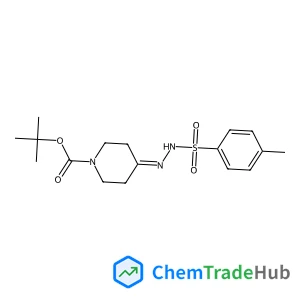
tert-Butyl 4-(2-(p-Tolylsulfonyl)hydrazono)piperidine-1-carboxylate
CAS Number:
1046478-89-0
Molecular Formula:
C17H25N3O4S
One-pot polycondensation reaction of triethoxyvinylsilane (A-151) with excessive neopentyl glycol (NPG) is employed as an efficient and facile methodology for the synthesis of novel hyperbranched polysiloxanes contemporaneously bearing plenty of unconjugated carbon–carbon double bonds and hydroxyl groups (HPUHs). Interestingly, the obtained HPUHs obviously without containing conventional chromophores exhibit conspicuous ultraviolet absorbency and bright blue photoluminescence when irradiated by a UV lamp with 365 nm wavelength. The excitation and emission intensities of the as-prepared polymers progressively grow along with raising their molecular weights and concentrations, and even the brightest blue glow in the solid state is observed, suggesting the emission intensity is molecular-weight and concentration-dependent. The preliminary investigation indicates that both the carbon–carbon double bond and the hydroxyl group are very important in the formation of blue-luminescent species. Thus, this work opens a new route to design new light-emitting materials.
Min Zhou, Fan Pu, Zhao Wang, Tingwei Cai, Hao Chen, Haiyong Zhang, Shiyou Guan
DOI: 10.1039/C3CP51276B
Yungang Zhou, Chengfei Yang, Xia Xiang, Xiaotao Zu
DOI: 10.1039/C3CP51518D
Juraj Sibik, Evgenyi Y. Shalaev, J. Axel Zeitler
DOI: 10.1039/C3CP51936H
Bas C. van der Wiel, René M. Williams
DOI: 10.1039/C3CP52148F
Dae Sung Chung, Il Kang, Yun-Hi Kim, Soon-Ki Kwon
DOI: 10.1039/C3CP52422A
Martin J. Hollamby
DOI: 10.1039/C3CP50293G
Deya Das, Seungchul Kim, Kwang-Ryeol Lee, Abhishek K. Singh
DOI: 10.1039/C3CP52891J
Daniel R. Albert, H. Floyd Davis
DOI: 10.1039/C3CP51930A
When considering alternatives to 1-(4-Chlorophenyl)-N-hydroxymethanimine (CAS: 3...
This compound should be stored in a cool, dry place away from direct sunlight. I...
3-(4-Bromophenyl)-5-(2-fluorophenyl)-1,2,4-oxadiazole is synthesized through a m...
5-Chloro-2-(4-chlorophenyl)-4-methyl-6-[3-(1-piperidinyl)propoxy]pyrimidine (CAS...
2-Chloro-4-(difluoromethoxy)pyridine is used in the pharmaceutical industry for ...
3-Chloro-6-methylpyridazine (CAS: 1121-79-5) is classified under the Globally Ha...
Several alternatives can be used in the synthesis of Methyl 4,5-dimethyl-2-nitro...
Alternatives to (2E,2'E)-3,3'-(1,4-Phenylene)bisacrylaldehyde include other acry...
3-Amino-5-chloropyridin-2-ol hydrochloride is an organic compound with the CAS n...
When handling 6,7-Difluoro-2,3-dihydro-4H-chromen-4-one, it is essential to wear...

Polymer Chemistry welcomes submissions in all areas of polymer science that have a strong focus on macromolecular chemistry. Manuscripts may cover a broad range of fields, yet no direct application focus is required.