












Practical applications of small-angle neutron scattering
Literature Information
Publication Date
2013-03-25
DOI
10.1039/C3CP50293G
Impact Factor
3.676
Authors
Martin J. Hollamby
View Original
Abstract
Recent improvements in beam-line accessibility and technology have led to small-angle neutron scattering (SANS) becoming more frequently applied to materials problems. SANS has been used to study the assembly, dispersion, alignment and mixing of nanoscale condensed matter, as well as to characterise the internal structure of organic thin films, porous structures and inclusions within steel. Using time-resolved SANS, growth mechanisms in materials systems and soft matter phase transitions can also be explored. This review is intended for newcomers to SANS as well as experts. Therefore, the basic knowledge required for its use is first summarised. After this introduction, various examples are given of the types of soft and hard matter that have been studied by SANS. The information that can be extracted from the data is highlighted, alongside the methods used to obtain it. In addition to presenting the findings, explanations are provided on how the SANS measurements were optimised, such as the use of contrast variation to highlight specific parts of a structure. Emphasis is placed on the use of complementary techniques to improve data quality (e.g. using other scattering methods) and the accuracy of data analysis (e.g. using microscopy to separately determine shape and size). This is done with a view to providing guidance on how best to design and analyse future SANS measurements on materials not listed below.
Related Literature
Hyperspectral images: a qualitative approach to evaluate the chemical profile distribution of Ca, K, Mg, Na and P in edible seeds employing laser-induced breakdown spectroscopy
Raimundo R. Gamela, Marco A. Sperança, Daniel F. Andrade, Edenir R. Pereira-Filho
2019-09-25
Paper
DOI: 10.1039/C9AY01916B
Aspects and applications of non-aqueous high temperature packed capillary liquid chromatography
Paper
DOI: 10.1039/A903908B
Au@SiO2 core–shell nanoparticles for laser desorption/ionization time of flight mass spectrometry
Xiaoqing Zhu, Lianglan Wu, Divyesh C. Mungra, Sijing Xia, Jin Zhu
2012-03-13
Paper
DOI: 10.1039/C2AN35074B
FTIR microspectroscopy for rapid screening and monitoring of polyunsaturated fatty acid production in commercially valuable marine yeasts and protists
Jitraporn Vongsvivut, Philip Heraud, Adarsha Gupta, Munish Puri, Don McNaughton, Colin J. Barrow
2013-07-31
Paper
DOI: 10.1039/C3AN00485F
In situ analysis of corrosion inhibitors using a portable mass spectrometer with paper spray ionization
Fred. P. M. Jjunju, Anyin Li, Abraham Badu-Tawiah, Pu Wei, Linfan Li, Zheng Ouyang, Iman S. Roqan, R. Graham Cooks
2013-05-09
Paper
DOI: 10.1039/C3AN00249G
You might also like
Compound Q&A
Are there alternatives to 1-(4-Chlorophenyl)-N-hydroxymethanimine (CAS: 3848-36-0) in synthesis?
When considering alternatives to 1-(4-Chlorophenyl)-N-hydroxymethanimine (CAS: 3...
3848-36-01-(4-Chlorophenyl)-N...
Compound Q&A
How should (1R,9S,10S,12S,14E,16S,19R,20R,21S,22R)-3,9,21-Trihydroxy-5,10,12,14,16,20,22-heptamethyl-23,24-dioxatetracyclo[17.3.1.1~6,9~.0~2,7~]tetracosa-2,5,7,14-tetraen-4-one (CAS: 183202-73-5) be stored?
This compound should be stored in a cool, dry place away from direct sunlight. I...
183202-73-5(1R,9S,10S,12S,14E,1...
Compound Q&A
How is 3-(4-Bromophenyl)-5-(2-fluorophenyl)-1,2,4-oxadiazole (CAS: 419553-16-5) typically synthesized?
3-(4-Bromophenyl)-5-(2-fluorophenyl)-1,2,4-oxadiazole is synthesized through a m...
419553-16-53-(4-Bromophenyl)-5-...
Compound Q&A
How is 5-Chloro-2-(4-chlorophenyl)-4-methyl-6-[3-(1-piperidinyl)propoxy]pyrimidine (CAS: 1639220-19-1) typically synthesized?
5-Chloro-2-(4-chlorophenyl)-4-methyl-6-[3-(1-piperidinyl)propoxy]pyrimidine (CAS...
1639220-19-15-Chloro-2-(4-chloro...
Compound Q&A
What industries use 2-Chloro-4-(difluoromethoxy)pyridine (CAS: 1206978-15-5)?
2-Chloro-4-(difluoromethoxy)pyridine is used in the pharmaceutical industry for ...
1206978-15-52-Chloro-4-(difluoro...
Compound Q&A
What regulatory guidelines apply to 3-Chloro-6-methylpyridazine (CAS: 1121-79-5)?
3-Chloro-6-methylpyridazine (CAS: 1121-79-5) is classified under the Globally Ha...
1121-79-53-Chloro-6-methylpyr...
Compound Q&A
Are there alternatives to Methyl 4,5-dimethyl-2-nitrobenzoate in synthesis?
Several alternatives can be used in the synthesis of Methyl 4,5-dimethyl-2-nitro...
90922-74-0Methyl 4,5-dimethyl-...
Compound Q&A
Are there alternatives to (2E,2'E)-3,3'-(1,4-Phenylene)bisacrylaldehyde in synthesis?
Alternatives to (2E,2'E)-3,3'-(1,4-Phenylene)bisacrylaldehyde include other acry...
63405-68-5(2E,2'E)-3,3'-(1,4-P...
Compound Q&A
What is 3-Amino-5-chloropyridin-2-ol hydrochloride (CAS: 1261906-29-9)?
3-Amino-5-chloropyridin-2-ol hydrochloride is an organic compound with the CAS n...
1261906-29-93-Amino-5-chloropyri...
Compound Q&A
What precautions should be taken when handling 6,7-Difluoro-2,3-dihydro-4H-chromen-4-one (CAS: 1092349-93-3)?
When handling 6,7-Difluoro-2,3-dihydro-4H-chromen-4-one, it is essential to wear...
1092349-93-36,7-Difluoro-2,3-dih...
Source Journal
Physical Chemistry Chemical Physics

CiteScore:
5.5
Self-citation Rate:
10.3%
Articles per Year:
3036
Physical Chemistry Chemical Physics (PCCP) is an international journal co-owned by 19 physical chemistry and physics societies from around the world. This journal publishes original, cutting-edge research in physical chemistry, chemical physics and biophysical chemistry. To be suitable for publication in PCCP, articles must include significant innovation and/or insight into physical chemistry; this is the most important criterion that reviewers and Editors will judge against when evaluating submissions. The journal has a broad scope and welcomes contributions spanning experiment, theory, computation and data science. Topical coverage includes spectroscopy, dynamics, kinetics, statistical mechanics, thermodynamics, electrochemistry, catalysis, surface science, quantum mechanics, quantum computing and machine learning. Interdisciplinary research areas such as polymers and soft matter, materials, nanoscience, energy, surfaces/interfaces, and biophysical chemistry are welcomed if they demonstrate significant innovation and/or insight into physical chemistry. Joined experimental/theoretical studies are particularly appreciated when complementary and based on up-to-date approaches.
Recommended Compounds
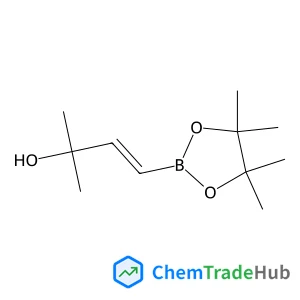
(E)-2-methyl-4-(4,4,5,5-tetramethyl-1,3,2-dioxaborolan-2-yl)but-3-en-2-ol
CAS Number:
581802-26-8
Molecular Formula:
C11H21BO3
Recommended Suppliers







Disclaimer
This page provides academic journal information for reference and research purposes only. We are not affiliated with any journal publishers and do not handle publication submissions. For publication-related inquiries, please contact the respective journal publishers directly.
If you notice any inaccuracies in the information displayed, please contact us at support@chemtradehub.com. We will promptly review and address your concerns.