


![5,10-Dihydroindeno[2,1-a]indene structure](https://static.chemtradehub.com/structs/654/6543-29-9-71ca.webp "5,10-Dihydroindeno[2,1-a]indene structure")
Multicomponent sequential polymerizations of alkynes, carbonyl chloride and amino ester salts toward helical and luminescent polymers
Literature Information
Publication Date
2016-01-29
DOI
10.1039/C6PY00024J
Impact Factor
5.582
Authors
Rongrong Hu
View Original
Abstract
Multicomponent sequential reactions have recently received much attention owing to their outstanding advantages, such as simple operation, atom economy, and environmental benefit. In this work, we report a new multicomponent sequential reaction and the corresponding multicomponent sequential polymerization approach to construct conjugated structures with advanced functionalities. By employing 1,8-diazabicyclo[5.4.0]undec-7-ene as an additive, alkynes, carbonyl chloride and amino ester salts undergo a one-pot three-component sequential reaction successfully. Similarly, the derived multicomponent sequential polymerizations of diyne, terephthaloyl chloride and amino ester proceed smoothly in a regio- and stereoregular manner and generate conjugated nitrogen-substituted poly(enaminone)s with high molecular weights in satisfactory yields. All the resulting polymers are soluble in common solvents, and possess high thermal stability and good film-forming ability. Interestingly, the incorporation of optically active chiral amino esters as pendants leads to polymeric products with helical rotating backbones, as revealed by their circular dichroism spectra in the solutions and as cast films. With fluorescent tetraphenylethene moieties embedded in the polymer chains, the polymers display a phenomenon of aggregation-enhanced emission. They emit weakly in the solution state, but fluoresce intensely as aggregates. Moreover, the thin films of the polymers exhibit high light refractivity (n = 1.9305–1.5992) in a wide wavelength region (400–1000 nm), which can be readily modulated by UV irradiation. Additionally, the polymeric products with photosensitivity can generate highly resolved two-dimensional luminescent patterns by UV treatment.
Recommended Journals

Journal of Enzyme inhibition and Medicinal Chemistry

Coloration Technology

Physical Chemistry Chemical Physics

Mini-Reviews in Medicinal Chemistry

Current Pharmaceutical Biotechnology

Nature Reviews Drug Discovery

Foundations of Chemistry

Green Chemistry

European Journal of Organic Chemistry

Molecular Diversity
Related Literature
The effect of metal ions on the viscoelastic properties of thermosensitive sol-to-gel reversible metallo-supramolecular hydrogels
A. Gutierres, S. Pascual, L. Fontaine, S. Piogé, L. Benyahia
2018-04-04
Paper
DOI: 10.1039/C7PY02118F
All-acrylic superelastomers: facile synthesis and exceptional mechanical behavior
Wei Lu, Andrew Goodwin, Yangyang Wang, Panchao Yin, Weiyu Wang, Jiahua Zhu, Ting Wu, Xinyi Lu, Bin Hu, Kunlun Hong, Nam-Goo Kang, Jimmy Mays
2017-10-17
Paper
DOI: 10.1039/C7PY01518F
Correction: Copper(ii) gluconate (a non-toxic food supplement/dietary aid) as a precursor catalyst for effective photo-induced living radical polymerisation of acrylates
Vasiliki Nikolaou, Fehaid Alsubaie, Alexandre Simula, David J. Fox, David M. Haddleton
2017-11-28
Correction
DOI: 10.1039/C7PY90190A
Encapsulation property of hyperbranched polyglycerols as prospective drug delivery systems
Ting Yin, Ke Li, Ruibin Wang, Yantian Chen, Lili Jing
2017-12-04
Paper
DOI: 10.1039/C7PY01419H
Smart self-assembled microgel films as encapsulating carriers for UV-absorbing molecules
Abdel Khoukh, Pablo Taboada, Kamel Chougrani, Valérie Alard
2018-02-16
Communication
DOI: 10.1039/C8PY00146D
A switch from anionic to bifunctional H-bonding catalyzed ring-opening polymerizations towards polyether–polyester diblock copolymers
Yaya Liu, Xin Wang, Zhenjiang Li, Fulan Wei, Hui Zhu, He Dong, Siming Chen, Herui Sun, Kun Yang, Kai Guo
2017-12-05
Communication
DOI: 10.1039/C7PY01842H
Synthesis, characterization and potential applications of 5-hydroxymethylfurfural derivative based poly(β-thioether esters) synthesized via thiol-Michael addition polymerization
Daihui Zhang, Marie-Josée Dumont
2018-01-16
Paper
DOI: 10.1039/C7PY02052J
Tailored emulsion-templated porous polymer scaffolds for iPSC-derived human neural precursor cell culture
Ashley R. Murphy
2017-10-06
Paper
DOI: 10.1039/C7PY01375B
You might also like
Compound Q&A
What precautions should be taken when handling lithium chloride hydrate (1:1:1) (CAS: 16712-20-2)?
When handling lithium chloride hydrate (1:1:1) (CAS: 16712-20-2), it is importan...
16712-20-2Lithium chloride hyd...
Compound Q&A
Is 4-(4H-1,2,4-Triazol-4-yl)piperidine (CAS: 690261-92-8) safe?
4-(4H-1,2,4-Triazol-4-yl)piperidine is generally considered safe for use in phar...
690261-92-84-(4H-1,2,4-Triazol-...
Compound Q&A
How should waste containing 1,3-Thiazole-2-carboxamide (CAS: 16733-85-0) be handled?
Waste containing 1,3-Thiazole-2-carboxamide (CAS: 16733-85-0) should be collecte...
16733-85-01,3-Thiazole-2-carbo...
Compound Q&A
What regulatory guidelines apply to 5-(Difluoromethyl)-2-fluorobenzonitrile (CAS: 934175-58-3)?
5-(Difluoromethyl)-2-fluorobenzonitrile (CAS: 934175-58-3) is subject to regulat...
934175-58-35-(Difluoromethyl)-2...
Compound Q&A
How is Methyl 3-acetamido-2-thiophenecarboxylate (CAS: 22288-79-5) typically synthesized?
Methyl 3-acetamido-2-thiophenecarboxylate can be synthesized by the reaction of ...
22288-79-5Methyl 3-acetamido-2...
Compound Q&A
What is 4-Isoquinolinecarbonitrile (CAS: 34846-65-6)?
4-Isoquinolinecarbonitrile is a chemical compound with the CAS number 34846-65-6...
34846-65-64-Isoquinolinecarbon...
Compound Q&A
How should Methyl 1H-1,2,3-triazole-4-carboxylate (CAS: 877309-59-6) be stored?
Store Methyl 1H-1,2,3-triazole-4-carboxylate (CAS: 877309-59-6) in a cool, dry p...
877309-59-6Methyl 1H-1,2,3-tria...
Compound Q&A
What regulatory guidelines apply to 6-Bromo[1,3]thiazolo[5,4-b]pyridin-2-amine (CAS: 1160791-13-8)?
6-Bromo[1,3]thiazolo[5,4-b]pyridin-2-amine (CAS: 1160791-13-8) is subject to the...
1160791-13-86-Bromo[1,3]thiazolo...
Compound Q&A
Is (2S,3S)-2-Ammonio-3-(3,4-dihydroxyphenyl)-3-hydroxypropanoate (CAS: 23651-95-8) safe?
(2S,3S)-2-Ammonio-3-(3,4-dihydroxyphenyl)-3-hydroxypropanoate (CAS: 23651-95-8) ...
23651-95-8(2S,3S)-2-Ammonio-3-...
Compound Q&A
What are the physical and chemical properties of 7-bromo-3-methyl-3,4-dihydroquinazolin-4-one (CAS: 1293987-84-4)?
7-Bromo-3-methyl-3,4-dihydroquinazolin-4-one is a solid with a crystalline form....
1293987-84-47-bromo-3-methyl-3,4...
Source Journal
Polymer Chemistry

CiteScore:
8.6
Self-citation Rate:
7.3%
Articles per Year:
457
Polymer Chemistry welcomes submissions in all areas of polymer science that have a strong focus on macromolecular chemistry. Manuscripts may cover a broad range of fields, yet no direct application focus is required.
Recommended Compounds
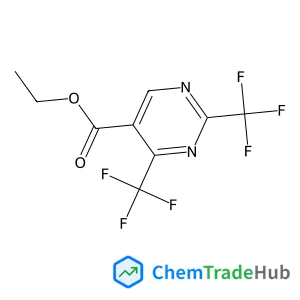
Ethyl 2,4-bis(trifluoromethyl)-5-pyrimidinecarboxylate
CAS Number:
188781-15-9
Molecular Formula:
C9H6F6N2O2
Recommended Suppliers





Disclaimer
This page provides academic journal information for reference and research purposes only. We are not affiliated with any journal publishers and do not handle publication submissions. For publication-related inquiries, please contact the respective journal publishers directly.
If you notice any inaccuracies in the information displayed, please contact us at support@chemtradehub.com. We will promptly review and address your concerns.