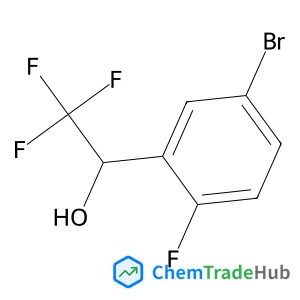
1-(5-Bromo-2-fluorophenyl)-2,2,2-trifluoroethanol
CAS Number:
1039827-16-1
Molecular Formula:
C8H5BrF4O
Bin Yang, Masoud Mahjouri-Samani, Christopher M. Rouleau, David B. Geohegan, Kai Xiao
A promising way to advance perovskite solar cells is to improve the quality of the electron transport material – e.g., titanium dioxide (TiO2) – in a direction that increases electron transport and extraction. Although dense TiO2 films are easily grown in solution, efficient electron extraction suffers due to a lack of interfacial contact area with the perovskites. Conversely, mesoporous films do offer high surface-area-to-volume ratios, thereby promoting efficient electron extraction, but their morphology is relatively difficult to control via conventional solution synthesis methods. Here, a pulsed laser deposition method was used to assemble TiO2 nanoparticles into TiO2 hierarchical architectures exhibiting an anatase crystal structure, and prototype solar cells employing these structures yielded power conversion efficiencies of ∼14%. Our approach demonstrates a way to grow high aspect-ratio TiO2 nanostructures for improved interfacial contact between TiO2 and perovskite materials, leading to high electron–hole pair separation and electron extraction efficiencies for superior photovoltaic performance. Compared to previous pulsed laser deposition-synthesized TiO2 mesoporous crystalline networks that needed post-thermal annealing at 500 °C to form mesoporous crystalline networks, our relatively low temperature (300 °C) TiO2 processing method may promote reduced energy-consumption during device fabrication, as well as enable compatibility with flexible polymer substrates such as polyimide.

Organic Process Research & Development

Chemistry Education Research and Practice

Drug Discovery Today

Russian Chemical Bulletin

Current Opinion in Colloid & Interface Science

Saudi Pharmaceutical Journal

Acta Materialia

Current Opinion in Solid State & Materials Science

New Journal of Chemistry

Russian Journal of Applied Chemistry
Alexander Kothe, Martin Wilke, Alexandre Moguilevski, Nicholas Engel, Bernd Winter, Igor Yu. Kiyan
DOI: 10.1039/C4CP02482F
Yongming Fu, Yayu Zhao, Penglei Wang, Lili Xing, Xinyu Xue
DOI: 10.1039/C4CP04983G
M. Vogrin, M. M. Wojcik, J. Mieczkowski, K. Madrak, D. Pociecha, E. Gorecka
DOI: 10.1039/C4CP01641F
R. F. Jin, Y. F. Chang
DOI: 10.1039/C4CP04394D
Subarna Khanal, Nabraj Bhattarai, David McMaster, Daniel Bahena, J. Jesus Velazquez-Salazar, Miguel Jose-Yacaman
DOI: 10.1039/C4CP02208D
E. Vöhringer-Martinez, O. Link, K. R. Siefermann, F. Wiederschein, H. Grubmüller
DOI: 10.1039/C4CP02063D
Haley M. Stowe, Eunsu Paek, Dhivya Manogaran
DOI: 10.1039/C4CP04518A
Paola Nava, Yannick Carissan
DOI: 10.1039/C4CP01695E
2-(2-Chloroacetamido)-3-phenylpropanoic acid (CAS: 7765-11-9) is generally consi...
2-(Benzyloxy)-5-bromobenzoic acid can be handled safely if appropriate precautio...
(4-Methyl-1,2,5-oxadiazol-3-yl)methanamine hydrochloride is a chemical compound ...
2-(5-Hexylthiophen-2-yl)-4,4,5,5-tetramethyl-1,3,2-dioxaborolane (CAS: 917985-54...
While 4-(8-Methyl-9H-1,3-dioxolo[4,5-h][2,3]benzodiazepin-5-yl)benzenamine (CAS:...
The market for tert-butyl 3-hydroxy-4,5,7,8-tetrahydro-2H-pyrazolo[3,4-d]azepine...
Waste containing 3,5-Diamino-1H-pyrazole-4-carbonitrile (CAS: 6844-58-2) should ...
(6-Fluoro-3-pyridinyl)boronic acid can be synthesized through the reaction of 6-...
Dibenzyl carbonimidoylbiscarbamate (CAS: 10065-79-9) finds applications in vario...
The market for (beta,beta,2,3,4,5,6-~2~H_7_)Phenylalanine (CAS: 74228-83-4) is g...

Physical Chemistry Chemical Physics (PCCP) is an international journal co-owned by 19 physical chemistry and physics societies from around the world. This journal publishes original, cutting-edge research in physical chemistry, chemical physics and biophysical chemistry. To be suitable for publication in PCCP, articles must include significant innovation and/or insight into physical chemistry; this is the most important criterion that reviewers and Editors will judge against when evaluating submissions. The journal has a broad scope and welcomes contributions spanning experiment, theory, computation and data science. Topical coverage includes spectroscopy, dynamics, kinetics, statistical mechanics, thermodynamics, electrochemistry, catalysis, surface science, quantum mechanics, quantum computing and machine learning. Interdisciplinary research areas such as polymers and soft matter, materials, nanoscience, energy, surfaces/interfaces, and biophysical chemistry are welcomed if they demonstrate significant innovation and/or insight into physical chemistry. Joined experimental/theoretical studies are particularly appreciated when complementary and based on up-to-date approaches.
![3-[4-(difluoromethoxy)phenyl]-2-({[(9H-fluoren-9-yl)methoxy]carbonyl}amino)propanoic acid structure](https://static.chemtradehub.com/structs/149/1496564-27-2-952e.webp "3-[4-(difluoromethoxy)phenyl]-2-({[(9H-fluoren-9-yl)methoxy]carbonyl}amino)propanoic acid structure")
![3,7-Di(1,1':3',1''-terphenyl-5'-yl)-10,11,12,13-tetrahydrodiindeno[7,1-de:1',7'-fg][1,3,2]dioxaphosphocin-5-ol 5-oxide structure](https://static.chemtradehub.com/structs/135/1352810-38-8-3f10.webp "3,7-Di(1,1':3',1''-terphenyl-5'-yl)-10,11,12,13-tetrahydrodiindeno[7,1-de:1',7'-fg][1,3,2]dioxaphosphocin-5-ol 5-oxide structure")
![Ethyl thieno[3,2-f]quinoline-2-carboxylate structure](https://static.chemtradehub.com/structs/299/29948-26-3-f62b.webp "Ethyl thieno[3,2-f]quinoline-2-carboxylate structure")