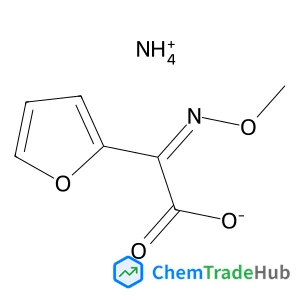
Ammonium (Z)-2-(furan-2-yl)-2-(methoxyimino)acetate
CAS Number:
97148-39-5
Molecular Formula:
C7H10N2O4
V. V. Medvedev, E. Gullikson, B. Padavala, J. H. Edgar, R. W. E. van de Kruijs, F. Bijkerk, D. Prendergast
We employ X-ray absorption near-edge spectroscopy at the boron K-edge and the phosphorus L2,3-edge to study the structural properties of cubic boron phosphide (c-BP) samples. The X-ray absorption spectra are modeled from first-principles within the density functional theory framework using the excited electron core-hole (XCH) approach. A simple structural model of a perfect c-BP crystal accurately reproduces the P L2,3-edge, however it fails to describe the broad and gradual onset of the B K-edge. Simulations of the spectroscopic signatures in boron 1s excitations of intrinsic point defects and the hexagonal BP crystal phase show that these additions to the structural model cannot reproduce the broad pre-edge of the experimental spectrum. Calculated formation enthalpies show that, during the growth of c-BP, it is possible that amorphous boron phases can be grown in conjunction with the desired boron phosphide crystalline phase. In combination with experimental and theoretically obtained X-ray absorption spectra of an amorphous boron structure, which have a similar broad absorption onset in the B K-edge spectrum as the cubic boron phosphide samples, we provide evidence for the presence of amorphous boron clusters in the synthesized c-BP samples.

Biocatalysis and Biotransformation

Journal of Chemical Sciences

Atomization and Sprays

Polycyclic Aromatic Compounds

Journal of Asian Natural Products Research

Medicinal Chemistry Research

Chinese Journal of Chemistry

Journal of the Indian Institute of Science

Heteroatom Chemistry

Bioorganic & Medicinal Chemistry Letters
Yong-Chul Jeong, Dae Gyu Park, Eunkyoung Kim, Kwang-Hyun Ahn, Sung Ik Yang
DOI: 10.1039/B600754F
Yong-Fei Zeng, Fu-Chen Liu, Jiong-Peng Zhao, Shuang Cai, Xian-He Bu, Joan Ribas
DOI: 10.1039/B601311B
Dirk Hildebrandt, Wiebke Hüggenberg, Matthias Kanthak, Tobias Plöger, Iris M. Müller, Gerald Dyker
DOI: 10.1039/B602498J
Julien Frey, Tomáš Kraus, Valérie Heitz, Jean-Pierre Sauvage
DOI: 10.1039/B509745B
Kirsty M. Anderson, Andres E. Goeta, Kirsty S. B. Hancock, Jonathan W. Steed
DOI: 10.1039/B602492K
Sibaprasad Bhattacharyya, David F. Dye, Maren Pink, Jeffrey M. Zaleski
DOI: 10.1039/B509125J
Chinh Q. Nguyen, Adekunle Adeogun, Mohammad Afzaal, Mohammad A. Malik, Paul O'Brien
DOI: 10.1039/B603198F
Mark L. Hlavinka, Jeffrey F. Greco, John R. Hagadorn
DOI: 10.1039/B509190J
Christoforos G. Kokotos, Varinder K. Aggarwal
DOI: 10.1039/B602226J
1H-Indazole-6-carbonitrile finds applications in pharmaceuticals, where it serve...
Waste containing Dioctyl (2E)-2-butenedioate (CAS: 2997-85-5) should be collecte...
Sodium [(1,2-benzoxazol-3-ylmethyl)sulfonyl]azanide is primarily used in pharmac...
Dimethyl 4-(4,4,5,5-tetramethyl-1,3,2-dioxaborolan-2-yl)-2,6-pyridinedicarboxyla...
Waste containing 2-Fluoro-6-hydrazinopyridine (CAS: 80714-39-2) should be manage...
6-Formyl-2-pyridinecarboxylic acid is an organic compound with the molecular for...
Research trends for this compound indicate a focus on its potential applications...
9H-Tribenzo[b,d,f]azepine is typically synthesized via a multi-step process invo...
1-Cyclopropyl-7-ethoxy-6-fluoro-8-methoxy-4-oxo-1,4-dihydro-3-quinolinecarboxyli...
Waste containing Methyl 3-oxo-1,2,3,4-tetrahydro-6-quinoxalinecarboxylate (CAS: ...

Physical Chemistry Chemical Physics (PCCP) is an international journal co-owned by 19 physical chemistry and physics societies from around the world. This journal publishes original, cutting-edge research in physical chemistry, chemical physics and biophysical chemistry. To be suitable for publication in PCCP, articles must include significant innovation and/or insight into physical chemistry; this is the most important criterion that reviewers and Editors will judge against when evaluating submissions. The journal has a broad scope and welcomes contributions spanning experiment, theory, computation and data science. Topical coverage includes spectroscopy, dynamics, kinetics, statistical mechanics, thermodynamics, electrochemistry, catalysis, surface science, quantum mechanics, quantum computing and machine learning. Interdisciplinary research areas such as polymers and soft matter, materials, nanoscience, energy, surfaces/interfaces, and biophysical chemistry are welcomed if they demonstrate significant innovation and/or insight into physical chemistry. Joined experimental/theoretical studies are particularly appreciated when complementary and based on up-to-date approaches.