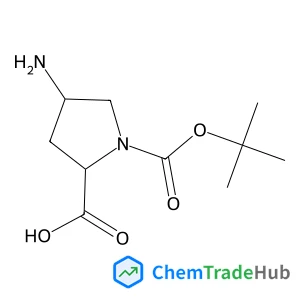
(2R,4R)-1-Boc-4-Aminopyrrolidine-2-carboxylic acid
CAS Number:
132622-98-1
Molecular Formula:
C10H18N2O4
Milan Ončák, Andriy Pysanenko, Michal Fárník
We investigate ion chemistry in pyruvic acid (PA) clusters in a molecular beam experiment. We generate two types of species, isolated (PA)N clusters and clusters deposited on large water clusters (ice nanoparticles) (PA)N·(H2O)M, ≈ 390, and follow their chemistry after either 70 eV electron ionization (EI) or 193 nm UV photoionization (PI). In the (PA)N clusters, where the ionization starts with a PA molecule, both the EI and PI yield essentially the same ions: nominally (PA)nHk+, k = 1,2,3,…. Based on quantum chemical calculations, we suggest that several proton or hydrogen transfer reactions take place within a reaction cascade, with the hydrogen atoms stemming from other PA molecules. When a proton or hydrogen atom is transferred, the resulting [PA–H]˙ radical decomposes to CH3CO˙ and CO2 in an exothermic reaction. On the other hand, the EI and PI show entirely different patterns on nanoices: the EI proceeds mostly via water ionization yielding protonated water clusters (H2O)mH+ and, in most cases, PA molecules evaporate. The PI of pyruvic acid on nanoices exhibits essentially the same ion-chemistry as the ionization of (PA)N clusters, demonstrating also that the individually adsorbed PA molecules coagulate on nanoices. Our results show that ionized pyruvic acid might act both as donor and acceptor of protons or hydrogen atoms, with the proton/hydrogen donation being irreversible due to decomposition of the [PA–H]˙ radical.
Matthew A. Henderson, J. Scott McIndoe
DOI: 10.1039/B606938J
Craig P. Butts, Michael Green, Thomas N. Hooper, Richard J. Kilby, John E. McGrady, Dimitrios A. Pantazis, Christopher A. Russell
DOI: 10.1039/B717204D
Ruibing Wang, Lina Yuan, Donal H. Macartney
DOI: 10.1039/B605919H
Ezequiel Perez-Inestrosa, Jose-María Montenegro, Daniel Collado, Rafael Suau
DOI: 10.1039/B717690B
Markus Rohe, Klaus Merz
DOI: 10.1039/B716199A
Qi Zeng, Ping Cai, Zhen Li, Jingui Qin, Ben Zhong Tang
DOI: 10.1039/B717764J
Jian Jin, Yukihiro Sugiyama, Keita Mitsui, Hideo Arakawa, Izumi Ichinose
DOI: 10.1039/B717485C
When considering alternatives to 1-(4-Chlorophenyl)-N-hydroxymethanimine (CAS: 3...
This compound should be stored in a cool, dry place away from direct sunlight. I...
3-(4-Bromophenyl)-5-(2-fluorophenyl)-1,2,4-oxadiazole is synthesized through a m...
5-Chloro-2-(4-chlorophenyl)-4-methyl-6-[3-(1-piperidinyl)propoxy]pyrimidine (CAS...
2-Chloro-4-(difluoromethoxy)pyridine is used in the pharmaceutical industry for ...
3-Chloro-6-methylpyridazine (CAS: 1121-79-5) is classified under the Globally Ha...
Several alternatives can be used in the synthesis of Methyl 4,5-dimethyl-2-nitro...
Alternatives to (2E,2'E)-3,3'-(1,4-Phenylene)bisacrylaldehyde include other acry...
3-Amino-5-chloropyridin-2-ol hydrochloride is an organic compound with the CAS n...
When handling 6,7-Difluoro-2,3-dihydro-4H-chromen-4-one, it is essential to wear...

Physical Chemistry Chemical Physics (PCCP) is an international journal co-owned by 19 physical chemistry and physics societies from around the world. This journal publishes original, cutting-edge research in physical chemistry, chemical physics and biophysical chemistry. To be suitable for publication in PCCP, articles must include significant innovation and/or insight into physical chemistry; this is the most important criterion that reviewers and Editors will judge against when evaluating submissions. The journal has a broad scope and welcomes contributions spanning experiment, theory, computation and data science. Topical coverage includes spectroscopy, dynamics, kinetics, statistical mechanics, thermodynamics, electrochemistry, catalysis, surface science, quantum mechanics, quantum computing and machine learning. Interdisciplinary research areas such as polymers and soft matter, materials, nanoscience, energy, surfaces/interfaces, and biophysical chemistry are welcomed if they demonstrate significant innovation and/or insight into physical chemistry. Joined experimental/theoretical studies are particularly appreciated when complementary and based on up-to-date approaches.