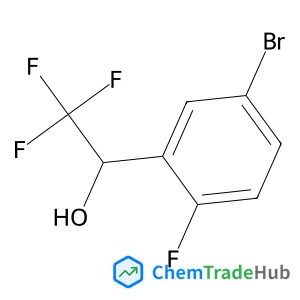
1-(5-Bromo-2-fluorophenyl)-2,2,2-trifluoroethanol
CAS Number:
1039827-16-1
Molecular Formula:
C8H5BrF4O
Chun-Hung Chang, Kaito Takahashi
The kinetics of the reaction of anti-CH3CHOO with water vapor were investigated using transient UV absorption spectroscopy at temperatures from 288 to 328 K and 500 Torr. We found that both the water monomer and the water dimer react with anti-CH3CHOO. The rate coefficients of the reaction of the water monomer and dimer with anti-CH3CHOO at 298 K were determined to be (1.31 ± 0.26) × 10−14 cm3 s−1 and (4.40 ± 0.29) × 10−11 cm3 s−1, respectively. Furthermore, for the water dimer reaction, we observed very large negative temperature dependence with an activation energy of −12.17 ± 0.66 kcal mol−1. On the other hand, the monomer reaction showed minimal temperature dependence with nearly zero activation energy. At atmospherically relevant humidity, in opposition to previous experiments conducted for CH2OO in which water dimer reaction predominates at room temperature, for anti-CH3CHOO, the water monomer reaction can contribute significantly (∼30% of the reaction with water vapor at relative humidity RH = 40% and 298 K). These results show that substitution of an alkyl group can greatly affect the reaction of Criegee intermediates with water vapor, especially changing the contributions of water monomer and dimer reactions.

Russian Journal of General Chemistry

New Journal of Chemistry

Journal of Natural Medicines

Current Opinion in Colloid & Interface Science

Current Opinion in Solid State & Materials Science

Crystallography Reports

Russian Journal of Coordination Chemistry

Journal of Saudi Chemical Society

Saudi Pharmaceutical Journal

Organic Process Research & Development
David C. Bock
DOI: 10.1039/C4CP04819A
Liangpeng Wu, Yulan Zhang, Xinjun Li, Chaoping Cen
DOI: 10.1039/C4CP01347F
Xiuzhen Zheng, Danzhen Li, Xiaofang Li, Linhui Yu, Peng Wang, Xiaoyun Zhang, Jialin Fang, Yu Shao, Yi Zheng
DOI: 10.1039/C4CP01888E
Kavita Garg, Chiranjib Majumder, Sandip K. Nayak, Dinesh K. Aswal, Shiv K. Gupta, Subrata Chattopadhyay
DOI: 10.1039/C4CP04044A
Weihong Wu, Yunxiang Lu, Hairong Ding, Changjun Peng, Honglai Liu
DOI: 10.1039/C4CP04603J
Yansong Zhou, Gang Chen, Yaoguang Yu, Yujie Feng, Yi Zheng, Fang He, Zhonghui Han
DOI: 10.1039/C4CP03736G
Pushkar Kanhere, Prathamesh Shenai, Sudip Chakraborty, Jianwei Zheng
DOI: 10.1039/C4CP01000K
Guang-Feng Wei, Cheng Shang, Zhi-Pan Liu
DOI: 10.1039/C4CP04145C
Akihiro Nakamura, Katsushi Fujii, Masakazu Sugiyama, Yoshiaki Nakano
DOI: 10.1039/C4CP01599A
K. Zberecki, R. Swirkowicz, M. Wierzbicki
DOI: 10.1039/C4CP04884A
2-(2-Chloroacetamido)-3-phenylpropanoic acid (CAS: 7765-11-9) is generally consi...
2-(Benzyloxy)-5-bromobenzoic acid can be handled safely if appropriate precautio...
(4-Methyl-1,2,5-oxadiazol-3-yl)methanamine hydrochloride is a chemical compound ...
2-(5-Hexylthiophen-2-yl)-4,4,5,5-tetramethyl-1,3,2-dioxaborolane (CAS: 917985-54...
While 4-(8-Methyl-9H-1,3-dioxolo[4,5-h][2,3]benzodiazepin-5-yl)benzenamine (CAS:...
The market for tert-butyl 3-hydroxy-4,5,7,8-tetrahydro-2H-pyrazolo[3,4-d]azepine...
Waste containing 3,5-Diamino-1H-pyrazole-4-carbonitrile (CAS: 6844-58-2) should ...
(6-Fluoro-3-pyridinyl)boronic acid can be synthesized through the reaction of 6-...
Dibenzyl carbonimidoylbiscarbamate (CAS: 10065-79-9) finds applications in vario...
The market for (beta,beta,2,3,4,5,6-~2~H_7_)Phenylalanine (CAS: 74228-83-4) is g...

Physical Chemistry Chemical Physics (PCCP) is an international journal co-owned by 19 physical chemistry and physics societies from around the world. This journal publishes original, cutting-edge research in physical chemistry, chemical physics and biophysical chemistry. To be suitable for publication in PCCP, articles must include significant innovation and/or insight into physical chemistry; this is the most important criterion that reviewers and Editors will judge against when evaluating submissions. The journal has a broad scope and welcomes contributions spanning experiment, theory, computation and data science. Topical coverage includes spectroscopy, dynamics, kinetics, statistical mechanics, thermodynamics, electrochemistry, catalysis, surface science, quantum mechanics, quantum computing and machine learning. Interdisciplinary research areas such as polymers and soft matter, materials, nanoscience, energy, surfaces/interfaces, and biophysical chemistry are welcomed if they demonstrate significant innovation and/or insight into physical chemistry. Joined experimental/theoretical studies are particularly appreciated when complementary and based on up-to-date approaches.
![(1R)-N-((1R)-1-Phenylethyl)-1-[4-(tert-butyldimethylsilyloxymethyl)cyclohexyl]ethan-1-amine structure](https://static.chemtradehub.com/structs/672/672314-45-3-47ef.webp "(1R)-N-((1R)-1-Phenylethyl)-1-[4-(tert-butyldimethylsilyloxymethyl)cyclohexyl]ethan-1-amine structure")