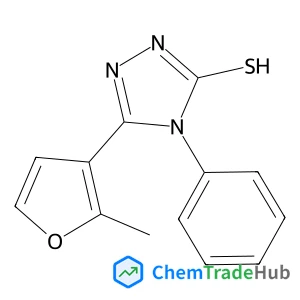
5-(2-Methyl-3-furyl)-4-phenyl-2,4-dihydro-3H-1,2,4-triazole-3-thione
CAS Number:
346464-59-3
Molecular Formula:
C13H11N3OS
Bassil M. El-Zaatari, Abhishek U. Shete, Brian J. Adzima
The kinetic behaviour of the photo-induced copper(I) catalyzed azide–alkyne cycloaddition (CuAAC) reaction was studied in detail using real-time Fourier transform infrared (FTIR) spectroscopy on both a solvent-based monofunctional and a neat polymer network forming system. The results in the solvent-based system showed near first-order kinetics on copper and photoinitiator concentrations up to a threshold value in which the kinetics switch to zeroth-order. This kinetic shift shows that the photo-CuAAC reaction is not susceptible from side reactions such as copper disproportionation, copper(I) reduction, and radical termination at the early stages of the reaction. The overall reaction rate and conversion is highly dependent on the initial concentrations of photoinitiator and copper(II) as well as their relative ratios. The conversion was decreased when an excess of photoinitiator was utilized compared to its threshold value. Interestingly, the reaction showed an induction period at relatively low intensities. The induction period is decreased by increasing light intensity and photoinitiator concentration. The reaction trends and limitations were further observed in a solventless polymer network forming system, exhibiting a similar copper and photoinitiator threshold behaviour.
Xiao-Ping Zhou, Zhengtao Xu, Matthias Zeller, Allen D. Hunter
DOI: 10.1039/B910265E
Suseung Lee, Inhee Choi, Surin Hong, Young In Yang, Jeongjin Lee, Taewook Kang, Jongheop Yi
DOI: 10.1039/B910666A
Christiane Hohberger, Yuko Araki, Kunihiko Hatase, Klaus Beckerle, Jun Okuda
DOI: 10.1039/B912813A
Rong-Mei Kong, Xiao-Bing Zhang, Liang-Liang Zhang, Xiao-Yong Jin, Shuang-Yan Huan, Guo-Li Shen, Ru-Qin Yu
DOI: 10.1039/B911163H
Martin B. Duriska, Suzanne M. Neville, Stuart R. Batten
DOI: 10.1039/B910994C
A. M. Coto-García, M. T. Fernández-Argüelles, J. M. Costa-Fernández, A. Sanz-Medel
DOI: 10.1039/B909469E
Yung-Son Hon, Tze-Wei Tseng, Chia-Yi Cheng
DOI: 10.1039/B912887E
Kilian Muñiz, Alvaro Iglesias, Yewen Fang
DOI: 10.1039/B912139K
Xiaoru Zhang, Huanran Zhou, Caifeng Ding, Shusheng Zhang
DOI: 10.1039/B907844D
When handling lithium chloride hydrate (1:1:1) (CAS: 16712-20-2), it is importan...
4-(4H-1,2,4-Triazol-4-yl)piperidine is generally considered safe for use in phar...
Waste containing 1,3-Thiazole-2-carboxamide (CAS: 16733-85-0) should be collecte...
5-(Difluoromethyl)-2-fluorobenzonitrile (CAS: 934175-58-3) is subject to regulat...
Methyl 3-acetamido-2-thiophenecarboxylate can be synthesized by the reaction of ...
4-Isoquinolinecarbonitrile is a chemical compound with the CAS number 34846-65-6...
Store Methyl 1H-1,2,3-triazole-4-carboxylate (CAS: 877309-59-6) in a cool, dry p...
6-Bromo[1,3]thiazolo[5,4-b]pyridin-2-amine (CAS: 1160791-13-8) is subject to the...
(2S,3S)-2-Ammonio-3-(3,4-dihydroxyphenyl)-3-hydroxypropanoate (CAS: 23651-95-8) ...
7-Bromo-3-methyl-3,4-dihydroquinazolin-4-one is a solid with a crystalline form....

Physical Chemistry Chemical Physics (PCCP) is an international journal co-owned by 19 physical chemistry and physics societies from around the world. This journal publishes original, cutting-edge research in physical chemistry, chemical physics and biophysical chemistry. To be suitable for publication in PCCP, articles must include significant innovation and/or insight into physical chemistry; this is the most important criterion that reviewers and Editors will judge against when evaluating submissions. The journal has a broad scope and welcomes contributions spanning experiment, theory, computation and data science. Topical coverage includes spectroscopy, dynamics, kinetics, statistical mechanics, thermodynamics, electrochemistry, catalysis, surface science, quantum mechanics, quantum computing and machine learning. Interdisciplinary research areas such as polymers and soft matter, materials, nanoscience, energy, surfaces/interfaces, and biophysical chemistry are welcomed if they demonstrate significant innovation and/or insight into physical chemistry. Joined experimental/theoretical studies are particularly appreciated when complementary and based on up-to-date approaches.
![[(2R)-6,6-Dimethyl-2-morpholinyl]methanol hydrochloride (1:1) structure](https://static.chemtradehub.com/structs/141/1416444-88-6-e06a.webp "[(2R)-6,6-Dimethyl-2-morpholinyl]methanol hydrochloride (1:1) structure")