












Platinum-catalysed aerobic 1,2-aminooxygenation of alkenes‡
Literature Information
Publication Date
2009-08-28
DOI
10.1039/B912139K
Impact Factor
6.222
Authors
Kilian Muñiz, Alvaro Iglesias, Yewen Fang
View Original
Abstract
Platinum(II) salts in combination with copper salts and molecular oxygen catalyse an unprecedented intramolecular transfer of heteroatoms to alkenes to yield aminooxygenation products under sustainable conditions.
Related Literature
Polymerization of α-(halomethyl)acrylates through sequential nucleophilic attack of dithiols using a combination of addition–elimination and click reactions
Yasuhiro Kohsaka, Keito Hagiwara, Keiichiro Ito
2016-12-27
Communication
DOI: 10.1039/C6PY02145J
Straight chain D–A copolymers based on thienothiophene and benzothiadiazole for efficient polymer field effect transistors and photovoltaic cells
Yuxiang Li, Tack Ho Lee, Song Yi Park, Mohammad Afsar Uddin, Taehyo Kim, Sungu Hwang, Jin Young Kim, Han Young Woo
2016-06-15
Paper
DOI: 10.1039/C6PY00674D
RAFT iniferter polymerization in miniemulsion using visible light
Kenward Jung, Per B. Zetterlund
2017-06-23
Communication
DOI: 10.1039/C7PY00939A
RAFT polymerization to form stimuli-responsive polymers
2016-11-22
Review Article
DOI: 10.1039/C6PY01849A
Control of cross-linking and reactions in one-step dispersion polymerization toward particles with combined anisotropies
Yanan Liu, Kun Jiang, Yuhong Ma, Lianying Liu, Wantai Yang
2016-03-24
Paper
DOI: 10.1039/C6PY00218H
Synthesis of diketopyrrolopyrrole based conjugated polymers containing thieno[3,2-b]thiophene flanking groups for high performance thin film transistors
Shih-Hao Peng, Wei-Yi Tu, Ganesh Gollavelli, Chain-Shu Hsu
2017-05-01
Paper
DOI: 10.1039/C7PY00402H
Synthesis and electrochemical polymerization of diketopyrrolopyrrole based donor–acceptor–donor monomers containing 3,6- and 2,7-linked carbazoles
Merve Akbayrak, Ahmet M. Önal
2016-09-13
Paper
DOI: 10.1039/C6PY01489E
Facile green synthesis of isoindigo-based conjugated polymers using aldol polycondensation
Kilwon Cho
2017-05-01
Paper
DOI: 10.1039/C7PY00484B
You might also like
Compound Q&A
What precautions should be taken when handling lithium chloride hydrate (1:1:1) (CAS: 16712-20-2)?
When handling lithium chloride hydrate (1:1:1) (CAS: 16712-20-2), it is importan...
16712-20-2Lithium chloride hyd...
Compound Q&A
Is 4-(4H-1,2,4-Triazol-4-yl)piperidine (CAS: 690261-92-8) safe?
4-(4H-1,2,4-Triazol-4-yl)piperidine is generally considered safe for use in phar...
690261-92-84-(4H-1,2,4-Triazol-...
Compound Q&A
How should waste containing 1,3-Thiazole-2-carboxamide (CAS: 16733-85-0) be handled?
Waste containing 1,3-Thiazole-2-carboxamide (CAS: 16733-85-0) should be collecte...
16733-85-01,3-Thiazole-2-carbo...
Compound Q&A
What regulatory guidelines apply to 5-(Difluoromethyl)-2-fluorobenzonitrile (CAS: 934175-58-3)?
5-(Difluoromethyl)-2-fluorobenzonitrile (CAS: 934175-58-3) is subject to regulat...
934175-58-35-(Difluoromethyl)-2...
Compound Q&A
How is Methyl 3-acetamido-2-thiophenecarboxylate (CAS: 22288-79-5) typically synthesized?
Methyl 3-acetamido-2-thiophenecarboxylate can be synthesized by the reaction of ...
22288-79-5Methyl 3-acetamido-2...
Compound Q&A
What is 4-Isoquinolinecarbonitrile (CAS: 34846-65-6)?
4-Isoquinolinecarbonitrile is a chemical compound with the CAS number 34846-65-6...
34846-65-64-Isoquinolinecarbon...
Compound Q&A
How should Methyl 1H-1,2,3-triazole-4-carboxylate (CAS: 877309-59-6) be stored?
Store Methyl 1H-1,2,3-triazole-4-carboxylate (CAS: 877309-59-6) in a cool, dry p...
877309-59-6Methyl 1H-1,2,3-tria...
Compound Q&A
What regulatory guidelines apply to 6-Bromo[1,3]thiazolo[5,4-b]pyridin-2-amine (CAS: 1160791-13-8)?
6-Bromo[1,3]thiazolo[5,4-b]pyridin-2-amine (CAS: 1160791-13-8) is subject to the...
1160791-13-86-Bromo[1,3]thiazolo...
Compound Q&A
Is (2S,3S)-2-Ammonio-3-(3,4-dihydroxyphenyl)-3-hydroxypropanoate (CAS: 23651-95-8) safe?
(2S,3S)-2-Ammonio-3-(3,4-dihydroxyphenyl)-3-hydroxypropanoate (CAS: 23651-95-8) ...
23651-95-8(2S,3S)-2-Ammonio-3-...
Compound Q&A
What are the physical and chemical properties of 7-bromo-3-methyl-3,4-dihydroquinazolin-4-one (CAS: 1293987-84-4)?
7-Bromo-3-methyl-3,4-dihydroquinazolin-4-one is a solid with a crystalline form....
1293987-84-47-bromo-3-methyl-3,4...
Source Journal
Chemical Communications

CiteScore:
8.6
Self-citation Rate:
4.7%
Articles per Year:
2458
ChemComm publishes urgent research which is of outstanding significance and interest to experts in the field, while also appealing to the journal’s broad chemistry readership. Our communication format is ideally suited to short, urgent studies that are of such importance that they require accelerated publication. Our scope covers all topics in chemistry, and research at the interface of chemistry and other disciplines (such as materials science, nanoscience, physics, engineering and biology) where there is a significant novelty in the chemistry aspects. Major topic areas covered include: Analytical Chemistry Catalysis Chemical Biology and medicinal chemistry Computational Chemistry and Machine Learning Energy and sustainable chemistry Environmental Chemistry Green Chemistry Inorganic Chemistry Materials Chemistry Nanoscience Organic Chemistry Physical Chemistry Polymer Chemistry Supramolecular Chemistry
Recommended Compounds
![6,6-Dimethylbicyclo[3.1.1]hept-2-ene-2-carbaldehyde structure](https://static.chemtradehub.com/structs/564/564-94-3-e746.webp "6,6-Dimethylbicyclo[3.1.1]hept-2-ene-2-carbaldehyde structure")
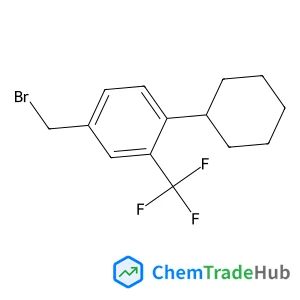
4-(Bromomethyl)-1-cyclohexyl-2-(trifluoromethyl)benzene
CAS Number:
800381-60-6
Molecular Formula:
C14H16BrF3
Recommended Suppliers




Disclaimer
This page provides academic journal information for reference and research purposes only. We are not affiliated with any journal publishers and do not handle publication submissions. For publication-related inquiries, please contact the respective journal publishers directly.
If you notice any inaccuracies in the information displayed, please contact us at support@chemtradehub.com. We will promptly review and address your concerns.