












Solvent evaporation versus proton transfer in nucleobase–Pt(CN)4,62− dianion clusters: a collisional excitation and electronic laser photodissociation spectroscopy study‡
Literature Information
Publication Date
2014-06-16
DOI
10.1039/C4CP00989D
Impact Factor
3.676
Authors
Ananya Sen, Thomas F. M. Luxford, Naruo Yoshikawa, Caroline E. H. Dessent
View Original
Abstract
Isolated molecular clusters of adenine, cytosine, thymine and uracil with Pt(CN)62− and Pt(CN)42− were studied for the first time to characterize the binding and reactivity of isolated transition metal complex ions with nucleobases. These clusters represent model systems for understanding metal complex–DNA adducts, as a function of individual nucleobases. Collisional excitation revealed that the clusters decay on the ground electronic surface by either solvent evaporation (i.e. loss of a nucleobase unit from the cluster) or via proton transfer from the nucleobase to the dianion. The Pt(CN)62−–nucleobase clusters decay only by solvent evaporation, while the Pt(CN)42− clusters fragment by both pathways. The enhanced proton-transfer reactivity of Pt(CN)42− is attributed to the higher charge-density of the ligands in this transition metal anion. % fragmentation curves of the clusters reveal that the adenine clusters display distinctively higher fragmentation onsets, which are traced to the propensity of adenine to form the shortest intercluster H-bond. We also present laser electronic photodissociation measurements for the Pt(CN)62−·Ur, Pt(CN)42−·Ur and Pt(CN)42−·Ur2 clusters to illustrate the potential of exploring metal complex DNA photophysics as a function of nucleobase within well-defined gaseous clusters. The spectra reported herein represent the first such measurements. We find that the electronic excited states decay with production of the same fragments (associated with solvent evaporation and proton transfer) observed upon collisional excitation of the electronic ground state, indicating ultrafast deactivation of the excited-state uracil-localized chromophore followed by vibrational predissociation.
Related Literature
Control of triplet state generation in heavy atom-free BODIPY–anthracene dyads by media polarity and structural factors
Mikhail A. Filatov, Safakath Karuthedath, Pavel M. Polestshuk, Susan Callaghan, Keith J. Flanagan, Maxime Telitchko, Thomas Wiesner, Frédéric Laquai, Mathias O. Senge
2018-02-12
Paper
DOI: 10.1039/C7CP08472B
How low-resolution structural data predict the conformational changes of a protein: a study on data-driven molecular dynamics simulations
Ryuhei Harada, Yasuteru Shigeta
2018-06-05
Paper
DOI: 10.1039/C8CP02246A
Methanol as a hydrate inhibitor and hydrate activator
Bjørn Kvamme, Juri Selvåg, Navid Saeidi, Tatiana Kuznetsova
2018-08-07
Paper
DOI: 10.1039/C8CP02447B
Phonon thermal transport in a class of graphene allotropes from first principles
Xiuxian Yang, Zhenhong Dai, Yinchang Zhao
2018-05-15
Paper
DOI: 10.1039/C8CP00987B
Pressure-induced switching properties of the iron(iii) spin-transition complex [FeIII(3-OMeSalEen)2]PF6
J. Laisney, H. J. Shepherd, L. Rechignat, G. Molnár, E. Rivière, M.-L. Boillot
2018-05-15
Paper
DOI: 10.1039/C8CP02376J
The direct observation of electron backflow in an organic heterojunction formed by two n-type materials
Bo Wu, Hai Shen Huang
2018-02-12
Paper
DOI: 10.1039/C7CP07817J
Bexarotene cannot reduce amyloid beta plaques through inhibition of production of amyloid beta peptides: in silico and in vitro study
Zuzana Bednarikova, Huynh Quang Linh, Zuzana Gazova, Mai Suan Li
2018-08-30
Paper
DOI: 10.1039/C8CP00049B
Revealing dynamically-organized receptor ion channel clusters in live cells by a correlated electric recording and super-resolution single-molecule imaging approach
Rajeev Yadav, H. Peter Lu
2018-02-02
Paper
DOI: 10.1039/C7CP08030A
You might also like
Compound Q&A
Is 2-(2-chloroacetamido)-3-phenylpropanoic acid (CAS: 7765-11-9) safe?
2-(2-Chloroacetamido)-3-phenylpropanoic acid (CAS: 7765-11-9) is generally consi...
7765-11-92-(2-chloroacetamido...
Compound Q&A
Is 2-(Benzyloxy)-5-bromobenzoic acid (CAS: 62176-31-2) safe?
2-(Benzyloxy)-5-bromobenzoic acid can be handled safely if appropriate precautio...
62176-31-22-(Benzyloxy)-5-brom...
Compound Q&A
What is (4-Methyl-1,2,5-oxadiazol-3-yl)methanamine hydrochloride (CAS: 1159825-48-5)?
(4-Methyl-1,2,5-oxadiazol-3-yl)methanamine hydrochloride is a chemical compound ...
1159825-48-5(4-Methyl-1,2,5-oxad...
Compound Q&A
What is 2-(5-Hexylthiophen-2-yl)-4,4,5,5-tetramethyl-1,3,2-dioxaborolane (CAS: 917985-54-7)?
2-(5-Hexylthiophen-2-yl)-4,4,5,5-tetramethyl-1,3,2-dioxaborolane (CAS: 917985-54...
917985-54-72-(5-Hexylthiophen-2...
Compound Q&A
Are there alternatives to 4-(8-Methyl-9H-1,3-dioxolo[4,5-h][2,3]benzodiazepin-5-yl)benzenamine (CAS: 102771-26-6) in synthesis?
While 4-(8-Methyl-9H-1,3-dioxolo[4,5-h][2,3]benzodiazepin-5-yl)benzenamine (CAS:...
102771-26-64-(8-Methyl-9H-1,3-d...
Compound Q&A
What is the market or research trend for tert-butyl 3-hydroxy-4,5,7,8-tetrahydro-2H-pyrazolo[3,4-d]azepine-6-carboxylate (CAS: 851376-80-2)?
The market for tert-butyl 3-hydroxy-4,5,7,8-tetrahydro-2H-pyrazolo[3,4-d]azepine...
851376-80-2tert-butyl 3-hydroxy...
Compound Q&A
How should waste containing 3,5-Diamino-1H-pyrazole-4-carbonitrile (CAS: 6844-58-2) be handled?
Waste containing 3,5-Diamino-1H-pyrazole-4-carbonitrile (CAS: 6844-58-2) should ...
6844-58-23,5-Diamino-1H-pyraz...
Compound Q&A
How is (6-Fluoro-3-pyridinyl)boronic acid (CAS: 351019-18-6) typically synthesized?
(6-Fluoro-3-pyridinyl)boronic acid can be synthesized through the reaction of 6-...
351019-18-6(6-Fluoro-3-pyridiny...
Compound Q&A
What industries use Dibenzyl carbonimidoylbiscarbamate (CAS: 10065-79-9)?
Dibenzyl carbonimidoylbiscarbamate (CAS: 10065-79-9) finds applications in vario...
10065-79-9Dibenzyl carbonimido...
Compound Q&A
What is the market or research trend for (beta,beta,2,3,4,5,6-~2~H_7_)Phenylalanine (CAS: 74228-83-4)?
The market for (beta,beta,2,3,4,5,6-~2~H_7_)Phenylalanine (CAS: 74228-83-4) is g...
74228-83-4(beta,beta,2,3,4,5,6...
Source Journal
Physical Chemistry Chemical Physics

CiteScore:
5.5
Self-citation Rate:
10.3%
Articles per Year:
3036
Physical Chemistry Chemical Physics (PCCP) is an international journal co-owned by 19 physical chemistry and physics societies from around the world. This journal publishes original, cutting-edge research in physical chemistry, chemical physics and biophysical chemistry. To be suitable for publication in PCCP, articles must include significant innovation and/or insight into physical chemistry; this is the most important criterion that reviewers and Editors will judge against when evaluating submissions. The journal has a broad scope and welcomes contributions spanning experiment, theory, computation and data science. Topical coverage includes spectroscopy, dynamics, kinetics, statistical mechanics, thermodynamics, electrochemistry, catalysis, surface science, quantum mechanics, quantum computing and machine learning. Interdisciplinary research areas such as polymers and soft matter, materials, nanoscience, energy, surfaces/interfaces, and biophysical chemistry are welcomed if they demonstrate significant innovation and/or insight into physical chemistry. Joined experimental/theoretical studies are particularly appreciated when complementary and based on up-to-date approaches.
Recommended Compounds
![Heptadecanoic Acid 3-[2-[4-(6-Fluoro-1,2-benzisoxazol-3-yl)-1-piperidinyl]ethyl]-6,7,8,9-tetrahydro-2-methyl-4-oxo-4H-pyrido[1,2-a]pyrimidin-9-yl Ester structure](https://static.chemtradehub.com/structs/140/1404053-62-8-9da4.webp "Heptadecanoic Acid 3-[2-[4-(6-Fluoro-1,2-benzisoxazol-3-yl)-1-piperidinyl]ethyl]-6,7,8,9-tetrahydro-2-methyl-4-oxo-4H-pyrido[1,2-a]pyrimidin-9-yl Ester structure")
Heptadecanoic Acid 3-[2-[4-(6-Fluoro-1,2-benzisoxazol-3-yl)-1-piperidinyl]ethyl]-6,7,8,9-tetrahydro-2-methyl-4-oxo-4H-pyrido[1,2-a]pyrimidin-9-yl Ester
CAS Number:
1404053-62-8
Molecular Formula:
C40H59FN4O4
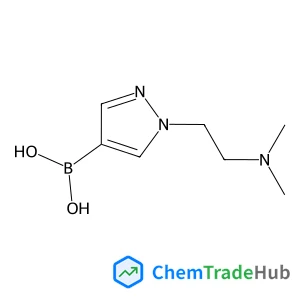
(1-(2-(Dimethylamino)ethyl)-1H-pyrazol-4-yl)boronic acid
CAS Number:
1086063-73-1
Molecular Formula:
C7H14BN3O2
Recommended Suppliers





Disclaimer
This page provides academic journal information for reference and research purposes only. We are not affiliated with any journal publishers and do not handle publication submissions. For publication-related inquiries, please contact the respective journal publishers directly.
If you notice any inaccuracies in the information displayed, please contact us at support@chemtradehub.com. We will promptly review and address your concerns.