












Accurate prediction of bulk properties in hydrogen bonded liquids: amides as case studies
Literature Information
Publication Date
2016-08-12
DOI
10.1039/C6CP04666E
Impact Factor
3.676
Authors
Marina Macchiagodena, Marco Pagliai
View Original
Abstract
In this contribution we show that it is possible to build accurate force fields for small organic molecules allowing the reliable reproduction of a large panel of bulk properties, which are seldom addressed in the same context. Starting from the results obtained in recent studies, we developed a protocol for charge estimation and virtual site generation for the amide class of molecules. The parametrization of electrostatic properties is based on population analysis and orbital localization of quantum mechanical computations rooted in density functional theory and the polarizable continuum model, without any additional external information. The new protocol, coupled to other recent studies in our group targeted at an accurate fitting of internal degrees of freedom, makes available a method for building force fields from scratch (excluding for the moment intermolecular van der Waals interactions) with focus on reproducing the structure and dynamics of hydrogen bonded liquids, yielding results that are in line or better than those delivered by current general force fields. The approach is tested on the demanding series formed by formamide and its two N-methyl derivatives, N-methylformamide and N,N-dimethylformamide. We show that the atomistic structure of the liquids arising from classical molecular dynamics (MD) simulations employing the new force field is in full agreement with X-ray and neutron diffraction experiments and the corresponding spatial distribution functions are in remarkable agreement with the results of ab initio MD simulations. It is noteworthy that the latter result has never been obtained before without using ad hoc (and system dependent) scale factors and that, in addition, our parameter-free procedure is able to reproduce static dielectric constants over a wide range of values without sacrificing the force field accuracy with respect to other observables. Finally, we are able to explain the trend of static dielectric constants followed by the three amides in terms of properties obtained from the simulations, namely hydrogen bond patterns and reorientational lifetimes.
Related Literature
Self-standing, metal nanoparticle embedded transparent films from multi-armed cardanol conjugates through in situ synthesis
Kuthanapillil Jyothish, Praveen Kumar Vemula, Swapnil R. Jadhav, Lynn C. Francesconi, George John
2009-06-08
Communication
DOI: 10.1039/B900208A
Hybrid functional mesostructured thin films with photo-oxidative properties in the visible range
Philippe Saint-Cricq, Thierry Pigot, Lionel Nicole, Clément Sanchez, Sylvie Lacombe
2009-07-22
Communication
DOI: 10.1039/B911742C
Selective gas adsorption in a magnesium-based metal–organic framework
Young Eun Cheon, Jungeun Park, Myunghyun Paik Suh
2009-08-05
Communication
DOI: 10.1039/B910228K
Reversible uptake of HgCl2 in a porous coordination polymer based on the dual functions of carboxylate and thioether
Xiao-Ping Zhou, Zhengtao Xu, Matthias Zeller, Allen D. Hunter
2009-08-05
Communication
DOI: 10.1039/B910265E
Platinum-catalysed aerobic 1,2-aminooxygenation of alkenes‡
Kilian Muñiz, Alvaro Iglesias, Yewen Fang
2009-08-28
Communication
DOI: 10.1039/B912139K
Synthesis of small polymeric nanoparticles sized below 10 nm viapolymerization of a cross-linker in a glassy polymer matrix
Kaka Zhang, Zhou Gui, Daoyong Chen, Ming Jiang
2009-09-02
Communication
DOI: 10.1039/B911574A
Facile synthesis of stapled, structurally reinforced peptide helices via a photoinduced intramolecular 1,3-dipolar cycloaddition reaction
Michael M. Madden, Claudia I. Rivera Vera, Wenjiao Song, Qing Lin
2009-08-13
Communication
DOI: 10.1039/B912094G
Metal oxide-sensitized TiO2 and TiO2−xNx with efficient charge transport conduits
Xin Shu, Zhe An, Lianying Wang, Jing He
2009-08-17
Communication
DOI: 10.1039/B909301J
New enantiopure NHCs derived from camphor
Peddiahgari Vasu Govardhana Reddy, Sobia Tabassum, Amélie Blanrue, René Wilhelm
2009-08-18
Communication
DOI: 10.1039/B911476A
You might also like
Compound Q&A
What precautions should be taken when handling lithium chloride hydrate (1:1:1) (CAS: 16712-20-2)?
When handling lithium chloride hydrate (1:1:1) (CAS: 16712-20-2), it is importan...
16712-20-2Lithium chloride hyd...
Compound Q&A
Is 4-(4H-1,2,4-Triazol-4-yl)piperidine (CAS: 690261-92-8) safe?
4-(4H-1,2,4-Triazol-4-yl)piperidine is generally considered safe for use in phar...
690261-92-84-(4H-1,2,4-Triazol-...
Compound Q&A
How should waste containing 1,3-Thiazole-2-carboxamide (CAS: 16733-85-0) be handled?
Waste containing 1,3-Thiazole-2-carboxamide (CAS: 16733-85-0) should be collecte...
16733-85-01,3-Thiazole-2-carbo...
Compound Q&A
What regulatory guidelines apply to 5-(Difluoromethyl)-2-fluorobenzonitrile (CAS: 934175-58-3)?
5-(Difluoromethyl)-2-fluorobenzonitrile (CAS: 934175-58-3) is subject to regulat...
934175-58-35-(Difluoromethyl)-2...
Compound Q&A
How is Methyl 3-acetamido-2-thiophenecarboxylate (CAS: 22288-79-5) typically synthesized?
Methyl 3-acetamido-2-thiophenecarboxylate can be synthesized by the reaction of ...
22288-79-5Methyl 3-acetamido-2...
Compound Q&A
What is 4-Isoquinolinecarbonitrile (CAS: 34846-65-6)?
4-Isoquinolinecarbonitrile is a chemical compound with the CAS number 34846-65-6...
34846-65-64-Isoquinolinecarbon...
Compound Q&A
How should Methyl 1H-1,2,3-triazole-4-carboxylate (CAS: 877309-59-6) be stored?
Store Methyl 1H-1,2,3-triazole-4-carboxylate (CAS: 877309-59-6) in a cool, dry p...
877309-59-6Methyl 1H-1,2,3-tria...
Compound Q&A
What regulatory guidelines apply to 6-Bromo[1,3]thiazolo[5,4-b]pyridin-2-amine (CAS: 1160791-13-8)?
6-Bromo[1,3]thiazolo[5,4-b]pyridin-2-amine (CAS: 1160791-13-8) is subject to the...
1160791-13-86-Bromo[1,3]thiazolo...
Compound Q&A
Is (2S,3S)-2-Ammonio-3-(3,4-dihydroxyphenyl)-3-hydroxypropanoate (CAS: 23651-95-8) safe?
(2S,3S)-2-Ammonio-3-(3,4-dihydroxyphenyl)-3-hydroxypropanoate (CAS: 23651-95-8) ...
23651-95-8(2S,3S)-2-Ammonio-3-...
Compound Q&A
What are the physical and chemical properties of 7-bromo-3-methyl-3,4-dihydroquinazolin-4-one (CAS: 1293987-84-4)?
7-Bromo-3-methyl-3,4-dihydroquinazolin-4-one is a solid with a crystalline form....
1293987-84-47-bromo-3-methyl-3,4...
Source Journal
Physical Chemistry Chemical Physics

CiteScore:
5.5
Self-citation Rate:
10.3%
Articles per Year:
3036
Physical Chemistry Chemical Physics (PCCP) is an international journal co-owned by 19 physical chemistry and physics societies from around the world. This journal publishes original, cutting-edge research in physical chemistry, chemical physics and biophysical chemistry. To be suitable for publication in PCCP, articles must include significant innovation and/or insight into physical chemistry; this is the most important criterion that reviewers and Editors will judge against when evaluating submissions. The journal has a broad scope and welcomes contributions spanning experiment, theory, computation and data science. Topical coverage includes spectroscopy, dynamics, kinetics, statistical mechanics, thermodynamics, electrochemistry, catalysis, surface science, quantum mechanics, quantum computing and machine learning. Interdisciplinary research areas such as polymers and soft matter, materials, nanoscience, energy, surfaces/interfaces, and biophysical chemistry are welcomed if they demonstrate significant innovation and/or insight into physical chemistry. Joined experimental/theoretical studies are particularly appreciated when complementary and based on up-to-date approaches.
Recommended Compounds
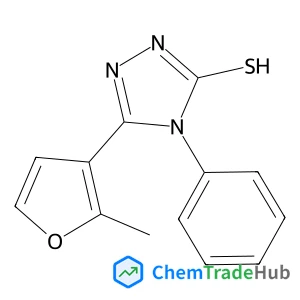
5-(2-Methyl-3-furyl)-4-phenyl-2,4-dihydro-3H-1,2,4-triazole-3-thione
CAS Number:
346464-59-3
Molecular Formula:
C13H11N3OS

Recommended Suppliers






Disclaimer
This page provides academic journal information for reference and research purposes only. We are not affiliated with any journal publishers and do not handle publication submissions. For publication-related inquiries, please contact the respective journal publishers directly.
If you notice any inaccuracies in the information displayed, please contact us at support@chemtradehub.com. We will promptly review and address your concerns.