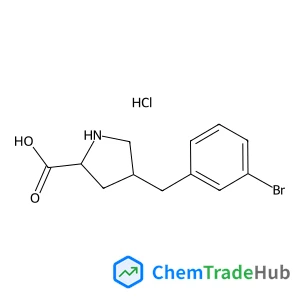
(2S,4R)-4-(3-Bromobenzyl)pyrrolidine-2-carboxylic acid hydrochloride
CAS Number:
1049734-10-2
Molecular Formula:
C12H15BrClNO2
Paul C. Jennings, Steen Lysgaard, Heine A. Hansen, Tejs Vegge
Ternary Pt–Au–M (M = 3d transition metal) nanoparticles show reduced OH adsorption energies and improved activity for the oxygen reduction reaction (ORR) compared to pure Pt nanoparticles, as obtained by density functional theory. The strain and ligand effects in nanoparticles are decoupled and correlated with the extended Pt(111) surface for benchmarking. The ternary metal in the core allows for tuning the catalytic activity through strain effects. Pt–Au–M for M = Cr, Mn, Co, Cu, Zn nanoparticles are of particular interest as they exhibit an optimal contribution of strain, ligand effects and stability. Good agreement is found with experimental studies showing increased activity of Pt–Au–Fe/Ni nanoparticles, and mid to late 3d transition metals are predicted to exhibit enhance activity and stability with respect to pure Pt nanoparticles.

Molecular Diversity

European Journal of Organic Chemistry

Environmental Toxicology and Pharmacology

Contact Lens & Anterior Eye

Advanced Engineering Materials

Angewandte Chemie International Edition

Faraday Discussions

Current Pharmaceutical Biotechnology

Physical Chemistry Chemical Physics

Journal of Enzyme inhibition and Medicinal Chemistry
Biqiong Chen
DOI: 10.1039/D3SU00302G
Anju Srivastava, Sriparna Dutta, Reena Jain
DOI: 10.1039/D3SU00246B
Kannan Vignesh, Dev Kumar Yadav, D. D. Wadikar, A. D. Semwal
DOI: 10.1039/D3FB00074E
Peiying Fan, Yuhan Zhang, Li Guan, Han Wang, George Zheng Chen
DOI: 10.1039/D3SU00197K
Gouri Sankar Das, Manish Srivastava, Kumud Malika Tripathi
DOI: 10.1039/D3SU00328K
Foziya Yusuf Vadia, Jinet Susan Johny, Naved I. Malek, Suresh Kumar Kailasa
DOI: 10.1039/D3FB90017G
Julia Diener, Christian Bartsch, Florian Dietrich, Claudia Falcke, Iva Anic, Steffen Roth, Andreas Taden, Michael Richter
DOI: 10.1039/D3SU00269A
Tanongsak Yingnakorn, Jennifer Hartley, Jason S. Terreblanche, Chunhong Lei, Andrew P. Abbott
DOI: 10.1039/D3SU00237C
Rakesh Ranjan, Benny Kattikanal George
DOI: 10.1039/D3SU00304C
2-(2-Chloroacetamido)-3-phenylpropanoic acid (CAS: 7765-11-9) is generally consi...
2-(Benzyloxy)-5-bromobenzoic acid can be handled safely if appropriate precautio...
(4-Methyl-1,2,5-oxadiazol-3-yl)methanamine hydrochloride is a chemical compound ...
2-(5-Hexylthiophen-2-yl)-4,4,5,5-tetramethyl-1,3,2-dioxaborolane (CAS: 917985-54...
While 4-(8-Methyl-9H-1,3-dioxolo[4,5-h][2,3]benzodiazepin-5-yl)benzenamine (CAS:...
The market for tert-butyl 3-hydroxy-4,5,7,8-tetrahydro-2H-pyrazolo[3,4-d]azepine...
Waste containing 3,5-Diamino-1H-pyrazole-4-carbonitrile (CAS: 6844-58-2) should ...
(6-Fluoro-3-pyridinyl)boronic acid can be synthesized through the reaction of 6-...
Dibenzyl carbonimidoylbiscarbamate (CAS: 10065-79-9) finds applications in vario...
The market for (beta,beta,2,3,4,5,6-~2~H_7_)Phenylalanine (CAS: 74228-83-4) is g...
Physical Chemistry Chemical Physics (PCCP) is an international journal co-owned by 19 physical chemistry and physics societies from around the world. This journal publishes original, cutting-edge research in physical chemistry, chemical physics and biophysical chemistry. To be suitable for publication in PCCP, articles must include significant innovation and/or insight into physical chemistry; this is the most important criterion that reviewers and Editors will judge against when evaluating submissions. The journal has a broad scope and welcomes contributions spanning experiment, theory, computation and data science. Topical coverage includes spectroscopy, dynamics, kinetics, statistical mechanics, thermodynamics, electrochemistry, catalysis, surface science, quantum mechanics, quantum computing and machine learning. Interdisciplinary research areas such as polymers and soft matter, materials, nanoscience, energy, surfaces/interfaces, and biophysical chemistry are welcomed if they demonstrate significant innovation and/or insight into physical chemistry. Joined experimental/theoretical studies are particularly appreciated when complementary and based on up-to-date approaches.
![(1R)-N-((1R)-1-Phenylethyl)-1-[4-(tert-butyldimethylsilyloxymethyl)cyclohexyl]ethan-1-amine structure](https://static.chemtradehub.com/structs/672/672314-45-3-47ef.webp "(1R)-N-((1R)-1-Phenylethyl)-1-[4-(tert-butyldimethylsilyloxymethyl)cyclohexyl]ethan-1-amine structure")