




Co-Al-CO3 layered double hydroxide: an efficient and regenerable catalyst for glycolysis of polyethylene terephthalate
Literature Information
Publication Date
2023-10-16
DOI
10.1039/D3SU00304C
Impact Factor
0
Authors
Rakesh Ranjan, Benny Kattikanal George
View Original
Abstract
Polyethylene terephthalate (PET) is one among the common polymers we use in our day-to-day lives. Despite its wide range of applications, recycling of PET waste is a serious concern due to its non-biodegradability. This paper deliberates the use of Co-Al-CO3 layered double hydroxide (LDH) as a catalyst for the glycolysis of PET and the mechanistic aspects of catalysis. Co-Al-CO3 LDH showed superior properties compared to similar LDH materials. 100% PET conversion and 96% yield for bis hydroxy ethylene terephthalate (BHET) were achieved within a reaction time of 2 hours, at a reaction temperature of 180 °C and with a catalyst concentration of 1%. Glycolysis conditions such as reaction temperature, time, and ethylene glycol (EG)/PET ratio were optimized. The effect of M+2/M+3 on BHET yield was studied, and an increase in BHET yield was observed up to a ratio of 3 : 1. The replacement of Co2+, either completely or partially with another M2+, resulted in a significant decrease in BHET yield. The catalysis mechanism of Co-Al-CO3 LDH was explained by correlating the decarbonation temperature of the carbonate anion with catalytic performance. Magnetically separable CoAl31@Fe3O4 was prepared with a BHET yield of 99%. Regeneration was demonstrated up to 4 cycles and a BHET yield of 86% was achieved in the fourth cycle.
Recommended Journals

Herald of the Russian Academy of Sciences

Bioorganic & Medicinal Chemistry

Colloid Journal

Medicinal Chemistry Research

Acta Metallurgica Sinica-English Letters

NDT & E International

Critical Reviews in Solid State and Materials Sciences

Journal of the Indian Institute of Science

Atomization and Sprays

Heteroatom Chemistry
Related Literature
Synthesis of monodisperse chromium nanoparticles from the thermolysis of a Fischer carbene complex
Seung Uk Son, Youngjin Jang, Ki Youl Yoon, Changhua An, Yosun Hwang, Je-Geun Park, Han-Jin Noh, Jae-Young Kim, Jae-Hoon Park, Taeghwan Hyeon
2004-11-26
Communication
DOI: 10.1039/B411656A
Facile resolution of constrained geometry indenyl-phenoxide ligation
Luke E. Turner, Matthew G. Thorn, Phillip E. Fanwick, Ian P. Rothwell
2003-03-28
Communication
DOI: 10.1039/B212724E
Photon-driven nanomechanical cyclic motion
Hai-Feng Ji, Yu Feng, Xiaohe Xu, Vemana Purushotham, Thomas Thundat, Gilbert M. Brown
2004-09-28
Communication
DOI: 10.1039/B408997A
Synthesis of novel starburst and dendritic polyhedral oligosilsesquioxanes
Kenji Wada, Naoki Watanabe, Koichi Yamada, Teruyuki Kondo, Take-aki Mitsudo
2004-11-29
Communication
DOI: 10.1039/B413921F
Reactivity of a N-heterocyclic carbene, 1,3-di-(1-adamantyl) imidazol-2-ylidene, with a pseudo-acid: structural characterization of Claisen condensation adduct
Gabriela A. Grasa, Rohit Singh, Natalie M. Scott, Edwin D. Stevens, Steven P. Nolan
2004-11-04
Communication
DOI: 10.1039/B410986D
Electrical property and water repellency of a networked monolayer film prepared from Au nanoparticles
Hiroshi Shiigi, Yojiro Yamamoto, Hidetaka Yakabe, Shiho Tokonami, Tsutomu Nagaoka
2003-04-02
Communication
DOI: 10.1039/B212226J
A novel {Fei–Feii–Feii–Fei} iron thiolate carbonyl assembly which electrocatalyses hydrogen evolution
Cédric Tard, Xiaoming Liu, David L. Hughes, Christopher J. Pickett
2004-11-11
Communication
DOI: 10.1039/B411559G
Silica coated fullerenols: seeded growth of silica spheres under acidic conditions
Elizabeth A. Whitsitt, Andrew R. Barron
2003-04-04
Communication
DOI: 10.1039/B212808J
Thermosensitive PNIPAAm cryogel with superfast and stable oscillatory properties
Xian-Zheng Zhang, Chih-Chang Chu
2003-05-19
Communication
DOI: 10.1039/B301423A
A new route to fullerene substituted phenylalanine derivatives
Jianzhong Yang, Andrew R. Barron
2004-10-25
Communication
DOI: 10.1039/B411118D
You might also like
Compound Q&A
What industries use (1R,3S)-1,3-Cyclopentanediol (CAS: 16326-97-9)?
(1R,3S)-1,3-Cyclopentanediol finds applications in various industries. In the ph...
16326-97-9(1R,3S)-1,3-Cyclopen...
Compound Q&A
What precautions should be taken when handling N'-[4-(Dimethylamino)phenyl]-N,N-dimethyl-1,4-benzenediamine (CAS: 637-31-0)?
When handling N'-[4-(Dimethylamino)phenyl]-N,N-dimethyl-1,4-benzenediamine, it i...
637-31-0N'-[4-(Dimethylamino...
Compound Q&A
Are there alternatives to 5-(2,4-Difluorophenyl)-2-methoxypyrimidine (CAS: 1352318-16-1) in synthesis?
There are several alternatives to 5-(2,4-Difluorophenyl)-2-methoxypyrimidine in ...
1352318-16-15-(2,4-Difluoropheny...
Compound Q&A
What regulatory guidelines apply to 1-(3-Methoxyphenoxy)propan-2-ol (CAS: 382141-68-6)?
1-(3-Methoxyphenoxy)propan-2-ol (CAS: 382141-68-6) must comply with the Globally...
382141-68-61-(3-Methoxyphenoxy)...
Compound Q&A
Is Tetrodotoxin Citrate (CAS: 18660-81-6) safe?
Tetrodotoxin Citrate is extremely dangerous and should be handled with extreme c...
18660-81-6Tetrodotoxin Citrate
Compound Q&A
What are the main uses of 2-Methyl-2-propanyl [(1R,3S)-3-hydroxycyclopentyl]carbamate (CAS: 225641-84-9)?
2-Methyl-2-propanyl [(1R,3S)-3-hydroxycyclopentyl]carbamate (CAS: 225641-84-9) i...
225641-84-92-Methyl-2-propanyl ...
Compound Q&A
How should waste containing 4-(2-Hydroxyhexafluoroisopropyl)Benzoic Acid (CAS: 16261-80-6) be handled?
Waste containing 4-(2-Hydroxyhexafluoroisopropyl)Benzoic Acid (CAS: 16261-80-6) ...
16261-80-64-(2-Hydroxyhexafluo...
Compound Q&A
How is 2-Methyl-2-proanyl {(2S)-1-[(benzyloxy)amino]-3-hydroxy-3-methyl-1-oxo-2-butanyl}carbamate (CAS: 102507-19-7) typically synthesized?
2-Methyl-2-proanyl {(2S)-1-[(benzyloxy)amino]-3-hydroxy-3-methyl-1-oxo-2-butanyl...
102507-19-72-Methyl-2-propanyl ...
Compound Q&A
What is Benzeneethanamine, α-ethyl-, hydrochloride (1:1) (CAS: 20735-15-3)?
Benzeneethanamine, α-ethyl-, hydrochloride (1:1) is an organic compound with the...
20735-15-3Benzeneethanamine, α...
Compound Q&A
Are there alternatives to 3-{(E)-[4-(Dimethylamino)phenyl]diazenyl}benzoic acid (CAS: 20691-84-3) in synthesis?
In the synthesis of compounds similar to 3-{(E)-[4-(Dimethylamino)phenyl]diazeny...
20691-84-33-{(E)-[4-(Dimethyla...
Source Journal
Recommended Compounds
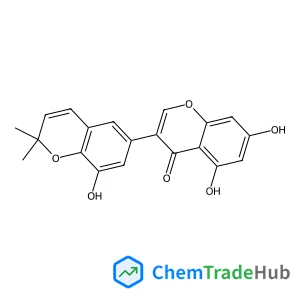
5,7,8'-Trihydroxy-2',2'-dimethyl-2'H,4H-3,6'-bichromen-4-one
CAS Number:
129280-33-7
Molecular Formula:
C20H16O6


Recommended Suppliers






Disclaimer
This page provides academic journal information for reference and research purposes only. We are not affiliated with any journal publishers and do not handle publication submissions. For publication-related inquiries, please contact the respective journal publishers directly.
If you notice any inaccuracies in the information displayed, please contact us at support@chemtradehub.com. We will promptly review and address your concerns.