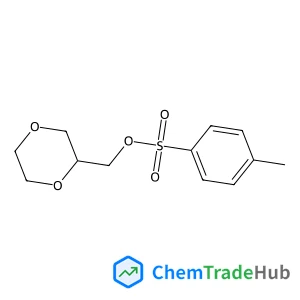
(S)-(1,4-Dioxan-2-yl)methyl 4-methylbenzenesulfonate
CAS Number:
917882-64-5
Molecular Formula:
C12H16O5S
Karina Hoher, Piercarlo F. Cardoso, Luiz F. Lepre, Rômulo A. Ando, Leonardo J. A. Siqueira
An investigation comprising experimental techniques (absorption capacity of SO2 and vibrational spectroscopy) and molecular simulations (thermodynamics, structure, and dynamics) has been performed for the polymer poly(ethylene oxide) (PEO), the ionic liquid butyltrimethylammonium bis(trifluoromethylsulfonyl)imide ([N4111][Tf2N]) and their mixtures as sulfur dioxide (SO2) absorbing materials. The polymer PEO has higher capacity to absorb SO2 than the neat ionic liquid, whereas the mixtures presented intermediary absorption capacities. The band assigned to the symmetric stretching band of SO2 at ca. 1140 cm−1, which is considered a spectroscopic probe for the strength of SO2 interactions with its neighborhood, shifts to lower wavenumbers as more negative total interaction energy values of SO2 were evaluated from the simulations. The solvation free energy of SO2, ΔGsol, correlates linearly with the absorption capacity of SO2. The negative values of ΔGsol are due to negative and positive values of enthalpy and entropy, respectively. In the ionic liquid, SO2 weakens the cation–anion interactions, whereas in the mixture with a high content of PEO these interactions are slightly increased. Such effects were correlated with the relative population of cisoid and transoid conformers of Tf2N anions as revealed by Raman spectroscopy. Moreover, the presence of SO2 in the systems provokes the increase of diffusion coefficients of the absorbing species in comparison with the systems without the gas. Proper to the slow dynamics of the polymer, the diffusion coefficient of ions and SO2 diminishes with the increase of the PEO content.
Akihiro Nakamura, Katsushi Fujii, Masakazu Sugiyama, Yoshiaki Nakano
DOI: 10.1039/C4CP01599A
Haley M. Stowe, Eunsu Paek, Dhivya Manogaran
DOI: 10.1039/C4CP04518A
Yansong Zhou, Gang Chen, Yaoguang Yu, Yujie Feng, Yi Zheng, Fang He, Zhonghui Han
DOI: 10.1039/C4CP03736G
Pei-Hsing Huang, Shang-Chao Hung, Ming-Yueh Huang
DOI: 10.1039/C4CP01922A
Pilar Redondo, Antonio Largo, Víctor Manuel Rayón, Germán Molpeceres, José Ángel Sordo, Carmen Barrientos
DOI: 10.1039/C4CP02094D
Yong Na, Yulin Yang, Ruiqing Fan, Ping Wang, Liang Li
DOI: 10.1039/C4CP04240A
Ananya Sen, Thomas F. M. Luxford, Naruo Yoshikawa, Caroline E. H. Dessent
DOI: 10.1039/C4CP00989D
Daohui Zhao, Chunwang Peng, Jian Zhou
DOI: 10.1039/C4CP04696J
Wei Li, Yanli Zeng, Xueying Zhang, Shijun Zheng, Lingpeng Meng
DOI: 10.1039/C4CP02430C
Christoph Richter, Max Beu, Derck Schlettwein
DOI: 10.1039/C4CP00723A
2-(2-Chloroacetamido)-3-phenylpropanoic acid (CAS: 7765-11-9) is generally consi...
2-(Benzyloxy)-5-bromobenzoic acid can be handled safely if appropriate precautio...
(4-Methyl-1,2,5-oxadiazol-3-yl)methanamine hydrochloride is a chemical compound ...
2-(5-Hexylthiophen-2-yl)-4,4,5,5-tetramethyl-1,3,2-dioxaborolane (CAS: 917985-54...
While 4-(8-Methyl-9H-1,3-dioxolo[4,5-h][2,3]benzodiazepin-5-yl)benzenamine (CAS:...
The market for tert-butyl 3-hydroxy-4,5,7,8-tetrahydro-2H-pyrazolo[3,4-d]azepine...
Waste containing 3,5-Diamino-1H-pyrazole-4-carbonitrile (CAS: 6844-58-2) should ...
(6-Fluoro-3-pyridinyl)boronic acid can be synthesized through the reaction of 6-...
Dibenzyl carbonimidoylbiscarbamate (CAS: 10065-79-9) finds applications in vario...
The market for (beta,beta,2,3,4,5,6-~2~H_7_)Phenylalanine (CAS: 74228-83-4) is g...

Physical Chemistry Chemical Physics (PCCP) is an international journal co-owned by 19 physical chemistry and physics societies from around the world. This journal publishes original, cutting-edge research in physical chemistry, chemical physics and biophysical chemistry. To be suitable for publication in PCCP, articles must include significant innovation and/or insight into physical chemistry; this is the most important criterion that reviewers and Editors will judge against when evaluating submissions. The journal has a broad scope and welcomes contributions spanning experiment, theory, computation and data science. Topical coverage includes spectroscopy, dynamics, kinetics, statistical mechanics, thermodynamics, electrochemistry, catalysis, surface science, quantum mechanics, quantum computing and machine learning. Interdisciplinary research areas such as polymers and soft matter, materials, nanoscience, energy, surfaces/interfaces, and biophysical chemistry are welcomed if they demonstrate significant innovation and/or insight into physical chemistry. Joined experimental/theoretical studies are particularly appreciated when complementary and based on up-to-date approaches.