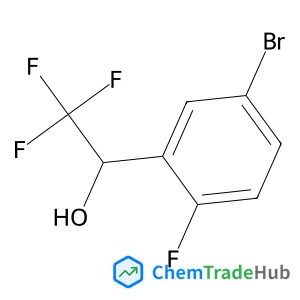
1-(5-Bromo-2-fluorophenyl)-2,2,2-trifluoroethanol
CAS Number:
1039827-16-1
Molecular Formula:
C8H5BrF4O
Yanli Zeng, Xiaoyan Li, Zheng Sun, Lingpeng Meng
For cyclopropane and its derivatives M3H6 (M = C, Si, Ge, Sn, Pb), “pseudo π-hole” regions above and below the M–M–M three-membered ring have been discovered, and pseudo π-hole interactions between M3H6 and F–CN have been designed and investigated by MP2/aug-cc-pVTZ and MP2/aug-cc-pVTZ-pp calculations. To investigate the enhancing effects of F⋯N halogen bonds on the pseudo π-hole interactions, the termolecular and tetramolecular complexes M3H6⋯(NCF)n (n = 2, 3) were constructed. Energy decomposition analysis shows that the dispersion term contributes the most among the three attractive components in the C3H6⋯(NCF)n (n = 1, 2, 3) complexes while in the Si3H6⋯(NCF)n and Ge3H6⋯(NCF)n complexes, the electrostatic term has the largest contribution. The electrostatic and polarization energies have more effect than the dispersion energy for the enhancement of the F⋯N halogen bond on the pseudo π-hole interactions. With the increase in the number of NCF units from 1 to 3, the VS,min values outside the nitrogen atom of NCF become increasingly negative, the electric field of the lone pair of nitrogen becomes greater and causes a further increase of electron density outside the nitrogen atom and a further decrease of electron density outside the pseudo π-hole region, resulting in a stronger pseudo π-hole interaction.

Photochemical & Photobiological Sciences

Lab on a Chip

Angewandte Chemie International Edition

Environmental Toxicology and Pharmacology

Coloration Technology

Journal of Enzyme inhibition and Medicinal Chemistry

Physical Chemistry Chemical Physics

CrystEngComm

Faraday Discussions

Journal of Medical Biochemistry
Rakesh Ranjan, Benny Kattikanal George
DOI: 10.1039/D3SU00304C
M. Beatriz P. P. Oliveira
DOI: 10.1039/D3FB00115F
Francielle Miranda de Matos, Gabriela Boscariol Rasera, Ruann Janser Soares de Castro
DOI: 10.1039/D3FB00097D
Kavita Devi, Ghanshyam S. Chauhan, Sunita Ranote, Sandeep Chauhan, Kiran Kumar
DOI: 10.1039/D3LP00118K
Daniele Carullo, Cesare Rovera, Tommaso Bellesia, Nadia Santo, Diego Romano, Stefano Farris
DOI: 10.1039/D3FB00147D
Kacper P. Krakowiak, Ruaraidh D. McIntosh, David Ellis
DOI: 10.1039/D3FB00088E
Matthew T. Garnett, Harrish Kumar Senthil Kumar, Bryan S. Beckingham, Symone L. M. Alexander
DOI: 10.1039/D3SU00192J
Tanya Singh Raghuvanshi, Bhanu Prakash
DOI: 10.1039/D3FB00098B
Reshab Majumder, Saptadip Miatur, Akash Saha, Shamim Hossain
DOI: 10.1039/D3FB00169E
2-(2-Chloroacetamido)-3-phenylpropanoic acid (CAS: 7765-11-9) is generally consi...
2-(Benzyloxy)-5-bromobenzoic acid can be handled safely if appropriate precautio...
(4-Methyl-1,2,5-oxadiazol-3-yl)methanamine hydrochloride is a chemical compound ...
2-(5-Hexylthiophen-2-yl)-4,4,5,5-tetramethyl-1,3,2-dioxaborolane (CAS: 917985-54...
While 4-(8-Methyl-9H-1,3-dioxolo[4,5-h][2,3]benzodiazepin-5-yl)benzenamine (CAS:...
The market for tert-butyl 3-hydroxy-4,5,7,8-tetrahydro-2H-pyrazolo[3,4-d]azepine...
Waste containing 3,5-Diamino-1H-pyrazole-4-carbonitrile (CAS: 6844-58-2) should ...
(6-Fluoro-3-pyridinyl)boronic acid can be synthesized through the reaction of 6-...
Dibenzyl carbonimidoylbiscarbamate (CAS: 10065-79-9) finds applications in vario...
The market for (beta,beta,2,3,4,5,6-~2~H_7_)Phenylalanine (CAS: 74228-83-4) is g...
Physical Chemistry Chemical Physics (PCCP) is an international journal co-owned by 19 physical chemistry and physics societies from around the world. This journal publishes original, cutting-edge research in physical chemistry, chemical physics and biophysical chemistry. To be suitable for publication in PCCP, articles must include significant innovation and/or insight into physical chemistry; this is the most important criterion that reviewers and Editors will judge against when evaluating submissions. The journal has a broad scope and welcomes contributions spanning experiment, theory, computation and data science. Topical coverage includes spectroscopy, dynamics, kinetics, statistical mechanics, thermodynamics, electrochemistry, catalysis, surface science, quantum mechanics, quantum computing and machine learning. Interdisciplinary research areas such as polymers and soft matter, materials, nanoscience, energy, surfaces/interfaces, and biophysical chemistry are welcomed if they demonstrate significant innovation and/or insight into physical chemistry. Joined experimental/theoretical studies are particularly appreciated when complementary and based on up-to-date approaches.
![3-[4-(difluoromethoxy)phenyl]-2-({[(9H-fluoren-9-yl)methoxy]carbonyl}amino)propanoic acid structure](https://static.chemtradehub.com/structs/149/1496564-27-2-952e.webp "3-[4-(difluoromethoxy)phenyl]-2-({[(9H-fluoren-9-yl)methoxy]carbonyl}amino)propanoic acid structure")