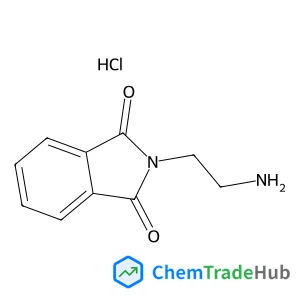
2-(2-Aminoethyl)-1H-isoindole-1,3(2H)-dione hydrochloride (1:1)
CAS Number:
30250-67-0
Molecular Formula:
C10H11ClN2O2
Kavita Devi, Ghanshyam S. Chauhan, Sunita Ranote, Sandeep Chauhan, Kiran Kumar
Oil pollution due to accidental oil spills and unethical industrial discharge into the aquatic system has been a major problem for decades. Industrialization and urbanization have made us dependent on petroleum products for survival. Hence, with the augmented transportation of these oil products, incidents of oil spill accidents have now become common. Water pollution due to these spills drastically affects aquatic and terrestrial life. Thus, it necessitates the use of economical and eco-friendly biosorbents for oil spill remediation. Herein, we report the synthesis of efficient oleophilic gels based on pristine coconut husk (Ch) and acrylate monomers [2-ethylhexyl acrylate and methyl acrylate] using the free radical polymerization technique with potassium persulfate (KPS)-N,N′-methylenebisacrylamide (MBA) as an initiator–crosslinker system. The synthesized oleophilic gels were characterized further using different techniques. The adsorption of various petroleum products such as toluene, petroleum ether, petrol, and diesel from their respective oil–water emulsions has been studied. The polymers poly(EHA)-cl-Ch and poly(MA)-cl-Ch synthesized with 2% [MBA] showed maximum adsorption capacities of 15.2 g g−1 and 13.0 g g−1, respectively, within 60 min at 35 °C, which is far better than pristine coconut husk which showed an adsorption capacity of only 2.1 g g−1 under the same conditions. The kinetics data best fitted in the pseudo-second-order kinetics model. The oleophilic gels were found to be reusable with appreciable adsorption of up to six cycles of regeneration. The cumulative adsorption capacities of poly(EHA)-cl-Ch and poly(MA)-cl-Ch were found to be 50.0 g g−1 and 35.2 g g−1, respectively. The effect of salinity on the adsorption capacity was also investigated using varied brine water emulsions. The oleophilic gels showed comparable adsorption capacities of 15.0 g g−1 and 12.2 g g−1 for poly(EHA)-cl-Ch and poly(MA)-cl-Ch, respectively, at a lower brine water concentration (1%). At a higher concentration of brine solution (5%), appreciable adsorption capacities of 12.8 g g−1 and 10.4 g g−1 were reported. A comparison between the two monomers clearly depicted the increase in the oleophilic capacity with the increase in the hydrocarbon chain. The synthesized oleophilic gels are, therefore, suitable candidates for dealing with oil spill cleanup.

Topics in Catalysis

Critical Reviews in Solid State and Materials Sciences

Journal of the Indian Institute of Science

Journal of Asian Natural Products Research

Herald of the Russian Academy of Sciences

Journal of Chemical Sciences

Bioorganic & Medicinal Chemistry Letters

Biocatalysis and Biotransformation

Cellulose

Main Group Chemistry
Elizabeth A. Whitsitt, Andrew R. Barron
DOI: 10.1039/B212808J
Weicheng Wu, Andrew. C. Grimsdale, Klaus Müllen
DOI: 10.1039/B301512M
James C. Errey, Balaram Mukhopadhyay, K. P. Ravindranathan Kartha, Robert A. Field
DOI: 10.1039/B410184G
Ping Yin, Song Gao, Li-Min Zheng, Zheming Wang, Xin-Quan Xin
DOI: 10.1039/B212674E
John J. Perry, Gregory J. McManus, Michael J. Zaworotko
DOI: 10.1039/B408973A
Hiroshi Shiigi, Yojiro Yamamoto, Hidetaka Yakabe, Shiho Tokonami, Tsutomu Nagaoka
DOI: 10.1039/B212226J
Toshiaki Mori, Yoshimi Sekine, Kenji Yamamoto, Yoshio Okahata
DOI: 10.1039/B411082J
Amir H. Mahmoudkhani, Adrien P. Côté, George K. H. Shimizu
DOI: 10.1039/B412325E
Barbara Binotti, Carla Carfagna, Cristiano Zuccaccia, Alceo Macchioni
DOI: 10.1039/B411214H
(1R,3S)-1,3-Cyclopentanediol finds applications in various industries. In the ph...
When handling N'-[4-(Dimethylamino)phenyl]-N,N-dimethyl-1,4-benzenediamine, it i...
There are several alternatives to 5-(2,4-Difluorophenyl)-2-methoxypyrimidine in ...
1-(3-Methoxyphenoxy)propan-2-ol (CAS: 382141-68-6) must comply with the Globally...
Tetrodotoxin Citrate is extremely dangerous and should be handled with extreme c...
2-Methyl-2-propanyl [(1R,3S)-3-hydroxycyclopentyl]carbamate (CAS: 225641-84-9) i...
Waste containing 4-(2-Hydroxyhexafluoroisopropyl)Benzoic Acid (CAS: 16261-80-6) ...
2-Methyl-2-proanyl {(2S)-1-[(benzyloxy)amino]-3-hydroxy-3-methyl-1-oxo-2-butanyl...
Benzeneethanamine, α-ethyl-, hydrochloride (1:1) is an organic compound with the...
In the synthesis of compounds similar to 3-{(E)-[4-(Dimethylamino)phenyl]diazeny...
![N-[(9H-Fluoren-9-ylmethoxy)carbonyl]-beta-phenyl-L-phenylalanine structure](https://static.chemtradehub.com/structs/201/201484-50-6-c2fc.webp "N-[(9H-Fluoren-9-ylmethoxy)carbonyl]-beta-phenyl-L-phenylalanine structure")