












Decoupling the effects of confinement and passivation on semiconductor quantum dots
Literature Information
Publication Date
2016-07-05
DOI
10.1039/C6CP03438A
Impact Factor
3.676
Authors
Roya Rudd, Colin Hall, Peter J. Murphy, Peter J. Reece, Eric Charrault, Drew Evans
View Original
Abstract
Semiconductor (SC) quantum dots (QDs) have recently been fabricated by both chemical and plasma techniques for specific absorption and emission of light. Their optical properties are governed by the size of the QD and the chemistry of any passivation at their surface. Here, we decouple the effects of confinement and passivation by utilising DC magnetron sputtering to fabricate SC QDs in a perfluorinated polyether oil. Very high band gaps are observed for fluorinated QDs with increasing levels of quantum confinement (from 4.2 to 4.6 eV for Si, and 2.5 to 3 eV for Ge), with a shift down to 3.4 eV for Si when oxygen is introduced to the passivation layer. In contrast, the fluorinated Si QDs display a constant UV photoluminescence (3.8 eV) irrespective of size. This ability to tune the size and passivation independently opens a new opportunity to extending the use of simple semiconductor QDs.
Related Literature
Effective pair potential between charged nanoparticles at high volume fractions
Guillaume Bareigts, Christophe Labbez
2017-01-20
Paper
DOI: 10.1039/C6CP08056A
Diffusive escape through a narrow opening: new insights into a classic problem
Denis S. Grebenkov, Gleb Oshanin
2016-12-15
Paper
DOI: 10.1039/C6CP06102H
Piezochromism and structural and electronic properties of benz[a]anthracene under pressure
Weizhao Cai, Rong Zhang, Shanti Deemyad
2017-01-31
Paper
DOI: 10.1039/C6CP08171A
Exploring experimental fitness landscapes for chemical synthesis and property optimization
Katharine Moore Tibbetts, Xiao-Jiang Feng, Herschel Rabitz
2017-01-18
Paper
DOI: 10.1039/C6CP06187G
Adsorbing the 3d-transition metal atoms to effectively modulate the electronic and magnetic behaviors of zigzag SiC nanoribbons
Hui Li, Wei Chen, Xiaopeng Shen, Jingwei Liu, Xuri Huang, Guangtao Yu
2017-01-03
Paper
DOI: 10.1039/C6CP06717D
Charge transport mechanisms in sol–gel grown La0.7Pb0.3MnO3/LaAlO3 manganite films
Eesh Vaghela, M. J. Keshvani, Keval Gadani, Zalak Joshi, Hetal Boricha, K. Asokan, D. Venkateshwarlu, V. Ganesan, N. A. Shah, P. S. Solanki
2017-01-31
Paper
DOI: 10.1039/C6CP07730G
Engineering the electronic and optoelectronic properties of InX (X = S, Se, Te) monolayers via strain
Hao Jin, Jianwei Li, Ying Dai, Yadong Wei
2017-01-09
Paper
DOI: 10.1039/C6CP08158D
The role of π-linkers in tuning the optoelectronic properties of triphenylamine derivatives for solar cell applications – A DFT/TDDFT study‡
Arunkumar Kathiravan, Rajadurai Vijay Solomon
2017-01-26
Paper
DOI: 10.1039/C6CP07768D
Collective proton transfer in ordinary ice: local environments, temperature dependence and deuteration effects
Christof Drechsel-Grau, Dominik Marx
2016-11-07
Perspective
DOI: 10.1039/C6CP05679B
You might also like
Compound Q&A
What precautions should be taken when handling 4-(2-Furylmethyl)thiomorpholine 1,1-dioxide (CAS: 79206-94-3)?
When handling 4-(2-Furylmethyl)thiomorpholine 1,1-dioxide (CAS: 79206-94-3), it ...
79206-94-34-(2-Furylmethyl)thi...
Compound Q&A
What precautions should be taken when handling 4-Chloro-N-[2-(4-morpholinyl)ethyl]benzamide (CAS: 71320-77-9)?
When handling 4-Chloro-N-[2-(4-morpholinyl)ethyl]benzamide (CAS: 71320-77-9), it...
71320-77-94-Chloro-N-[2-(4-mor...
Compound Q&A
How should waste containing 2-[2-(2-Methoxyethoxy)ethoxy]ethyl 4-methylbenzenesulfonate (CAS: 62921-74-8) be handled?
Waste containing this compound (CAS: 62921-74-8) should be handled according to ...
62921-74-82-[2-(2-Methoxyethox...
Compound Q&A
How should waste containing (S)-Methyl 2-amino-3-cyclohexylpropanoate be handled?
Waste containing (S)-Methyl 2-amino-3-cyclohexylpropanoate should be collected i...
40056-18-6(S)-Methyl 2-amino-3...
Compound Q&A
How is 5-({4-[(2S,4R)-4-Hydroxy-2-methyltetrahydro-2H-pyran-4-yl]-2-thienyl}sulfanyl)-1-methyl-1,3-dihydro-2H-indol-2-one (CAS: 166882-70-8) typically synthesized?
This compound can be synthesized using a multi-step process involving the conjug...
166882-70-85-({4-[(2S,4R)-4-Hyd...
Compound Q&A
Are there alternatives to (2E)-3-(3,4-Dichlorophenyl)acrylic acid (CAS: 7312-27-8) in synthesis?
There are several alternatives to (2E)-3-(3,4-Dichlorophenyl)acrylic acid in syn...
7312-27-8(2E)-3-(3,4-Dichloro...
Compound Q&A
How should Ethyl 6-(2-nitrophenyl)imidazo[2,1-b][1,3]thiazole-3-carboxylate (CAS: 925437-84-9) be stored?
Ethyl 6-(2-nitrophenyl)imidazo[2,1-b][1,3]thiazole-3-carboxylate (CAS: 925437-84...
925437-84-9Ethyl 6-(2-nitrophen...
Compound Q&A
How should waste containing 2-(1,3-Thiazol-2-yl)ethanamine (CAS: 18453-07-1) be handled?
Waste containing 2-(1,3-Thiazol-2-yl)ethanamine (CAS: 18453-07-1) should be coll...
18453-07-12-(1,3-Thiazol-2-yl)...
Compound Q&A
How is Methyl 5-iodo-2-methylbenzoate (CAS: 103440-54-6) typically synthesized?
Methyl 5-iodo-2-methylbenzoate can be synthesized through the iodination of meth...
103440-54-6Methyl 5-iodo-2-meth...
Compound Q&A
How is 5-Chloro[1,2,4]triazolo[1,5-a]pyridine (CAS: 1427399-34-5) typically synthesized?
5-Chloro[1,2,4]triazolo[1,5-a]pyridine is commonly synthesized via the condensat...
1427399-34-55-Chloro[1,2,4]triaz...
Source Journal
Physical Chemistry Chemical Physics

CiteScore:
5.5
Self-citation Rate:
10.3%
Articles per Year:
3036
Physical Chemistry Chemical Physics (PCCP) is an international journal co-owned by 19 physical chemistry and physics societies from around the world. This journal publishes original, cutting-edge research in physical chemistry, chemical physics and biophysical chemistry. To be suitable for publication in PCCP, articles must include significant innovation and/or insight into physical chemistry; this is the most important criterion that reviewers and Editors will judge against when evaluating submissions. The journal has a broad scope and welcomes contributions spanning experiment, theory, computation and data science. Topical coverage includes spectroscopy, dynamics, kinetics, statistical mechanics, thermodynamics, electrochemistry, catalysis, surface science, quantum mechanics, quantum computing and machine learning. Interdisciplinary research areas such as polymers and soft matter, materials, nanoscience, energy, surfaces/interfaces, and biophysical chemistry are welcomed if they demonstrate significant innovation and/or insight into physical chemistry. Joined experimental/theoretical studies are particularly appreciated when complementary and based on up-to-date approaches.
Recommended Compounds
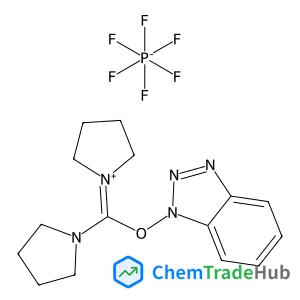
(1H-Benzotriazol-1-yloxy)(di-1-pyrrolidinyl)methylium hexafluorophosphate
CAS Number:
105379-24-6
Molecular Formula:
C15H21F6N5OP
![4-{2-[4-(2-Methyl-2-propanyl)phenyl]ethoxy}quinazoline structure](https://static.chemtradehub.com/structs/120/120928-09-8-d3db.webp "4-{2-[4-(2-Methyl-2-propanyl)phenyl]ethoxy}quinazoline structure")
4-{2-[4-(2-Methyl-2-propanyl)phenyl]ethoxy}quinazoline
CAS Number:
120928-09-8
Molecular Formula:
C20H22N2O
Recommended Suppliers







Disclaimer
This page provides academic journal information for reference and research purposes only. We are not affiliated with any journal publishers and do not handle publication submissions. For publication-related inquiries, please contact the respective journal publishers directly.
If you notice any inaccuracies in the information displayed, please contact us at support@chemtradehub.com. We will promptly review and address your concerns.