












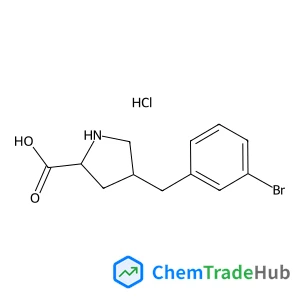
(2S,4R)-4-(3-Bromobenzyl)pyrrolidine-2-carboxylic acid hydrochloride
CAS Number:
1049734-10-2
Molecular Formula:
C12H15BrClNO2
I. Agustín Aucar, Sergio S. Gomez, Claudia G. Giribet, Gustavo A. Aucar
One of the most influential articles showing the best way to get the absolute values of NMR magnetic shieldings, σ (non-measurables) from both accurate measurements and theoretical calculations, was published a long time ago by Flygare. His model was shown to break down when heavy atoms are involved. This fact motivated the development of new theories of nuclear spin-rotation (SR) tensors, which consider electronic relativistic effects. One was published recently by some of us. In this article we take another step further and propose three different models that generalize Flygare's model. All of them are written using four-component relativistic expressions, though the two-component relativistic SO-S term also appears in one. The first clues for these developments were built from the relationship among σ and the SR tensors within the two-component relativistic LRESC model. Besides, we had to introduce a few other well defined assumptions: (i) relativistic corrections must be included in a way to best reproduce the relationship among the (e–e) term (called “paramagnetic” within the non-relativistic domain) of σ and its equivalent part of the SR tensor, (ii) as happens in Flygare's rule, the shielding of free atoms shall be included to improve accuracy. In the highest accurate model, a new term known as Spin–orbit due to spin, SO-S (in this mechanism the spin-Zeeman Hamiltonian replaces the orbital-Zeeman Hamiltonian), is included. We show the results of the application of those models to halogen containing linear molecules.
Soumya Ranjan Mishra, Vishal Gadore, Md. Ahmaruzzaman
DOI: 10.1039/D3SU00384A
Weiliang Han, Weigao Han, Zhicheng Tang
DOI: 10.1039/D3LF00147D
Smriti Chaturvedi, Snehasis Chakraborty
DOI: 10.1039/D3FB00094J
Jin Wook Yang, Hee Ryeong Kwon, Jin Ho Seo, Sangwoo Ryu
DOI: 10.1039/D3LF00094J
Gouri Sankar Das, Manish Srivastava, Kumud Malika Tripathi
DOI: 10.1039/D3SU00328K
Marco Rollo, Massimo A. G. Perini, Alessandro Sanzone, Lorenzo Polastri, Matteo Tiecco, Alejandro Torregrosa-Chinillach, Elisa Martinelli, Gianluca Ciancaleoni
DOI: 10.1039/D3SU00205E
Peiying Fan, Yuhan Zhang, Li Guan, Han Wang, George Zheng Chen
DOI: 10.1039/D3SU00197K
Akiho Horibe, Tomoko Murayama, Tsuyoshi Kawai, Yoshiyuki Nonoguchi
DOI: 10.1039/D3LF00119A
Anju Srivastava, Sriparna Dutta, Reena Jain
DOI: 10.1039/D3SU00246B
2-(2-Chloroacetamido)-3-phenylpropanoic acid (CAS: 7765-11-9) is generally consi...
2-(Benzyloxy)-5-bromobenzoic acid can be handled safely if appropriate precautio...
(4-Methyl-1,2,5-oxadiazol-3-yl)methanamine hydrochloride is a chemical compound ...
2-(5-Hexylthiophen-2-yl)-4,4,5,5-tetramethyl-1,3,2-dioxaborolane (CAS: 917985-54...
While 4-(8-Methyl-9H-1,3-dioxolo[4,5-h][2,3]benzodiazepin-5-yl)benzenamine (CAS:...
The market for tert-butyl 3-hydroxy-4,5,7,8-tetrahydro-2H-pyrazolo[3,4-d]azepine...
Waste containing 3,5-Diamino-1H-pyrazole-4-carbonitrile (CAS: 6844-58-2) should ...
(6-Fluoro-3-pyridinyl)boronic acid can be synthesized through the reaction of 6-...
Dibenzyl carbonimidoylbiscarbamate (CAS: 10065-79-9) finds applications in vario...
The market for (beta,beta,2,3,4,5,6-~2~H_7_)Phenylalanine (CAS: 74228-83-4) is g...

Physical Chemistry Chemical Physics (PCCP) is an international journal co-owned by 19 physical chemistry and physics societies from around the world. This journal publishes original, cutting-edge research in physical chemistry, chemical physics and biophysical chemistry. To be suitable for publication in PCCP, articles must include significant innovation and/or insight into physical chemistry; this is the most important criterion that reviewers and Editors will judge against when evaluating submissions. The journal has a broad scope and welcomes contributions spanning experiment, theory, computation and data science. Topical coverage includes spectroscopy, dynamics, kinetics, statistical mechanics, thermodynamics, electrochemistry, catalysis, surface science, quantum mechanics, quantum computing and machine learning. Interdisciplinary research areas such as polymers and soft matter, materials, nanoscience, energy, surfaces/interfaces, and biophysical chemistry are welcomed if they demonstrate significant innovation and/or insight into physical chemistry. Joined experimental/theoretical studies are particularly appreciated when complementary and based on up-to-date approaches.
![19-[Chloro(dideuterio)methyl]-19-deuterio-20,20-dideuteriooxyoctatriacontane-18,21-dione structure](https://static.chemtradehub.com/structs/124/1246818-85-8-6244.webp "19-[Chloro(dideuterio)methyl]-19-deuterio-20,20-dideuteriooxyoctatriacontane-18,21-dione structure")
![Ethyl thieno[3,2-f]quinoline-2-carboxylate structure](https://static.chemtradehub.com/structs/299/29948-26-3-f62b.webp "Ethyl thieno[3,2-f]quinoline-2-carboxylate structure")





