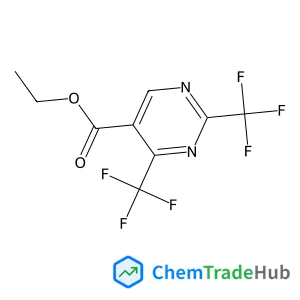
Ethyl 2,4-bis(trifluoromethyl)-5-pyrimidinecarboxylate
CAS Number:
188781-15-9
Molecular Formula:
C9H6F6N2O2
Chen Qu, Joel M. Bowman
We report a full-dimensional, permutationally invariant potential energy surface (PES) for the cyclic formic acid dimer. This PES is a least-squares fit to 13475 CCSD(T)-F12a/haTZ (VTZ for H and aVTZ for C and O) energies. The energy-weighted, root-mean-square fitting error is 11 cm−1 and the barrier for the double-proton transfer on the PES is 2848 cm−1, in good agreement with the directly-calculated ab initio value of 2853 cm−1. The zero-point vibrational energy of 15 337 ± 7 cm−1 is obtained from diffusion Monte Carlo calculations. Energies of fundamentals of fifteen modes are calculated using the vibrational self-consistent field and virtual-state configuration interaction method. The ground-state tunneling splitting is computed using a reduced-dimensional Hamiltonian with relaxed potentials. The highest-level, four-mode coupled calculation gives a tunneling splitting of 0.037 cm−1, which is roughly twice the experimental value. The tunneling splittings of (DCOOH)2 and (DCOOD)2 from one to three mode calculations are, as expected, smaller than that for (HCOOH)2 and consistent with experiment.
Safa Shoaee, Zesheng An, Xuan Zhang, Stephen Barlow, Seth R. Marder, Warren Duffy, James R. Durrant
DOI: 10.1039/B909071A
Hisashi Shimakoshi, Makoto Abiru, Shin-ichiro Izumi, Yoshio Hisaeda
DOI: 10.1039/B913255D
Cho-Long Park, Ah Young Jee, Minyung Lee, Sang-gi Lee
DOI: 10.1039/B910836J
Hua Ling, Aram Kang, Matthew Wook Chang
DOI: 10.1039/B912003C
Yun Chen, Hui Li, Shuanglian Cai
DOI: 10.1039/B908853A
Gaojian Chen, Jatin Kumar, Andrew Gregory, Martina H. Stenzel
DOI: 10.1039/B910340F
DOI: 10.1039/B908378B
Binnur Aydogan, Ali Senol Gundogan, Turan Ozturk, Yusuf Yagci
DOI: 10.1039/B914953H
Seunghee Hong, Minhak Oh, Mira Park, Ji Woong Yoon, Jong-San Chang, Myoung Soo Lah
DOI: 10.1039/B909250A
Chao Wang, Yinsheng Guo, Yapei Wang, Huaping Xu, Xi Zhang
DOI: 10.1039/B912502G
When handling lithium chloride hydrate (1:1:1) (CAS: 16712-20-2), it is importan...
4-(4H-1,2,4-Triazol-4-yl)piperidine is generally considered safe for use in phar...
Waste containing 1,3-Thiazole-2-carboxamide (CAS: 16733-85-0) should be collecte...
5-(Difluoromethyl)-2-fluorobenzonitrile (CAS: 934175-58-3) is subject to regulat...
Methyl 3-acetamido-2-thiophenecarboxylate can be synthesized by the reaction of ...
4-Isoquinolinecarbonitrile is a chemical compound with the CAS number 34846-65-6...
Store Methyl 1H-1,2,3-triazole-4-carboxylate (CAS: 877309-59-6) in a cool, dry p...
6-Bromo[1,3]thiazolo[5,4-b]pyridin-2-amine (CAS: 1160791-13-8) is subject to the...
(2S,3S)-2-Ammonio-3-(3,4-dihydroxyphenyl)-3-hydroxypropanoate (CAS: 23651-95-8) ...
7-Bromo-3-methyl-3,4-dihydroquinazolin-4-one is a solid with a crystalline form....

Physical Chemistry Chemical Physics (PCCP) is an international journal co-owned by 19 physical chemistry and physics societies from around the world. This journal publishes original, cutting-edge research in physical chemistry, chemical physics and biophysical chemistry. To be suitable for publication in PCCP, articles must include significant innovation and/or insight into physical chemistry; this is the most important criterion that reviewers and Editors will judge against when evaluating submissions. The journal has a broad scope and welcomes contributions spanning experiment, theory, computation and data science. Topical coverage includes spectroscopy, dynamics, kinetics, statistical mechanics, thermodynamics, electrochemistry, catalysis, surface science, quantum mechanics, quantum computing and machine learning. Interdisciplinary research areas such as polymers and soft matter, materials, nanoscience, energy, surfaces/interfaces, and biophysical chemistry are welcomed if they demonstrate significant innovation and/or insight into physical chemistry. Joined experimental/theoretical studies are particularly appreciated when complementary and based on up-to-date approaches.