












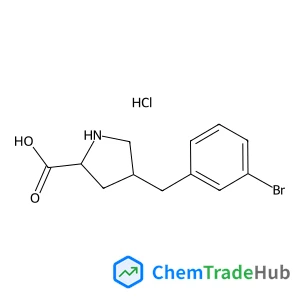
(2S,4R)-4-(3-Bromobenzyl)pyrrolidine-2-carboxylic acid hydrochloride
CAS Number:
1049734-10-2
Molecular Formula:
C12H15BrClNO2
Zhiqi Li, Xinyuan Zhang, Zhihui Zhang, Shujun Li, Chunyu Liu, Wenbin Guo, Shengping Ruan
The reproducible silylation of titanium oxide (TiO2) with small molecular (dichloromethyl) dimethylchlorosilane (DCS) as the cathode buffer layer was developed to improve electron extraction. Through incorporating the DCS capping layer into polymer solar cells (PSCs), the interfacial coherence of devices could be enhanced, leading to a shift in nanocrystallite size and a smaller internal charge transport resistance. Furthermore, a TiO2/DCS combined interfacial layer could serve as both an exciton dissociation center and a charge transfer channel, which results in a reduction in the energy barrier and electron loss, improving hole-blocking and surface-state passivation in the TiO2 interfacial layer. The Kelvin probe measurements demonstrate that the employment of the DCS nanolayer decreases conduction band energy of TiO2via forming a dipole layer at the interface of TiO2 and the DCS nanolayer, which tunes the work-function of the device and ulteriorly enhances charge carrier transfer between the electrode and the active layer. As a result, the photocurrent and the fill factor of the PSCs are both increased, resulting in an increased power conversion efficiency (PCE) of 6.959%.
Tao Niu, Shan Yang, Xinxin Wu
DOI: 10.1039/D0QO00952K
Youcan Zhang, Han-Jun Ai
DOI: 10.1039/D0QO00999G
Shengxiang Qiu, Hongxin Liu, Haibo Tan
DOI: 10.1039/D0QO00484G
Guanyinsheng Qiu, Hongwei Zhou, Jin-Biao Liu
DOI: 10.1039/C9OB00320G
Shi-Chang Gao, Kang Wan, Xu Fang, Yong-Xue Li, Min Xue, Yong Yang
DOI: 10.1039/D0QO00746C
Stéphane Le Gac, Elsa Caytan, Vincent Dorcet, Bernard Boitrel
DOI: 10.1039/C9OB00489K
Shan-Shan Zhu, Jiang-Nan Zhou, Quan-Long Wu, Wen-Juan Hao, Shu-Jiang Tu, Bo Jiang
DOI: 10.1039/D0QO00917B
2-(2-Chloroacetamido)-3-phenylpropanoic acid (CAS: 7765-11-9) is generally consi...
2-(Benzyloxy)-5-bromobenzoic acid can be handled safely if appropriate precautio...
(4-Methyl-1,2,5-oxadiazol-3-yl)methanamine hydrochloride is a chemical compound ...
2-(5-Hexylthiophen-2-yl)-4,4,5,5-tetramethyl-1,3,2-dioxaborolane (CAS: 917985-54...
While 4-(8-Methyl-9H-1,3-dioxolo[4,5-h][2,3]benzodiazepin-5-yl)benzenamine (CAS:...
The market for tert-butyl 3-hydroxy-4,5,7,8-tetrahydro-2H-pyrazolo[3,4-d]azepine...
Waste containing 3,5-Diamino-1H-pyrazole-4-carbonitrile (CAS: 6844-58-2) should ...
(6-Fluoro-3-pyridinyl)boronic acid can be synthesized through the reaction of 6-...
Dibenzyl carbonimidoylbiscarbamate (CAS: 10065-79-9) finds applications in vario...
The market for (beta,beta,2,3,4,5,6-~2~H_7_)Phenylalanine (CAS: 74228-83-4) is g...

Physical Chemistry Chemical Physics (PCCP) is an international journal co-owned by 19 physical chemistry and physics societies from around the world. This journal publishes original, cutting-edge research in physical chemistry, chemical physics and biophysical chemistry. To be suitable for publication in PCCP, articles must include significant innovation and/or insight into physical chemistry; this is the most important criterion that reviewers and Editors will judge against when evaluating submissions. The journal has a broad scope and welcomes contributions spanning experiment, theory, computation and data science. Topical coverage includes spectroscopy, dynamics, kinetics, statistical mechanics, thermodynamics, electrochemistry, catalysis, surface science, quantum mechanics, quantum computing and machine learning. Interdisciplinary research areas such as polymers and soft matter, materials, nanoscience, energy, surfaces/interfaces, and biophysical chemistry are welcomed if they demonstrate significant innovation and/or insight into physical chemistry. Joined experimental/theoretical studies are particularly appreciated when complementary and based on up-to-date approaches.
![(1R)-N-((1R)-1-Phenylethyl)-1-[4-(tert-butyldimethylsilyloxymethyl)cyclohexyl]ethan-1-amine structure](https://static.chemtradehub.com/structs/672/672314-45-3-47ef.webp "(1R)-N-((1R)-1-Phenylethyl)-1-[4-(tert-butyldimethylsilyloxymethyl)cyclohexyl]ethan-1-amine structure")
![(1S)-1,5-Anhydro-2-O-alpha-L-arabinopyranosyl-1-[5-hydroxy-7-({6-O-[3-(4-hydroxy-3-methoxyphenyl)propanoyl]-beta-D-glucopyranosyl}oxy)-2-(4-hydroxyphenyl)-4-oxo-4H-chromen-6-yl]-D-glucitol structure](https://static.chemtradehub.com/structs/225/2252345-81-4-bcff.webp "(1S)-1,5-Anhydro-2-O-alpha-L-arabinopyranosyl-1-[5-hydroxy-7-({6-O-[3-(4-hydroxy-3-methoxyphenyl)propanoyl]-beta-D-glucopyranosyl}oxy)-2-(4-hydroxyphenyl)-4-oxo-4H-chromen-6-yl]-D-glucitol structure")
![{3-[Bis(4-hydroxyphenyl)methyl]-1-[2-(dimethylamino)ethyl]-1H-indol-2-yl}[4-(2-chlorophenyl)-1-piperazinyl]methanone structure](https://static.chemtradehub.com/structs/170/170365-25-0-e4d7.webp "{3-[Bis(4-hydroxyphenyl)methyl]-1-[2-(dimethylamino)ethyl]-1H-indol-2-yl}[4-(2-chlorophenyl)-1-piperazinyl]methanone structure")





