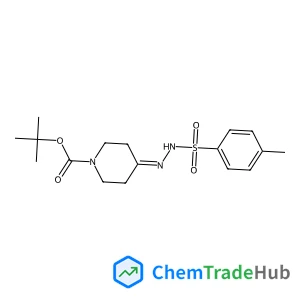
tert-Butyl 4-(2-(p-Tolylsulfonyl)hydrazono)piperidine-1-carboxylate
CAS Number:
1046478-89-0
Molecular Formula:
C17H25N3O4S
Andrej Junginger, Galen T. Craven, Thomas Bartsch, R. M. Benito, Rigoberto Hernandez
Reaction rates across time-dependent barriers are difficult to define and difficult to obtain using standard transition state theory approaches because of the complexity of the geometry of the dividing surface separating reactants and products. Using perturbation theory (PT) or Lagrangian descriptors (LDs), we can obtain the transition state trajectory and the associated recrossing-free dividing surface. With the latter, we are able to determine the exact reactant population decay and the corresponding rates to benchmark the PT and LD approaches. Specifically, accurate rates are obtained from a local description regarding only direct barrier crossings and to those obtained from a stability analysis of the transition state trajectory. We find that these benchmarks agree with the PT and LD approaches for obtaining recrossing-free dividing surfaces. This result holds not only for the local dynamics in the vicinity of the barrier top, but also for the global dynamics of particles that are quenched at the reactant or product wells after their sojourn over the barrier region. The double-well structure of the potential allows for long-time dynamics related to collisions with the outside walls that lead to long-time returns in the low-friction regime. This additional global dynamics introduces slow-decay pathways that do not result from the local transition across the recrossing-free dividing surface associated with the transition state trajectory, but can be addressed if that structure is augmented by the population transfer of the long-time returns.
DOI: 10.1039/C9CP00257J
Paweł Piotr Michałowski, Piotr Knyps, Paweł Ciepielewski, Piotr Caban, Ewa Dumiszewska, Jacek Baranowski
DOI: 10.1039/C9CP00613C
Stefano Di Stefano, Luigi Mandolini
DOI: 10.1039/C8CP06344C
Huixin Zhang, Xiao Du, Shengqi Ding, Qiang Wang, Lutong Chang, Xuli Ma, Xiaogang Hao, Changjun Pen
DOI: 10.1039/C9CP00714H
Qiang Zhu
DOI: 10.1039/C8CP07202G
Giuseppe Cassone, Holger Kruse, Jiri Sponer
DOI: 10.1039/C8CP07492E
Ting Wang, Guangtao Yu, Jingwei Liu, Xuri Huang, Wei Chen
DOI: 10.1039/C8CP06011H
Stuart W. Crane, Omair Ghafur, Thomas Y. Cowie, Anita G. Lindsay, James O. F. Thompson, Jason B. Greenwood
DOI: 10.1039/C9CP00620F
Luiz Fernando Lepre, Laure Pison, Ines Otero, Arnaud Gautier, Julien Dévemy, Pascale Husson, Agilio A. H. Pádua, Margarida Costa Gomes
DOI: 10.1039/C9CP00593E
T. Niemann, P. Stange, A. Strate
DOI: 10.1039/C8CP06417B
When considering alternatives to 1-(4-Chlorophenyl)-N-hydroxymethanimine (CAS: 3...
This compound should be stored in a cool, dry place away from direct sunlight. I...
3-(4-Bromophenyl)-5-(2-fluorophenyl)-1,2,4-oxadiazole is synthesized through a m...
5-Chloro-2-(4-chlorophenyl)-4-methyl-6-[3-(1-piperidinyl)propoxy]pyrimidine (CAS...
2-Chloro-4-(difluoromethoxy)pyridine is used in the pharmaceutical industry for ...
3-Chloro-6-methylpyridazine (CAS: 1121-79-5) is classified under the Globally Ha...
Several alternatives can be used in the synthesis of Methyl 4,5-dimethyl-2-nitro...
Alternatives to (2E,2'E)-3,3'-(1,4-Phenylene)bisacrylaldehyde include other acry...
3-Amino-5-chloropyridin-2-ol hydrochloride is an organic compound with the CAS n...
When handling 6,7-Difluoro-2,3-dihydro-4H-chromen-4-one, it is essential to wear...

Physical Chemistry Chemical Physics (PCCP) is an international journal co-owned by 19 physical chemistry and physics societies from around the world. This journal publishes original, cutting-edge research in physical chemistry, chemical physics and biophysical chemistry. To be suitable for publication in PCCP, articles must include significant innovation and/or insight into physical chemistry; this is the most important criterion that reviewers and Editors will judge against when evaluating submissions. The journal has a broad scope and welcomes contributions spanning experiment, theory, computation and data science. Topical coverage includes spectroscopy, dynamics, kinetics, statistical mechanics, thermodynamics, electrochemistry, catalysis, surface science, quantum mechanics, quantum computing and machine learning. Interdisciplinary research areas such as polymers and soft matter, materials, nanoscience, energy, surfaces/interfaces, and biophysical chemistry are welcomed if they demonstrate significant innovation and/or insight into physical chemistry. Joined experimental/theoretical studies are particularly appreciated when complementary and based on up-to-date approaches.