












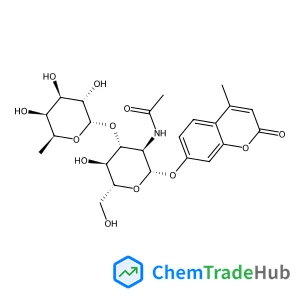
4-Methyl-2-oxo-2H-chromen-7-yl 2-acetamido-2-deoxy-3-O-(6-deoxy-alpha-L-galactopyranosyl)-beta-D-glucopyranoside
CAS Number:
383160-12-1
Molecular Formula:
C24H31NO12
Anthony Cirri, Alexey Silakov, Lasse Jensen, Benjamin J. Lear
Thiolate-protected gold nanoparticles have a rich history as model systems for understanding the physical and chemical properties of metallic nanoscale materials that, in turn, form the basis for applications in areas such as molecular electronics, photocatalytic systems, and plasmonic solar cells. It is well known that the electronic properties of gold nanoparticles can be tuned by modifying the geometry, size and dielectric surrounding of the particle. However, much less is known of how modifications to the surface chemistry modulates the electronic properties of gold nanoparticles. In part, this stems from the fact that there are few good tools for measuring the electronic properties with the sensitivity required for following the response to subtle changes in surface chemistry. In this work, we demonstrate conduction spin electron resonance (CESR) to be a sensitive and selective probe to determine how changes in surface chemistry of gold nanoparticles affect the metallic states near the Fermi energy. Using a series of para-substituted aromatic thiolate ligands, we find that the g-factor, as measured using CESR, correlates well with experimental and computational parameters often used to understand ligand effects in classical inorganic complexes. This suggests classical inorganic reasoning can function as a framework for understanding how to control the electronic properties of gold nanoparticles using their surface chemistry.
Yoichi M. A. Yamada, Kaoru Torii
DOI: 10.1039/B912696A
Suchetan Pal, Jaswinder Sharma, Hao Yan, Yan Liu
DOI: 10.1039/B911069K
Niveen M. Khashab, Matthew E. Belowich, Ali Trabolsi, Douglas C. Friedman, Cory Valente, Yuen Lau, Hussam A. Khatib, Jeffrey I. Zink, J. Fraser Stoddart
DOI: 10.1039/B910431C
M. Arunachalam, Pradyut Ghosh
DOI: 10.1039/B910014H
Michael M. Madden, Claudia I. Rivera Vera, Wenjiao Song, Qing Lin
DOI: 10.1039/B912094G
Boon Ping Ting, Jie Zhang, Majad Khan, Yi Yan Yang, Jackie Y. Ying
DOI: 10.1039/B910730D
Cho-Long Park, Ah Young Jee, Minyung Lee, Sang-gi Lee
DOI: 10.1039/B910836J
Shuichi Nakanishi, Jin Nishida, Hiroyuki Tanaka, Daiki Morisaki, Hiroshi Nomoto
DOI: 10.1039/B912908A
Yung-Son Hon, Tze-Wei Tseng, Chia-Yi Cheng
DOI: 10.1039/B912887E
When handling lithium chloride hydrate (1:1:1) (CAS: 16712-20-2), it is importan...
4-(4H-1,2,4-Triazol-4-yl)piperidine is generally considered safe for use in phar...
Waste containing 1,3-Thiazole-2-carboxamide (CAS: 16733-85-0) should be collecte...
5-(Difluoromethyl)-2-fluorobenzonitrile (CAS: 934175-58-3) is subject to regulat...
Methyl 3-acetamido-2-thiophenecarboxylate can be synthesized by the reaction of ...
4-Isoquinolinecarbonitrile is a chemical compound with the CAS number 34846-65-6...
Store Methyl 1H-1,2,3-triazole-4-carboxylate (CAS: 877309-59-6) in a cool, dry p...
6-Bromo[1,3]thiazolo[5,4-b]pyridin-2-amine (CAS: 1160791-13-8) is subject to the...
(2S,3S)-2-Ammonio-3-(3,4-dihydroxyphenyl)-3-hydroxypropanoate (CAS: 23651-95-8) ...
7-Bromo-3-methyl-3,4-dihydroquinazolin-4-one is a solid with a crystalline form....

Physical Chemistry Chemical Physics (PCCP) is an international journal co-owned by 19 physical chemistry and physics societies from around the world. This journal publishes original, cutting-edge research in physical chemistry, chemical physics and biophysical chemistry. To be suitable for publication in PCCP, articles must include significant innovation and/or insight into physical chemistry; this is the most important criterion that reviewers and Editors will judge against when evaluating submissions. The journal has a broad scope and welcomes contributions spanning experiment, theory, computation and data science. Topical coverage includes spectroscopy, dynamics, kinetics, statistical mechanics, thermodynamics, electrochemistry, catalysis, surface science, quantum mechanics, quantum computing and machine learning. Interdisciplinary research areas such as polymers and soft matter, materials, nanoscience, energy, surfaces/interfaces, and biophysical chemistry are welcomed if they demonstrate significant innovation and/or insight into physical chemistry. Joined experimental/theoretical studies are particularly appreciated when complementary and based on up-to-date approaches.
![(R)-N-[(S)-1-[2-(Diphenylphosphino)phenyl]ethyl]-2-methylpropane-2-sulfinamide structure](https://static.chemtradehub.com/structs/159/1595319-98-4-33e7.webp "(R)-N-[(S)-1-[2-(Diphenylphosphino)phenyl]ethyl]-2-methylpropane-2-sulfinamide structure")
![tert-butyl 8-benzyl-2,8-diazaspiro[4.5]decane-2-carboxylate structure](https://static.chemtradehub.com/structs/336/336191-16-3-bb55.webp "tert-butyl 8-benzyl-2,8-diazaspiro[4.5]decane-2-carboxylate structure")
![N-[2-(2-Pyridinyl)ethyl]-1-propanamine structure](https://static.chemtradehub.com/structs/554/55496-57-6-22b4.webp "N-[2-(2-Pyridinyl)ethyl]-1-propanamine structure")



