













Diffusion and precipitation processes in iron-based silica gardens
Literature Information
Publication Date
2016-07-01
DOI
10.1039/C6CP02107G
Impact Factor
3.676
Authors
F. Glaab, J. Rieder, J. M. García-Ruiz, W. Kunz, M. Kellermeier
View Original
Abstract
Silica gardens are tubular structures that form along the interface of multivalent metal salts and alkaline solutions of sodium silicate, driven by a complex interplay of osmotic and buoyant forces together with chemical reaction. They display peculiar plant-like morphologies and thus can be considered as one of the few examples for the spontaneous biomimetic self-ordering of purely inorganic materials. Recently, we could show that silica gardens moreover are highly dynamic systems that remain far from equilibrium for considerable periods of time long after macroscopic growth is completed. Due to initial compartmentalisation, drastic concentration gradients were found to exist across the tube walls, which give rise to noticeable electrochemical potential differences and decay only slowly in a series of coupled diffusion and precipitation processes. In the present work, we extend these studies and investigate the effect of the nature of the used metal cations on the dynamic behaviour of the system. To that end, we have grown single macroscopic silica garden tubes by controlled addition of sodium silicate sol to pellets of iron(II) and iron(III) chloride. In the following, the concentrations of ionic species were measured as a function of time on both sides of the formed membranes, while electrochemical potentials and pH were monitored online by immersing the corresponding sensors into the two separated solution reservoirs. At the end of the experiments, the solid tube material was furthermore characterised with respect to composition and microstructure by a combination of ex situ techniques. The collected data are compared to the previously reported case of cobalt-based silica gardens and used to shed light on ion diffusion through the inorganic membranes as well as progressive mineralisation at both surfaces of the tube walls. Our results reveal important differences in the dynamics of the three studied systems, which can be explained based on the acidity of the metal cations and the porosity of the membranes, leading to substantially dissimilar time-dependent solution chemistry as well as distinct final mineral structures. The insight gained in this work may help to better understand the diffusion properties and precipitation patterns in tubular iron (hydr)oxide/silicate structures observed in geological environments and during steel corrosion.
Recommended Journals
Related Literature
Exopolyhedral ligand flipping on isomerisation of novel supraicosahedral stannacarboranes
Peter D. Abram, David Ellis, Georgina M. Rosair, Alan J. Welch
2009-08-14
Communication
DOI: 10.1039/B911350A
Recognition and complexation of hydrated fluoride anion: F2(H2O)62− templated formation of a dimeric capsule of a tripodal amide
M. Arunachalam, Pradyut Ghosh
2009-08-14
Communication
DOI: 10.1039/B910014H
Electrical visualization of chemo-mechanical signal transduction using a smart gel-modified gate field effect transistor
Akira Matsumoto, Takashi Endo
2009-08-06
Communication
DOI: 10.1039/B911689C
Variable length ligands: a new class of bridging ligands for supramolecular chemistry and crystal engineering
Martin B. Duriska, Suzanne M. Neville, Stuart R. Batten
2009-08-24
Communication
DOI: 10.1039/B910994C
Centimetre scale assembly of vertically aligned and close packed semiconductor nanorods from solution
S. Ahmed
2009-09-08
Communication
DOI: 10.1039/B914478A
Remote control of bipyridine–metal coordination within a peptidedendrimer
Nicolas A. Uhlich, Peter Sommer, Claudia Bühr, Stefan Schürch, Jean-Louis Reymond, Tamis Darbre
2009-09-02
Communication
DOI: 10.1039/B912291E
Efficient synthesis of dendrimersvia a thiol–yne and esterification process and their potential application in the delivery of platinum anti-cancer drugs
Gaojian Chen, Jatin Kumar, Andrew Gregory, Martina H. Stenzel
2009-09-04
Communication
DOI: 10.1039/B910340F
Polythiophene derivatives by step-growth polymerizationvia photoinduced electron transfer reactions
Binnur Aydogan, Ali Senol Gundogan, Turan Ozturk, Yusuf Yagci
2009-09-07
Communication
DOI: 10.1039/B914953H
Metal oxide-sensitized TiO2 and TiO2−xNx with efficient charge transport conduits
Xin Shu, Zhe An, Lianying Wang, Jing He
2009-08-17
Communication
DOI: 10.1039/B909301J
A unique Bi–Bi bond forming reaction using organobismuth oxides and phosphorus compounds bearing a P(O)H group
Shigeru Shimada, Yoong-Kee Choe, Takashi Yamashita
2009-09-22
Communication
DOI: 10.1039/B914316E
You might also like
Compound Q&A
What precautions should be taken when handling lithium chloride hydrate (1:1:1) (CAS: 16712-20-2)?
When handling lithium chloride hydrate (1:1:1) (CAS: 16712-20-2), it is importan...
16712-20-2Lithium chloride hyd...
Compound Q&A
Is 4-(4H-1,2,4-Triazol-4-yl)piperidine (CAS: 690261-92-8) safe?
4-(4H-1,2,4-Triazol-4-yl)piperidine is generally considered safe for use in phar...
690261-92-84-(4H-1,2,4-Triazol-...
Compound Q&A
How should waste containing 1,3-Thiazole-2-carboxamide (CAS: 16733-85-0) be handled?
Waste containing 1,3-Thiazole-2-carboxamide (CAS: 16733-85-0) should be collecte...
16733-85-01,3-Thiazole-2-carbo...
Compound Q&A
What regulatory guidelines apply to 5-(Difluoromethyl)-2-fluorobenzonitrile (CAS: 934175-58-3)?
5-(Difluoromethyl)-2-fluorobenzonitrile (CAS: 934175-58-3) is subject to regulat...
934175-58-35-(Difluoromethyl)-2...
Compound Q&A
How is Methyl 3-acetamido-2-thiophenecarboxylate (CAS: 22288-79-5) typically synthesized?
Methyl 3-acetamido-2-thiophenecarboxylate can be synthesized by the reaction of ...
22288-79-5Methyl 3-acetamido-2...
Compound Q&A
What is 4-Isoquinolinecarbonitrile (CAS: 34846-65-6)?
4-Isoquinolinecarbonitrile is a chemical compound with the CAS number 34846-65-6...
34846-65-64-Isoquinolinecarbon...
Compound Q&A
How should Methyl 1H-1,2,3-triazole-4-carboxylate (CAS: 877309-59-6) be stored?
Store Methyl 1H-1,2,3-triazole-4-carboxylate (CAS: 877309-59-6) in a cool, dry p...
877309-59-6Methyl 1H-1,2,3-tria...
Compound Q&A
What regulatory guidelines apply to 6-Bromo[1,3]thiazolo[5,4-b]pyridin-2-amine (CAS: 1160791-13-8)?
6-Bromo[1,3]thiazolo[5,4-b]pyridin-2-amine (CAS: 1160791-13-8) is subject to the...
1160791-13-86-Bromo[1,3]thiazolo...
Compound Q&A
Is (2S,3S)-2-Ammonio-3-(3,4-dihydroxyphenyl)-3-hydroxypropanoate (CAS: 23651-95-8) safe?
(2S,3S)-2-Ammonio-3-(3,4-dihydroxyphenyl)-3-hydroxypropanoate (CAS: 23651-95-8) ...
23651-95-8(2S,3S)-2-Ammonio-3-...
Compound Q&A
What are the physical and chemical properties of 7-bromo-3-methyl-3,4-dihydroquinazolin-4-one (CAS: 1293987-84-4)?
7-Bromo-3-methyl-3,4-dihydroquinazolin-4-one is a solid with a crystalline form....
1293987-84-47-bromo-3-methyl-3,4...
Source Journal
Physical Chemistry Chemical Physics

CiteScore:
5.5
Self-citation Rate:
10.3%
Articles per Year:
3036
Physical Chemistry Chemical Physics (PCCP) is an international journal co-owned by 19 physical chemistry and physics societies from around the world. This journal publishes original, cutting-edge research in physical chemistry, chemical physics and biophysical chemistry. To be suitable for publication in PCCP, articles must include significant innovation and/or insight into physical chemistry; this is the most important criterion that reviewers and Editors will judge against when evaluating submissions. The journal has a broad scope and welcomes contributions spanning experiment, theory, computation and data science. Topical coverage includes spectroscopy, dynamics, kinetics, statistical mechanics, thermodynamics, electrochemistry, catalysis, surface science, quantum mechanics, quantum computing and machine learning. Interdisciplinary research areas such as polymers and soft matter, materials, nanoscience, energy, surfaces/interfaces, and biophysical chemistry are welcomed if they demonstrate significant innovation and/or insight into physical chemistry. Joined experimental/theoretical studies are particularly appreciated when complementary and based on up-to-date approaches.
Recommended Compounds
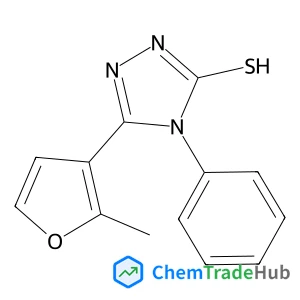
5-(2-Methyl-3-furyl)-4-phenyl-2,4-dihydro-3H-1,2,4-triazole-3-thione
CAS Number:
346464-59-3
Molecular Formula:
C13H11N3OS

![tert-butyl 8-benzyl-2,8-diazaspiro[4.5]decane-2-carboxylate structure](https://static.chemtradehub.com/structs/336/336191-16-3-bb55.webp "tert-butyl 8-benzyl-2,8-diazaspiro[4.5]decane-2-carboxylate structure")
tert-butyl 8-benzyl-2,8-diazaspiro[4.5]decane-2-carboxylate
CAS Number:
336191-16-3
Molecular Formula:
C20H30N2O2
![N-[2-(2-Pyridinyl)ethyl]-1-propanamine structure](https://static.chemtradehub.com/structs/554/55496-57-6-22b4.webp "N-[2-(2-Pyridinyl)ethyl]-1-propanamine structure")
Recommended Suppliers






Disclaimer
This page provides academic journal information for reference and research purposes only. We are not affiliated with any journal publishers and do not handle publication submissions. For publication-related inquiries, please contact the respective journal publishers directly.
If you notice any inaccuracies in the information displayed, please contact us at support@chemtradehub.com. We will promptly review and address your concerns.