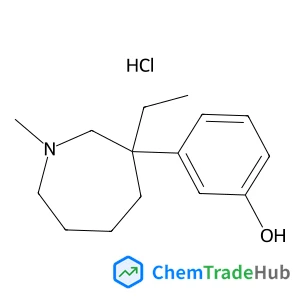
3-(3-Ethyl-1-methyl-3-azepanyl)phenol hydrochloride (1:1)
CAS Number:
59263-76-2
Molecular Formula:
C15H24ClNO
Meng Zhang, Yuxue Liu, Hancheng Zhu, Duanting Yan, Jian Yang, Xinyang Zhang, Chunguang Liu, Changshan Xu
Conductive C12A7:0.1%Gd3+,y%Sr2+ powders with different Sr2+ doping concentrations have been prepared in a H2 atmosphere by a solid state method in combination with subsequent UV-irradiation. The encaged electron concentration could be modulated through tuning Sr2+ doping and its maximum value reaches 2.3 × 1019 cm−3. This is attributed to the competition between enhanced uptake and the release of the encaged anions during their formation and diffusion processes and the suppression of encaged electrons generation due to the increased encaged OH− anions and the decreased encaged O2− anions. Although there exists encaged electrons and different encaged anions (O2−, H− and OH−) in C12A7 conductive powders prepared through the hydrogen route, a dominant local environment around Gd3+ could be observed using electron spin resonance (ESR) detection. It can be ascribed to the stronger coupling of the encaged OH− to the framework of C12A7 than those of the encaged electrons, O2− and H− anions. In addition, emission of Gd3+ ions is enhanced under UV or low voltage electron beam excitation and a new local environment around Gd3+ ions appears through the thermal annealing in air because of the decrease of the encaged OH− anions and the increase of the encaged O2− anions. Our results suggested that Sr2+ doping in combination with thermal annealing in air is an effective strategy for increasing the conductive performance and enhancing the emission of rare earth ions doped into C12A7 conductive phosphors for low-voltage field emission displays (FEDs).
Dong Myung Jang, Hyung Soon Im, Yoon Myung, Yong Jae Cho, Han Sung Kim, Seung Hyuk Back, Jeunghee Park, Eun Hee Cha, Minyung Lee
DOI: 10.1039/C3CP50769F
Stephanie J. Harris, Daniel Murdock, Yuyuan Zhang, Thomas A. A. Oliver, Michael P. Grubb, Andrew J. Orr-Ewing, Gregory M. Greetham, Ian P. Clark, Michael Towrie, Stephen E. Bradforth, Michael N. R. Ashfold
DOI: 10.1039/C3CP50756D
Xuefeng Lu, Hongjie Wang, Meng Chen, Lei Fan, Chao Wang, Shuhai Jia
DOI: 10.1039/C3CP50372K
Xi Zhang, Xuezhen Huang
DOI: 10.1039/C3CP51071A
Sunghyun Uhm
DOI: 10.1039/C3CP50885D
Jie Jiang, Xinghui Wang, Qing Zhang, Jingqi Li, X. X. Zhang
DOI: 10.1039/C3CP50197C
Yi Lin Yang, Yu-Chieh Ho, Yuri A. Dyakov, Wen-Hsin Hsu, Yi-Lun Sun, Wan-Chen Tsai, Wei-Ping Hu
DOI: 10.1039/C3CP44674C
Matija Zlatar, Maja Gruden-Pavlović, Mireia Güell
DOI: 10.1039/C2CP43735J
Alex Domingo, Martin Vérot, Fernando Mota, Juan J. Novoa, Vincent Robert
DOI: 10.1039/C3CP44647F
Thomas Elder, Joseph J. Bozell, Diana Cedeno
DOI: 10.1039/C3CP44404J
When handling 4-(2-Furylmethyl)thiomorpholine 1,1-dioxide (CAS: 79206-94-3), it ...
When handling 4-Chloro-N-[2-(4-morpholinyl)ethyl]benzamide (CAS: 71320-77-9), it...
Waste containing this compound (CAS: 62921-74-8) should be handled according to ...
Waste containing (S)-Methyl 2-amino-3-cyclohexylpropanoate should be collected i...
This compound can be synthesized using a multi-step process involving the conjug...
There are several alternatives to (2E)-3-(3,4-Dichlorophenyl)acrylic acid in syn...
Ethyl 6-(2-nitrophenyl)imidazo[2,1-b][1,3]thiazole-3-carboxylate (CAS: 925437-84...
Waste containing 2-(1,3-Thiazol-2-yl)ethanamine (CAS: 18453-07-1) should be coll...
Methyl 5-iodo-2-methylbenzoate can be synthesized through the iodination of meth...
5-Chloro[1,2,4]triazolo[1,5-a]pyridine is commonly synthesized via the condensat...

Physical Chemistry Chemical Physics (PCCP) is an international journal co-owned by 19 physical chemistry and physics societies from around the world. This journal publishes original, cutting-edge research in physical chemistry, chemical physics and biophysical chemistry. To be suitable for publication in PCCP, articles must include significant innovation and/or insight into physical chemistry; this is the most important criterion that reviewers and Editors will judge against when evaluating submissions. The journal has a broad scope and welcomes contributions spanning experiment, theory, computation and data science. Topical coverage includes spectroscopy, dynamics, kinetics, statistical mechanics, thermodynamics, electrochemistry, catalysis, surface science, quantum mechanics, quantum computing and machine learning. Interdisciplinary research areas such as polymers and soft matter, materials, nanoscience, energy, surfaces/interfaces, and biophysical chemistry are welcomed if they demonstrate significant innovation and/or insight into physical chemistry. Joined experimental/theoretical studies are particularly appreciated when complementary and based on up-to-date approaches.

![[4-(Heptyloxy)phenyl]boronic acid structure](https://static.chemtradehub.com/structs/136/136370-19-9-ad33.webp "[4-(Heptyloxy)phenyl]boronic acid structure")
![N-[(Benzyloxy)carbonyl]serine structure](https://static.chemtradehub.com/structs/276/2768-56-1-77f7.webp "N-[(Benzyloxy)carbonyl]serine structure")