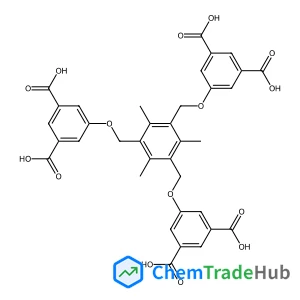
5,5',5''-(((2,4,6-Trimethylbenzene-1,3,5-triyl)tris(methylene))tris(oxy))triisophthalic acid
CAS Number:
1159974-70-5
Molecular Formula:
C36H30O15
Xin Zhang, Daniele Stradi, Lei Liu, Hong Luo, Mads Brandbyge, Gong Gu
Scanning tunneling spectroscopy is often employed to study two-dimensional (2D) materials on conductive growth substrates, in order to gain information on the electronic structures of the 2D material–substrate systems, which can lead to insight into 2D material–substrate interactions, growth mechanisms, etc. The interpretation of the spectra can be complicated, however. Specifically for graphene grown on copper, there have been conflicting reports of tunneling spectra. A clear understanding of the mechanisms behind the variability is desired. In this work, we have revealed that the root cause of the variability in tunneling spectra is the variation in graphene–substrate coupling under various experimental conditions, providing a salutary perspective on the important role of 2D material–substrate interactions. The conclusions are drawn from measured data and theoretical calculations for monolayer, AB-stacked bilayer, and twisted bilayer graphene coexisting on the same substrates in areas with and without intercalated oxygen, demonstrating a high degree of consistency. The Van Hove singularities of the twisted graphene unambiguously indicate the Dirac energy between them, lending strong evidence to our assignment of the spectral features. In addition, we have discovered an O–Cu superstructure that has never been observed before.
Lidong Sun, Günther Weidlinger, Mariella Denk, Richard Denk, Michael Hohage, Peter Zeppenfeld
DOI: 10.1039/C0CP00443J
James F. Wishart
DOI: 10.1039/B920652N
Ivan Alata, Otto Dopfer
DOI: 10.1039/C0CP00792G
Anthony B. Costa, R. Graham Cooks
DOI: 10.1039/C0CP01402H
Chunhui Xiao, Jinhua Chen, Bo Liu, Xiaochen Chu, Liang Wu, Shouzhuo Yao
DOI: 10.1039/C0CP00980F
Lei Chen, Olivier Lafon, Julien Trébosc, Feng Deng, Jean-Paul Amoureux
DOI: 10.1039/B926546E
Yin-Feng Wang, Zhuo Li, Ying Li, Zhi-Ru Li, Zong-Jun Li, Di Wu, Fang Ma, Chia-Chung Sun
DOI: 10.1039/B927344A
Eduardo D. Martínez, Leticia Granja, Martín G. Bellino, Galo J. A. A. Soler-Illia
DOI: 10.1039/C0CP00824A
Tangui Le Bahers, Frédéric Labat, Thierry Pauporté, Ilaria Ciofini
DOI: 10.1039/C004358C
Atsushi Itadani, Takashi Yumura, Takahiro Ohkubo, Hisayoshi Kobayashi, Yasushige Kuroda
DOI: 10.1039/C000967A
Waste containing N-Methoxy-N-methyl-1,3-thiazole-5-carboxamide (CAS: 898825-89-3...
N-(4-Biphenylyl)dibenzo[b,d]furan-4-amine should be stored in a tightly sealed c...
The market for 3-Acetamido-5-amino-2,4,6-triiodobenzoic acid (CAS: 1713-07-1) is...
Benzyl 2-O-acetyl-3,4,6-tri-O-benzyl-beta-D-galactopyranoside (CAS: 61820-03-9) ...
2-Ethylpiperazine dihydrochloride (CAS: 438050-52-3) is regulated under the Glob...
1,1'-[1,3-Phenylenebis(methylene)]bis(3-methyl-1H-pyrrole-2,5-dione) (CAS: 11946...
Several alternatives can be used in the synthesis of 5-Fluoro-2-(1-pyrrolidinyl)...
Proper personal protective equipment (PPE) must be worn when handling this compo...
When handling 6-Bromoimidazo[1,2-a]pyridin-8-amine, it is important to wear appr...
Alternatives to (2S,4R)-4-(4-Nitrobenzyl)pyrrolidine-2-carboxylic acid hydrochlo...

Physical Chemistry Chemical Physics (PCCP) is an international journal co-owned by 19 physical chemistry and physics societies from around the world. This journal publishes original, cutting-edge research in physical chemistry, chemical physics and biophysical chemistry. To be suitable for publication in PCCP, articles must include significant innovation and/or insight into physical chemistry; this is the most important criterion that reviewers and Editors will judge against when evaluating submissions. The journal has a broad scope and welcomes contributions spanning experiment, theory, computation and data science. Topical coverage includes spectroscopy, dynamics, kinetics, statistical mechanics, thermodynamics, electrochemistry, catalysis, surface science, quantum mechanics, quantum computing and machine learning. Interdisciplinary research areas such as polymers and soft matter, materials, nanoscience, energy, surfaces/interfaces, and biophysical chemistry are welcomed if they demonstrate significant innovation and/or insight into physical chemistry. Joined experimental/theoretical studies are particularly appreciated when complementary and based on up-to-date approaches.