












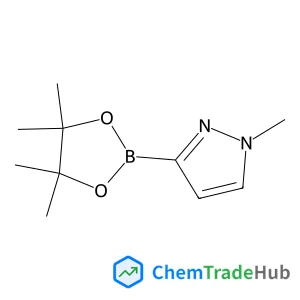
1-Methyl-3-(4,4,5,5-tetramethyl-1,3,2-dioxaborolan-2-yl)-1H-pyrazole
CAS Number:
1020174-04-2
Molecular Formula:
C10H17BN2O2
Sayantanu Koley, Sabyasachi Sen, Snehasish Saha, Swapan Chakrabarti
Herein, we report that borazine (B3N3H6), alternatively known as inorganic benzene, has the tantalizing potential to act as a multifunctional molecular spin diode with a significantly large spin valve action. The present computational foray into the multifunctionality of (B3N3H6)n=1–4 as a simultaneous spin diode and spin valve has been rationalized by the current rectification ratio with a maximum value of 34 for the tetramer and large tunneling magneto-resistance in the range of 50–100%, respectively. Remarkably, both the properties are evolved due to a single parameter, namely, the electrodes [Fe(100)] surface spin orientation induced charge density localization/delocalization in the singly occupied highest molecular orbital in the Fe(100)–(borazine)n=1–4–Fe(100) system.
H. W. Wang, C. L. Li, S. L. Yuan, J. F. Wang, C. L. Lu, J.-M. Liu
DOI: 10.1039/C6CP06369A
Chaozheng Li, Yonggang Yang, Donglin Li, Yufang Liu
DOI: 10.1039/C6CP07716A
Paulo R. Bueno, David A. Miranda
DOI: 10.1039/C6CP02504H
Christel Gervais, Christian Brouder, Nicolas Trcera, Amélie Bordage, Cristina Coelho-Diogo, Pierre Florian, Aydar Rakhmatullin, Lorenzo Paulatto, Michele Lazzeri, Delphine Cabaret
DOI: 10.1039/C6CP08393E
M. Ziatdinov, H. Lim, S. Fujii, K. Kusakabe, M. Kiguchi, T. Enoki, Y. Kim
DOI: 10.1039/C6CP08352H
Hui Li, Wei Chen, Xiaopeng Shen, Jingwei Liu, Xuri Huang, Guangtao Yu
DOI: 10.1039/C6CP06717D
R. Sasai, Y. Kato, W. Soontornchaiyakul, H. Usami, A. Masumori, W. Norimatsu
DOI: 10.1039/C6CP07250J
Natsumi Muramatsu, Naoki Mimura, Osamu Sato
DOI: 10.1039/C6CP06831F
Penghui Li, Fang Wang, Shiqian Wei, Xinyu Li
DOI: 10.1039/C6CP08409E
When handling 4-(2-Furylmethyl)thiomorpholine 1,1-dioxide (CAS: 79206-94-3), it ...
When handling 4-Chloro-N-[2-(4-morpholinyl)ethyl]benzamide (CAS: 71320-77-9), it...
Waste containing this compound (CAS: 62921-74-8) should be handled according to ...
Waste containing (S)-Methyl 2-amino-3-cyclohexylpropanoate should be collected i...
This compound can be synthesized using a multi-step process involving the conjug...
There are several alternatives to (2E)-3-(3,4-Dichlorophenyl)acrylic acid in syn...
Ethyl 6-(2-nitrophenyl)imidazo[2,1-b][1,3]thiazole-3-carboxylate (CAS: 925437-84...
Waste containing 2-(1,3-Thiazol-2-yl)ethanamine (CAS: 18453-07-1) should be coll...
Methyl 5-iodo-2-methylbenzoate can be synthesized through the iodination of meth...
5-Chloro[1,2,4]triazolo[1,5-a]pyridine is commonly synthesized via the condensat...

Physical Chemistry Chemical Physics (PCCP) is an international journal co-owned by 19 physical chemistry and physics societies from around the world. This journal publishes original, cutting-edge research in physical chemistry, chemical physics and biophysical chemistry. To be suitable for publication in PCCP, articles must include significant innovation and/or insight into physical chemistry; this is the most important criterion that reviewers and Editors will judge against when evaluating submissions. The journal has a broad scope and welcomes contributions spanning experiment, theory, computation and data science. Topical coverage includes spectroscopy, dynamics, kinetics, statistical mechanics, thermodynamics, electrochemistry, catalysis, surface science, quantum mechanics, quantum computing and machine learning. Interdisciplinary research areas such as polymers and soft matter, materials, nanoscience, energy, surfaces/interfaces, and biophysical chemistry are welcomed if they demonstrate significant innovation and/or insight into physical chemistry. Joined experimental/theoretical studies are particularly appreciated when complementary and based on up-to-date approaches.


![5-Acetyl-2,3-dihydrobenzo[b]furan structure](https://static.chemtradehub.com/structs/908/90843-31-5-eea4.webp "5-Acetyl-2,3-dihydrobenzo[b]furan structure")




