













A theoretical study of the potential energy surfaces for the double proton transfer reaction of model DNA base pairs
Literature Information
Publication Date
2017-01-17
DOI
10.1039/C6CP07716A
Impact Factor
3.676
Authors
Chaozheng Li, Yonggang Yang, Donglin Li, Yufang Liu
View Original
Abstract
The excited-state double proton transfer (ESDPT) mechanism in a model DNA base pair, 7-azaindole (7AI) dimer, has been debated over the years. Recently, Otero and coworkers concluded that the stepwise mechanism is not possible and the concerted mechanism dominates the dynamics (Chem. Sci., 2015, 6, 5762). In this work, the potential energy surfaces of the 7AI dimer in the ground state (S0) and the lowest energy excited singlet state (S1) were constructed. After vertical excitation to the S1 state, the single proton transfer can occur. The second proton transfer process in the stepwise mechanism is blocked by a high potential barrier (36.4 kcal mol−1), which is consistent with the result proposed by Otero and coworkers. However, the single proton transfer process is compatible with the concerted mechanism and we show that the single proton transfer process rather than the concerted mechanism dominates the dynamics. The concerted process is unfavorable in the S1 state compared with the barrierless single proton transfer process. In addition, the proton transfer process in the S0 state is revealed. The single proton transfer tautomer in the S1 state returns to the S0 state and transfers the second proton via a barrierless process. Finally, the double proton transfer tautomer in the S0 state can recover to the normal dimer through the reverse proton transfer reaction.
Related Literature
Synthesis and characterization of a pH-responsive mesalazine-polynorbornene supramolecular assembly
Vajk Farkas, Gábor Turczel, János Deme, László Trif, Anvar Mirzaei, Dang Vu Hai, Sándor Kéki, Péter Huszthy, Róbert Tuba
2021-03-05
Paper
DOI: 10.1039/D1PY00194A
Poly[glycidyl oligo(oxyethylene)carbamate]s (PGn-EOmR′ and R-PGn-EOmR′): controlled synthesis and effects of molecular parameters (n and m), side groups (R′), and end-groups (R) on thermoresponsive properties
Tingyu He, Yanqiu Wang, Liang Xu, Xiangming Fu, Atsushi Narumi, Shin-ichiro Sato
2021-03-31
Paper
DOI: 10.1039/D1PY00070E
Chemical conjugation of nucleic acid aptamers and synthetic polymers
Maria Nerantzaki, Capucine Loth, Jean-François Lutz
2021-06-07
Minireview
DOI: 10.1039/D1PY00516B
The self-assembly of single chain Janus nanoparticles from azobenzene-containing block copolymers and reversible photoinduced morphology transitions
Wei Wen
2021-03-25
Paper
DOI: 10.1039/D1PY00223F
Hierarchical ordering and multilayer structure of poly(ε-caprolactone) end-functionalized by a liquid crystalline unit: role of polymer crystallization
Wenqing Xu, Xing Li, Wenhua Yuan, Jian Zhou
2021-07-05
Paper
DOI: 10.1039/D1PY00702E
Visible light-degradable supramolecular gels comprising cross-linked polyrotaxanes capped with trithiocarbonate groups
Tae Woong Kang, Atsushi Tamura, Yoshinori Arisaka, Nobuhiko Yui
2021-06-09
Paper
DOI: 10.1039/D1PY00569C
Synthesis, characterization and self-assembly of linear and miktoarm star copolymers of exclusively immiscible polydienes
Ioannis Moutsios, Konstantina Tsitoni, Gkreti-Maria Manesi, Nikos Hadjichristidis
2021-04-12
Paper
DOI: 10.1039/D1PY00258A
Correction: Synthesis and structural characterization of bio-based bis(cyclic carbonate)s for the preparation of non-isocyanate polyurethanes
Kamila Błażek, Hynek Beneš, Zuzana Walterová, Sabina Abbrent, Arantxa Eceiza, Tamara Calvo-Correas, Janusz Datta
2021-03-31
Correction
DOI: 10.1039/D1PY90040D
Biobased polymers derived from itaconic acid bearing clickable groups with potent antibacterial activity and negligible hemolytic activity
A. Funes, R. Cuervo-Rodríguez
2021-05-05
Paper
DOI: 10.1039/D1PY00098E
You might also like
Compound Q&A
What precautions should be taken when handling 4-(2-Furylmethyl)thiomorpholine 1,1-dioxide (CAS: 79206-94-3)?
When handling 4-(2-Furylmethyl)thiomorpholine 1,1-dioxide (CAS: 79206-94-3), it ...
79206-94-34-(2-Furylmethyl)thi...
Compound Q&A
What precautions should be taken when handling 4-Chloro-N-[2-(4-morpholinyl)ethyl]benzamide (CAS: 71320-77-9)?
When handling 4-Chloro-N-[2-(4-morpholinyl)ethyl]benzamide (CAS: 71320-77-9), it...
71320-77-94-Chloro-N-[2-(4-mor...
Compound Q&A
How should waste containing 2-[2-(2-Methoxyethoxy)ethoxy]ethyl 4-methylbenzenesulfonate (CAS: 62921-74-8) be handled?
Waste containing this compound (CAS: 62921-74-8) should be handled according to ...
62921-74-82-[2-(2-Methoxyethox...
Compound Q&A
How should waste containing (S)-Methyl 2-amino-3-cyclohexylpropanoate be handled?
Waste containing (S)-Methyl 2-amino-3-cyclohexylpropanoate should be collected i...
40056-18-6(S)-Methyl 2-amino-3...
Compound Q&A
How is 5-({4-[(2S,4R)-4-Hydroxy-2-methyltetrahydro-2H-pyran-4-yl]-2-thienyl}sulfanyl)-1-methyl-1,3-dihydro-2H-indol-2-one (CAS: 166882-70-8) typically synthesized?
This compound can be synthesized using a multi-step process involving the conjug...
166882-70-85-({4-[(2S,4R)-4-Hyd...
Compound Q&A
Are there alternatives to (2E)-3-(3,4-Dichlorophenyl)acrylic acid (CAS: 7312-27-8) in synthesis?
There are several alternatives to (2E)-3-(3,4-Dichlorophenyl)acrylic acid in syn...
7312-27-8(2E)-3-(3,4-Dichloro...
Compound Q&A
How should Ethyl 6-(2-nitrophenyl)imidazo[2,1-b][1,3]thiazole-3-carboxylate (CAS: 925437-84-9) be stored?
Ethyl 6-(2-nitrophenyl)imidazo[2,1-b][1,3]thiazole-3-carboxylate (CAS: 925437-84...
925437-84-9Ethyl 6-(2-nitrophen...
Compound Q&A
How should waste containing 2-(1,3-Thiazol-2-yl)ethanamine (CAS: 18453-07-1) be handled?
Waste containing 2-(1,3-Thiazol-2-yl)ethanamine (CAS: 18453-07-1) should be coll...
18453-07-12-(1,3-Thiazol-2-yl)...
Compound Q&A
How is Methyl 5-iodo-2-methylbenzoate (CAS: 103440-54-6) typically synthesized?
Methyl 5-iodo-2-methylbenzoate can be synthesized through the iodination of meth...
103440-54-6Methyl 5-iodo-2-meth...
Compound Q&A
How is 5-Chloro[1,2,4]triazolo[1,5-a]pyridine (CAS: 1427399-34-5) typically synthesized?
5-Chloro[1,2,4]triazolo[1,5-a]pyridine is commonly synthesized via the condensat...
1427399-34-55-Chloro[1,2,4]triaz...
Source Journal
Physical Chemistry Chemical Physics

CiteScore:
5.5
Self-citation Rate:
10.3%
Articles per Year:
3036
Physical Chemistry Chemical Physics (PCCP) is an international journal co-owned by 19 physical chemistry and physics societies from around the world. This journal publishes original, cutting-edge research in physical chemistry, chemical physics and biophysical chemistry. To be suitable for publication in PCCP, articles must include significant innovation and/or insight into physical chemistry; this is the most important criterion that reviewers and Editors will judge against when evaluating submissions. The journal has a broad scope and welcomes contributions spanning experiment, theory, computation and data science. Topical coverage includes spectroscopy, dynamics, kinetics, statistical mechanics, thermodynamics, electrochemistry, catalysis, surface science, quantum mechanics, quantum computing and machine learning. Interdisciplinary research areas such as polymers and soft matter, materials, nanoscience, energy, surfaces/interfaces, and biophysical chemistry are welcomed if they demonstrate significant innovation and/or insight into physical chemistry. Joined experimental/theoretical studies are particularly appreciated when complementary and based on up-to-date approaches.
Recommended Compounds
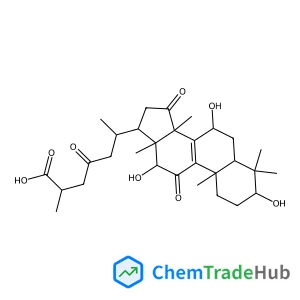
(3beta,7beta,12beta)-3,7,12-Trihydroxy-11,15,23-trioxolanost-8-en-26-oic acid
CAS Number:
98665-22-6
Molecular Formula:
C30H44O8

![1,2-Diphenyl-4-[2-(phenylsulfinyl)ethyl]-3,5-pyrazolidinedione structure](https://static.chemtradehub.com/structs/57-/57-96-5-efcc.webp "1,2-Diphenyl-4-[2-(phenylsulfinyl)ethyl]-3,5-pyrazolidinedione structure")
1,2-Diphenyl-4-[2-(phenylsulfinyl)ethyl]-3,5-pyrazolidinedione
CAS Number:
57-96-5
Molecular Formula:
C23H20N2O3S
Recommended Suppliers






Disclaimer
This page provides academic journal information for reference and research purposes only. We are not affiliated with any journal publishers and do not handle publication submissions. For publication-related inquiries, please contact the respective journal publishers directly.
If you notice any inaccuracies in the information displayed, please contact us at support@chemtradehub.com. We will promptly review and address your concerns.