












![Ethyl thieno[3,2-f]quinoline-2-carboxylate structure](https://static.chemtradehub.com/structs/299/29948-26-3-f62b.webp "Ethyl thieno[3,2-f]quinoline-2-carboxylate structure")
Halogenated earth abundant metalloporphyrins as photostable sensitizers for visible-light-driven water oxidation in a neutral phosphate buffer solution
Literature Information
Publication Date
2016-05-10
DOI
10.1039/C6CP01352J
Impact Factor
3.676
Authors
Hung-Cheng Chen, Joost N. H. Reek, René M. Williams, Albert M. Brouwer
View Original
Abstract
Very photostable tetrachloro-metalloporphyrins were developed as sensitizers for visible-light-driven water oxidation coupled to cobalt based water-oxidation catalysts in concentrated (0.1 M) phosphate buffer solution. Potassium persulfate (K2S2O8) acts as a sacrificial electron acceptor to oxidize the metalloporphyrin photosensitizers in their excited states. The radical cations thus produced drive the cobalt based water-oxidation catalysts: Co4O4-cubane and Co(NO3)2 as pre-catalyst for cobalt-oxide (CoOx) nanoparticles. Two different metalloporphyrins (Cu(II) and Ni(II)) both showed very high photostability in the photocatalytic reaction, as compared to non-halogenated analogues. This indicates that photostability primarily depends on the substitution of the porphyrin macrocycle, not on the central metal. Furthermore, our molecular design strategy not only positively increases the electrochemical potential by 120–140 mV but also extends the absorption spectrum up to ∼600 nm. As a result, the solar photon capturing abilities of halogenated metalloporphyrins (Cu(II) and Ni(II)) are comparable to that of the natural photosynthetic pigment, chlorophyll a. We successfully demonstrate long-term (>3 h) visible-light-driven water oxidation using our molecular system based on earth-abundant (first-row transition) metals in concentrated phosphate buffer solution.
Related Literature
BODIPY-amino acid conjugates – tuning the optical response with a meso-heteroatom
Marco Farinone, Joanna Cybińska, Miłosz Pawlicki
2020-06-15
Research Article
DOI: 10.1039/D0QO00481B
Pictet–Spengler reaction based on in situ generated α-amino iminium ions through the Heyns rearrangement
Guo-bin Yang, Yong-po Zhang, Dong-dong Guo, Jin-zhong Zhao, Guang-xun Li, Zhuo Tang
2020-09-18
Research Article
DOI: 10.1039/D0QO00722F
Telescoped synthesis of C3-functionalized (E)-arylamidines using Ugi–Mumm and regiospecific quinazolinone rearrangements
Victor A. Jaffett, Alok Nerurkar, Xufeng Cao, Ilia A. Guzei
2019-02-07
Paper
DOI: 10.1039/C9OB00073A
The synthesis of cyanoformamides via a CsF-promoted decyanation/oxidation cascade of 2-dialkylamino-malononitriles‡
Lin-Sheng Lei, Cao-Gen Xue, Xue-Tao Xu, Da-Ping Jin, Wen Bao, Huan Liang, Kun Zhang, Abdullah M. Asiri
2019-03-19
Communication
DOI: 10.1039/C9OB00510B
Rhenium-catalyzed alkylarylation of alkenes with PhI(O2CR)2via decarboxylation to access indolinones and dihydroquinolinones
Ping Zhang
2020-09-14
Research Article
DOI: 10.1039/D0QO00953A
Photo-induced preparation of unnatural α-amino acids: synthesis and characterization of novel Leu5-enkephalin analogues
Hongxiang Xue, Mengzhun Guo, Chao Wang, Yuxuan Shen, Rupeng Qi, Yifei Wu, Zhaoqing Xu, Min Chang
2020-07-28
Research Article
DOI: 10.1039/D0QO00696C
Practical copper-catalyzed chloronitration of alkenes with TMSCl and guanidine nitrate
Si-Yuan Li, Zhen-Yu Guan, Jing Xue, Guang-Yi Zhang, Xiao-Yu Guan, Qing-Hai Deng
2020-07-20
Research Article
DOI: 10.1039/D0QO00691B
Copper-catalyzed carbonylative synthesis of pyrrolidine-containing amides from γ,δ-unsaturated aromatic oxime esters
Youcan Zhang, Han-Jun Ai
2020-09-04
Research Article
DOI: 10.1039/D0QO00999G
Diastereoselective construction of the benzannulated spiroketal core of chaetoquadrins enabled by a regiodivergent cascade
Shengxiang Qiu, Hongxin Liu, Haibo Tan
2020-05-26
Research Article
DOI: 10.1039/D0QO00484G
Oxidative oxy-cyclization of 2-alkynylbenzamide enabled by TBAB/Oxone: switchable synthesis of isocoumarin-1-imines and isobenzofuran-1-imine
Guanyinsheng Qiu, Hongwei Zhou, Jin-Biao Liu
2019-04-01
Paper
DOI: 10.1039/C9OB00320G
You might also like
Compound Q&A
Is 2-(2-chloroacetamido)-3-phenylpropanoic acid (CAS: 7765-11-9) safe?
2-(2-Chloroacetamido)-3-phenylpropanoic acid (CAS: 7765-11-9) is generally consi...
7765-11-92-(2-chloroacetamido...
Compound Q&A
Is 2-(Benzyloxy)-5-bromobenzoic acid (CAS: 62176-31-2) safe?
2-(Benzyloxy)-5-bromobenzoic acid can be handled safely if appropriate precautio...
62176-31-22-(Benzyloxy)-5-brom...
Compound Q&A
What is (4-Methyl-1,2,5-oxadiazol-3-yl)methanamine hydrochloride (CAS: 1159825-48-5)?
(4-Methyl-1,2,5-oxadiazol-3-yl)methanamine hydrochloride is a chemical compound ...
1159825-48-5(4-Methyl-1,2,5-oxad...
Compound Q&A
What is 2-(5-Hexylthiophen-2-yl)-4,4,5,5-tetramethyl-1,3,2-dioxaborolane (CAS: 917985-54-7)?
2-(5-Hexylthiophen-2-yl)-4,4,5,5-tetramethyl-1,3,2-dioxaborolane (CAS: 917985-54...
917985-54-72-(5-Hexylthiophen-2...
Compound Q&A
Are there alternatives to 4-(8-Methyl-9H-1,3-dioxolo[4,5-h][2,3]benzodiazepin-5-yl)benzenamine (CAS: 102771-26-6) in synthesis?
While 4-(8-Methyl-9H-1,3-dioxolo[4,5-h][2,3]benzodiazepin-5-yl)benzenamine (CAS:...
102771-26-64-(8-Methyl-9H-1,3-d...
Compound Q&A
What is the market or research trend for tert-butyl 3-hydroxy-4,5,7,8-tetrahydro-2H-pyrazolo[3,4-d]azepine-6-carboxylate (CAS: 851376-80-2)?
The market for tert-butyl 3-hydroxy-4,5,7,8-tetrahydro-2H-pyrazolo[3,4-d]azepine...
851376-80-2tert-butyl 3-hydroxy...
Compound Q&A
How should waste containing 3,5-Diamino-1H-pyrazole-4-carbonitrile (CAS: 6844-58-2) be handled?
Waste containing 3,5-Diamino-1H-pyrazole-4-carbonitrile (CAS: 6844-58-2) should ...
6844-58-23,5-Diamino-1H-pyraz...
Compound Q&A
How is (6-Fluoro-3-pyridinyl)boronic acid (CAS: 351019-18-6) typically synthesized?
(6-Fluoro-3-pyridinyl)boronic acid can be synthesized through the reaction of 6-...
351019-18-6(6-Fluoro-3-pyridiny...
Compound Q&A
What industries use Dibenzyl carbonimidoylbiscarbamate (CAS: 10065-79-9)?
Dibenzyl carbonimidoylbiscarbamate (CAS: 10065-79-9) finds applications in vario...
10065-79-9Dibenzyl carbonimido...
Compound Q&A
What is the market or research trend for (beta,beta,2,3,4,5,6-~2~H_7_)Phenylalanine (CAS: 74228-83-4)?
The market for (beta,beta,2,3,4,5,6-~2~H_7_)Phenylalanine (CAS: 74228-83-4) is g...
74228-83-4(beta,beta,2,3,4,5,6...
Source Journal
Physical Chemistry Chemical Physics

CiteScore:
5.5
Self-citation Rate:
10.3%
Articles per Year:
3036
Physical Chemistry Chemical Physics (PCCP) is an international journal co-owned by 19 physical chemistry and physics societies from around the world. This journal publishes original, cutting-edge research in physical chemistry, chemical physics and biophysical chemistry. To be suitable for publication in PCCP, articles must include significant innovation and/or insight into physical chemistry; this is the most important criterion that reviewers and Editors will judge against when evaluating submissions. The journal has a broad scope and welcomes contributions spanning experiment, theory, computation and data science. Topical coverage includes spectroscopy, dynamics, kinetics, statistical mechanics, thermodynamics, electrochemistry, catalysis, surface science, quantum mechanics, quantum computing and machine learning. Interdisciplinary research areas such as polymers and soft matter, materials, nanoscience, energy, surfaces/interfaces, and biophysical chemistry are welcomed if they demonstrate significant innovation and/or insight into physical chemistry. Joined experimental/theoretical studies are particularly appreciated when complementary and based on up-to-date approaches.
Recommended Compounds
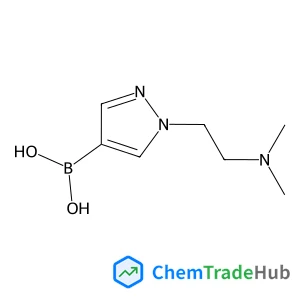
(1-(2-(Dimethylamino)ethyl)-1H-pyrazol-4-yl)boronic acid
CAS Number:
1086063-73-1
Molecular Formula:
C7H14BN3O2
![(1S)-1,5-Anhydro-2-O-alpha-L-arabinopyranosyl-1-[5-hydroxy-7-({6-O-[3-(4-hydroxy-3-methoxyphenyl)propanoyl]-beta-D-glucopyranosyl}oxy)-2-(4-hydroxyphenyl)-4-oxo-4H-chromen-6-yl]-D-glucitol structure](https://static.chemtradehub.com/structs/225/2252345-81-4-bcff.webp "(1S)-1,5-Anhydro-2-O-alpha-L-arabinopyranosyl-1-[5-hydroxy-7-({6-O-[3-(4-hydroxy-3-methoxyphenyl)propanoyl]-beta-D-glucopyranosyl}oxy)-2-(4-hydroxyphenyl)-4-oxo-4H-chromen-6-yl]-D-glucitol structure")
Recommended Suppliers






Disclaimer
This page provides academic journal information for reference and research purposes only. We are not affiliated with any journal publishers and do not handle publication submissions. For publication-related inquiries, please contact the respective journal publishers directly.
If you notice any inaccuracies in the information displayed, please contact us at support@chemtradehub.com. We will promptly review and address your concerns.