












Enhanced enzymatic activity from phosphotriesterase trimer gold nanoparticle bioconjugates for pesticide detection
Literature Information
Publication Date
2017-06-26
DOI
10.1039/C6AN02575G
Impact Factor
4.616
Authors
John A. Hondred, Joyce C. Breger, Nate T. Garland, Scott A. Walper, Igor L. Medintz, Jonathan C. Claussen
View Original
Abstract
The rapid detection of organophosphates (OPs), a class of strong neurotoxins, is critically important for monitoring acute insecticide exposure and potential chemical warfare agent use. Herein, we improve the enzymatic activity of a phosphotriesterase trimer (PTE3), an enzyme that selectively recognizes OPs directly, by conjugation with distinctly sized (i.e., 5, 10, and 20 nm diameter) gold nanoparticles (AuNPs). The number of enzymes immobilized on the AuNP was controlled by conjugating increasing molar ratios of PTE3 onto the AuNP surface via metal affinity coordination. This occurs between the PTE3-His6 termini and the AuNP-displayed Ni2+-nitrilotriacetic acid end groups and was confirmed with gel electrophoresis. The enzymatic efficiency of the resultant PTE3–AuNP bioconjugates was analyzed via enzyme progress curves acquired from two distinct assay formats that compared free unbound PTE3 with the following PTE3–AuNP bioconjugates: (1) fixed concentration of AuNPs while increasing the bioconjugate molar ratio of PTE3 displayed around the AuNP and (2) fixed concentration of PTE3 while increasing the bioconjugate molar ratio of PTE3–AuNP by decreasing the AuNP concentration. Both assay formats monitored the absorbance of p-nitrophenol that was produced as PTE3 hydrolyzed the substrate paraoxon, a commercial insecticide and OP nerve agent simulant. Results demonstrate a general equivalent trend between the two formats. For all experiments, a maximum enzymatic velocity (Vmax) increased by 17-fold over free enzyme for the lowest PTE3–AuNP ratio and the largest AuNP (i.e., ratio of 1 : 1, 20 nm dia. AuNP). This work provides a route to improve enzymatic OP detection strategies with enzyme–NP bioconjugates.
Related Literature
Theoretical study of spodium bonding in the active site of three Zn-proteins and several model systems
Rosa Llull, Gaizca Montalbán, Ivan Vidal, Rosa M. Gomila, Antonio Bauzá, Antonio Frontera
2021-07-13
Paper
DOI: 10.1039/D1CP02150H
Theoretical investigation of the SN2 mechanism of X− [X = SH, PH2] + CH3Y [Y = F, Cl, Br, I] reactions in water
Chen Li, Xin Xin, Dunyou Wang
2021-09-29
Paper
DOI: 10.1039/D1CP03048E
Revisiting the glass transition temperature of water–glycerol mixtures in the bulk and confined in mesoporous silica
Ivette Angarita, Ma. Florencia Mazzobre
2021-07-10
Paper
DOI: 10.1039/D1CP02153B
Superconducting properties of BaBi3 at ambient and high pressures
Yanan Wang, Tomoya Taguchi, Huan Li, Ai Suzuki, Yanting Zhang, Akari Miura, Mitsuki Ikeda, Hidenori Goto, Ritsuko Eguchi, Takafumi Miyazaki, Yen-Fa Liao, Hirofumi Ishii, Yoshihiro Kubozono
2021-09-20
Paper
DOI: 10.1039/D1CP00042J
Structure and thermodynamics of empty clathrate hydrates below the freezing point of water
Fernando J. A. L. Cruz, José P. B. Mota
2021-07-13
Paper
DOI: 10.1039/D1CP00893E
Tunable band gaps and high carrier mobilities in stanene by small organic molecule adsorption under external electric fields
Mei-Xia Xiao, Xiao Shao, Hai-Yang Song, Zhao Li, Min-Rong An, Cheng He
2021-07-01
Paper
DOI: 10.1039/D1CP01582F
Unraveling the computed non-least motion pathway for the homodimerization of superchameleonic isocyanides: the peculiar nonsymmetrical (F–NC)2 reactant complex
Marta Marin-Luna, Mateo Alajarin
2021-07-12
Paper
DOI: 10.1039/D1CP02674G
Investigation of CsPbBr3 CVD dynamics at various temperatures
Chenyang Bao, Xiang Peng, Leiying Ying, Yang Mei, Baoping Zhang, Hao Long
2021-09-28
Paper
DOI: 10.1039/D1CP03794C
Theoretical study of the dissociative photodetachment dynamics of the hydrated superoxide anion cluster
Yu Hashimoto, Kohei Saito, Toshiyuki Takayanagi, Hiroto Tachikawa
2021-07-27
Paper
DOI: 10.1039/D1CP02379A
Reactive force fields for aqueous and interfacial magnesium carbonate formation
Siavash Zare, Mohammad Javad Abdolhosseini Qomi
2021-10-01
Paper
DOI: 10.1039/D1CP02627E
You might also like
Compound Q&A
How is Ethyl 4-chlorothieno[2,3-b]pyridine-5-carboxylate (CAS: 59713-58-5) typically synthesized?
Ethyl 4-chlorothieno[2,3-b]pyridine-5-carboxylate (CAS: 59713-58-5) can be synth...
59713-58-5Ethyl 4-chlorothieno...
Compound Q&A
What regulatory guidelines apply to 5-Methyl-1H-indole-3-carbaldehyde (CAS: 52562-50-2)?
5-Methyl-1H-indole-3-carbaldehyde (CAS: 52562-50-2) is subject to various regula...
52562-50-25-Methyl-1H-indole-3...
Compound Q&A
What are the physical and chemical properties of (1,3-Dimethyl-2,4-dioxo-1,2,3,4-tetrahydro-5-pyrimidinyl)boronic acid (CAS: 223418-73-3)?
(1,3-Dimethyl-2,4-dioxo-1,2,3,4-tetrahydro-5-pyrimidinyl)boronic acid is a white...
223418-73-3(1,3-Dimethyl-2,4-di...
Compound Q&A
How should waste containing Sulfocostunolide A (CAS: 1016983-51-9) be handled?
Waste containing Sulfocostunolide A (CAS: 1016983-51-9) should be handled with c...
1016983-51-9Sulfocostunolide A
Compound Q&A
What precautions should be taken when handling Murraxocin (CAS: 88478-44-8)?
When handling Murraxocin (CAS: 88478-44-8), ensure proper personal protective eq...
88478-44-8Murraxocin
Compound Q&A
What are the physical and chemical properties of Formvar (CAS: 63148-64-1)?
Formvar (CAS: 63148-64-1) is an alkyd resin characterized by a high molecular we...
63148-64-1Formvar(R)
Compound Q&A
Is (S)-4-benzyl-2-((benzyloxy)methyl)morpholine (CAS: 205242-66-6) safe?
(S)-4-benzyl-2-((benzyloxy)methyl)morpholine is generally safe when handled with...
205242-66-6(S)-4-benzyl-2-((ben...
Compound Q&A
What industries use Methyl 1-(5-bromo-2-pyrimidinyl)cyclopropanecarboxylate (CAS: 1447607-69-3)?
Methyl 1-(5-bromo-2-pyrimidinyl)cyclopropanecarboxylate (CAS: 1447607-69-3) is p...
1447607-69-3Methyl 1-(5-bromo-2-...
Compound Q&A
Is 2-Methyl-1-phenyl-1-propanamine hydrochloride (CAS: 24290-47-9) safe?
2-Methyl-1-phenyl-1-propanamine hydrochloride (CAS: 24290-47-9) is generally con...
24290-47-92-Methyl-1-phenyl-1-...
Compound Q&A
How is 3-(4-Bromophenyl)-2-methylpropanoic acid (CAS: 66735-01-1) typically synthesized?
3-(4-Bromophenyl)-2-methylpropanoic acid is synthesized through a multi-step pro...
66735-01-13-(4-Bromophenyl)-2-...
Source Journal
Analyst

CiteScore:
7.8
Self-citation Rate:
5.6%
Articles per Year:
653
Analyst publishes analytical and bioanalytical research that reports premier fundamental discoveries and inventions, and the applications of those discoveries, unconfined by traditional discipline barriers.
Recommended Compounds
![Imidazo[1,5-a]pyrazine structure](https://static.chemtradehub.com/structs/274/274-49-7-d749.webp "Imidazo[1,5-a]pyrazine structure")
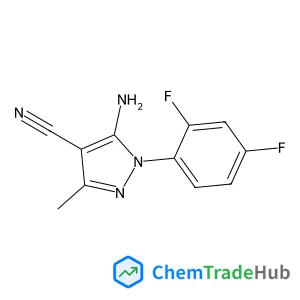
5-Amino-1-(2,4-difluorophenyl)-3-methyl-1H-pyrazole-4-carbonitrile
CAS Number:
1020057-92-4
Molecular Formula:
C11H8F2N4
Recommended Suppliers






Disclaimer
This page provides academic journal information for reference and research purposes only. We are not affiliated with any journal publishers and do not handle publication submissions. For publication-related inquiries, please contact the respective journal publishers directly.
If you notice any inaccuracies in the information displayed, please contact us at support@chemtradehub.com. We will promptly review and address your concerns.