












![5,10-Dihydroindeno[2,1-a]indene structure](https://static.chemtradehub.com/structs/654/6543-29-9-71ca.webp "5,10-Dihydroindeno[2,1-a]indene structure")
Development of a femtosecond time-resolved near-IR multiplex stimulated Raman spectrometer in resonance with transitions in the 900–1550 nm region
Literature Information
Publication Date
2016-06-08
DOI
10.1039/C6AN01051B
Impact Factor
4.616
Authors
Tomohisa Takaya, Koichi Iwata
View Original
Abstract
Charge transfer and charge delocalisation processes play key roles in the functions of large biomolecular systems and organic/inorganic devices. Many of the short-lived transients involved in these processes can be sensitively detected by monitoring their low-energy electronic transitions in the near-IR region. Ultrafast time-resolved near-IR Raman spectroscopy is a promising tool for investigating the structural dynamics of the short-lived transients as well as their electronic dynamics. In this study, we have developed a femtosecond time-resolved near-IR multiplex stimulated Raman spectrometer using the Raman pump pulse at 1190 nm and a broadband probe pulse covering the 900–1550 nm region. Spectral and temporal instrument responses of the spectrometer are estimated to be 5 cm−1 and 120 fs, respectively. Time-resolved near-IR stimulated Raman spectra of poly(3-dodecylthiophene) (P3DDT) are recorded in toluene solution for investigating its structural changes following the photoexcitation. The spectra strongly indicate conformational changes of P3DDT in excited states associated with the elongation of its effective conjugation length. The results on P3DDT fully demonstrate the effectiveness of the newly developed femtosecond time-resolved near-IR stimulated Raman spectrometer.
Related Literature
Enriching 2D transition metal borides via MB XMenes (M = Fe, Co, Ir): Strong correlation and magnetism
Jiawei Tang, Duo Wang, Jing Zhang, Litao Sun, Baisheng Sa, Bobby G. Sumpter, Jingsong Huang, Weiwei Sun
2023-11-14
Communication
DOI: 10.1039/D3NH00364G
SiO2 supported Ce–Co mixed oxide catalyzed selective allylic oxidation of cyclohexene
Aratikumari Suresh Prasad
2023-12-20
Paper
DOI: 10.1039/D3NJ04852G
Boosting the in-plane thermal conductivity of nanofibrillated cellulose films: alignment engineering of cross-linked AlN whiskers
Mengyang Niu, Zheng Zhao, Baokai Wang, Chang Yu, Mengyi Li, Jiajun Hu, Lifeng Zhu, Xu Hao, Shiqin Wan, Ming Yue, Weiwei Xuan, Qipeng Lu, Wenbin Cao, Kexin Chen, Qi Wang
2023-10-04
Paper
DOI: 10.1039/D3TA04770A
Porous Ga0.25Li6.25La3Zr2O12 frameworks by gelcasting–reaction sintering for high-performance hybrid quasi-solid lithium metal batteries
Ying Zhou, Ying Tian, Wen Wang, Yu Zhou
2023-09-29
Paper
DOI: 10.1039/D3TA04638A
Tumor microenvironment-responsive degradable silica nanoparticles: design principles and precision theranostic applications
Kaiyuan Tang, Zilu Liu, Zhijing Zhang, Shufan Duan, Hui Wang, Hui Yang, Dongliang Yang, Wenpei Fan
2023-11-29
Review Article
DOI: 10.1039/D3NH00388D
Enhanced catalytic performance of Co3O4/Eu2O3 with sulfur-modification in activating peroxymonosulfate for removal of methylene blue
Haili Shen, Ying Wei, Qiang Xia, Jun Shen
2024-01-09
Paper
DOI: 10.1039/D3NJ02953K
Phonon vortices at heavy impurities in two-dimensional materials
De-Liang Bao, Mingquan Xu, Ao-Wen Li, Wu Zhou
2023-12-07
Communication
DOI: 10.1039/D3NH00433C
Multistate switching of scanning tunnelling microscopy machined polyoxovanadate–dysprosium–phthalocyanine nanopatterns on graphite
Marco Moors, Irina Werner, Jens Bauer, Jonas Lorenz, Kirill Yu. Monakhov
2023-12-12
Communication
DOI: 10.1039/D3NH00345K
Defect engineering enhances plasmonic-hot electrons exploitation for CO2 reduction over polymeric catalysts
Zhehao Sun, Kaili Liu, Ary Anggara Wibowo, Julien Langley, Chao Zhang, Sandra E. Saji, Felipe Kremer, Dmitri Golberg, Hieu T. Nguyen, Nicholas Cox
2023-09-05
Communication
DOI: 10.1039/D3NH00348E
Strategy for enhancement of magnesium ion diffusion in a vanadium tetra sulfide-layered structure for rechargeable magnesium batteries
Muhammad Kashif Naseem, Mian Azmat, Changliang Du, Rong Jiang, Hajra, Youqi Zhu, Meishuai Zou, Chuanbao Cao
2023-10-25
Paper
DOI: 10.1039/D3TA04634F
You might also like
Compound Q&A
What precautions should be taken when handling lithium chloride hydrate (1:1:1) (CAS: 16712-20-2)?
When handling lithium chloride hydrate (1:1:1) (CAS: 16712-20-2), it is importan...
16712-20-2Lithium chloride hyd...
Compound Q&A
Is 4-(4H-1,2,4-Triazol-4-yl)piperidine (CAS: 690261-92-8) safe?
4-(4H-1,2,4-Triazol-4-yl)piperidine is generally considered safe for use in phar...
690261-92-84-(4H-1,2,4-Triazol-...
Compound Q&A
How should waste containing 1,3-Thiazole-2-carboxamide (CAS: 16733-85-0) be handled?
Waste containing 1,3-Thiazole-2-carboxamide (CAS: 16733-85-0) should be collecte...
16733-85-01,3-Thiazole-2-carbo...
Compound Q&A
What regulatory guidelines apply to 5-(Difluoromethyl)-2-fluorobenzonitrile (CAS: 934175-58-3)?
5-(Difluoromethyl)-2-fluorobenzonitrile (CAS: 934175-58-3) is subject to regulat...
934175-58-35-(Difluoromethyl)-2...
Compound Q&A
How is Methyl 3-acetamido-2-thiophenecarboxylate (CAS: 22288-79-5) typically synthesized?
Methyl 3-acetamido-2-thiophenecarboxylate can be synthesized by the reaction of ...
22288-79-5Methyl 3-acetamido-2...
Compound Q&A
What is 4-Isoquinolinecarbonitrile (CAS: 34846-65-6)?
4-Isoquinolinecarbonitrile is a chemical compound with the CAS number 34846-65-6...
34846-65-64-Isoquinolinecarbon...
Compound Q&A
How should Methyl 1H-1,2,3-triazole-4-carboxylate (CAS: 877309-59-6) be stored?
Store Methyl 1H-1,2,3-triazole-4-carboxylate (CAS: 877309-59-6) in a cool, dry p...
877309-59-6Methyl 1H-1,2,3-tria...
Compound Q&A
What regulatory guidelines apply to 6-Bromo[1,3]thiazolo[5,4-b]pyridin-2-amine (CAS: 1160791-13-8)?
6-Bromo[1,3]thiazolo[5,4-b]pyridin-2-amine (CAS: 1160791-13-8) is subject to the...
1160791-13-86-Bromo[1,3]thiazolo...
Compound Q&A
Is (2S,3S)-2-Ammonio-3-(3,4-dihydroxyphenyl)-3-hydroxypropanoate (CAS: 23651-95-8) safe?
(2S,3S)-2-Ammonio-3-(3,4-dihydroxyphenyl)-3-hydroxypropanoate (CAS: 23651-95-8) ...
23651-95-8(2S,3S)-2-Ammonio-3-...
Compound Q&A
What are the physical and chemical properties of 7-bromo-3-methyl-3,4-dihydroquinazolin-4-one (CAS: 1293987-84-4)?
7-Bromo-3-methyl-3,4-dihydroquinazolin-4-one is a solid with a crystalline form....
1293987-84-47-bromo-3-methyl-3,4...
Source Journal
Analyst

CiteScore:
7.8
Self-citation Rate:
5.6%
Articles per Year:
653
Analyst publishes analytical and bioanalytical research that reports premier fundamental discoveries and inventions, and the applications of those discoveries, unconfined by traditional discipline barriers.
Recommended Compounds
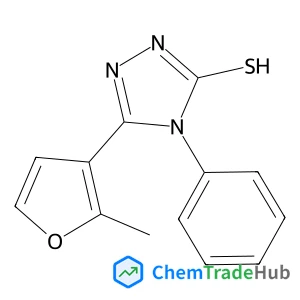
5-(2-Methyl-3-furyl)-4-phenyl-2,4-dihydro-3H-1,2,4-triazole-3-thione
CAS Number:
346464-59-3
Molecular Formula:
C13H11N3OS
Recommended Suppliers






Disclaimer
This page provides academic journal information for reference and research purposes only. We are not affiliated with any journal publishers and do not handle publication submissions. For publication-related inquiries, please contact the respective journal publishers directly.
If you notice any inaccuracies in the information displayed, please contact us at support@chemtradehub.com. We will promptly review and address your concerns.