













TEMP and copper cocatalyzed oxygenation of ketones with molecular oxygen: chemoselective synthesis of α-ketoesters
Literature Information
Publication Date
2015-02-11
DOI
10.1039/C5QO00028A
Impact Factor
5.281
Authors
Xiaoqiang Huang, Xinwei Li, Miancheng Zou, Jun Pan
View Original
Abstract
A novel and practical method for the synthesis of α-ketoesters through TEMP and copper cocatalyzed chemoselective oxidative coupling of commercially available methyl ketones with alcohols is developed. Mild conditions and broad substrate scope make this chemistry an efficient tool for the late-stage modification of bioactive compounds. Detailed mechanistic studies demonstrate a novel mechanism involving an organocatalytic cycle and SET process. The oxygenation process with molecular oxygen enables this transformation.
Recommended Journals
Related Literature
Multilevel simultaneous component analysis for fault detection in multicampaign process monitoring: application to on-line high performance liquid chromatography of a continuous process
Diana L. S. Ferreira, Sila Kittiwachana, Louise A. Fido, Duncan R. Thompson, Richard E. A. Escott, Richard G. Brereton
2009-06-17
Paper
DOI: 10.1039/B905285B
Establishing SI traceability for measurements of mercury vapour
Andrew S. Brown, Richard J. C. Brown, Warren T. Corns, Peter B. Stockwell
2008-04-30
Paper
DOI: 10.1039/B803724H
Factors influencing the discrimination and classification of prostate cancer cell lines by FTIR microspectroscopy
T. J. Harvey, E. Gazi, A. Henderson, R. D. Snook, N. W. Clarke, M. Brown, P. Gardner
2009-04-17
Paper
DOI: 10.1039/B903249E
UV-LED photopolymerised monoliths
Silvija Abele, Fu-Qiang Nie, František Foret, Brett Paull, Mirek Macka
2008-04-17
Communication
DOI: 10.1039/B802693A
Electrochemical characterisation and anodic stripping voltammetry at mesoporous platinum rotating disc electrodes
Pablo Lozano-Sanchez, Joanne M. Elliott
2007-12-11
Paper
DOI: 10.1039/B713037F
Label-free flow-enhanced specific detection ofBacillus anthracis using a piezoelectric microcantilever sensor
John-Paul McGovern, Wan Y. Shih, Richard Rest, Mitali Purohit, Yognandan Pandya, Wei-Heng Shih
2008-02-29
Paper
DOI: 10.1039/B715948J
Turn-on fluorescent cyanide sensor based on copper ion-modified CdTe quantum dots
Li Shang, Lihua Zhang, Shaojun Dong
2008-10-20
Paper
DOI: 10.1039/B812458B
Surface confinement and its effects on the luminescence quenching of a ruthenium-containing metallopolymer
Lynn Dennany, Tia E. Keyes, Robert J. Forster
2008-03-04
Paper
DOI: 10.1039/B718505G
You might also like
Compound Q&A
Is 2-(2-chloroacetamido)-3-phenylpropanoic acid (CAS: 7765-11-9) safe?
2-(2-Chloroacetamido)-3-phenylpropanoic acid (CAS: 7765-11-9) is generally consi...
7765-11-92-(2-chloroacetamido...
Compound Q&A
Is 2-(Benzyloxy)-5-bromobenzoic acid (CAS: 62176-31-2) safe?
2-(Benzyloxy)-5-bromobenzoic acid can be handled safely if appropriate precautio...
62176-31-22-(Benzyloxy)-5-brom...
Compound Q&A
What is (4-Methyl-1,2,5-oxadiazol-3-yl)methanamine hydrochloride (CAS: 1159825-48-5)?
(4-Methyl-1,2,5-oxadiazol-3-yl)methanamine hydrochloride is a chemical compound ...
1159825-48-5(4-Methyl-1,2,5-oxad...
Compound Q&A
What is 2-(5-Hexylthiophen-2-yl)-4,4,5,5-tetramethyl-1,3,2-dioxaborolane (CAS: 917985-54-7)?
2-(5-Hexylthiophen-2-yl)-4,4,5,5-tetramethyl-1,3,2-dioxaborolane (CAS: 917985-54...
917985-54-72-(5-Hexylthiophen-2...
Compound Q&A
Are there alternatives to 4-(8-Methyl-9H-1,3-dioxolo[4,5-h][2,3]benzodiazepin-5-yl)benzenamine (CAS: 102771-26-6) in synthesis?
While 4-(8-Methyl-9H-1,3-dioxolo[4,5-h][2,3]benzodiazepin-5-yl)benzenamine (CAS:...
102771-26-64-(8-Methyl-9H-1,3-d...
Compound Q&A
What is the market or research trend for tert-butyl 3-hydroxy-4,5,7,8-tetrahydro-2H-pyrazolo[3,4-d]azepine-6-carboxylate (CAS: 851376-80-2)?
The market for tert-butyl 3-hydroxy-4,5,7,8-tetrahydro-2H-pyrazolo[3,4-d]azepine...
851376-80-2tert-butyl 3-hydroxy...
Compound Q&A
How should waste containing 3,5-Diamino-1H-pyrazole-4-carbonitrile (CAS: 6844-58-2) be handled?
Waste containing 3,5-Diamino-1H-pyrazole-4-carbonitrile (CAS: 6844-58-2) should ...
6844-58-23,5-Diamino-1H-pyraz...
Compound Q&A
How is (6-Fluoro-3-pyridinyl)boronic acid (CAS: 351019-18-6) typically synthesized?
(6-Fluoro-3-pyridinyl)boronic acid can be synthesized through the reaction of 6-...
351019-18-6(6-Fluoro-3-pyridiny...
Compound Q&A
What industries use Dibenzyl carbonimidoylbiscarbamate (CAS: 10065-79-9)?
Dibenzyl carbonimidoylbiscarbamate (CAS: 10065-79-9) finds applications in vario...
10065-79-9Dibenzyl carbonimido...
Compound Q&A
What is the market or research trend for (beta,beta,2,3,4,5,6-~2~H_7_)Phenylalanine (CAS: 74228-83-4)?
The market for (beta,beta,2,3,4,5,6-~2~H_7_)Phenylalanine (CAS: 74228-83-4) is g...
74228-83-4(beta,beta,2,3,4,5,6...
Source Journal
Organic Chemistry Frontiers

CiteScore:
7.8
Self-citation Rate:
8.7%
Articles per Year:
724
Organic Chemistry Frontiers publishes high-quality research from across organic chemistry. Emphases are placed on studies that make significant contributions to the field of organic chemistry by reporting either new or significantly improved protocols or methodologies. Topics include, but are not limited to the following: Organic synthesis Development of synthetic methodologies Catalysis Natural products Functional organic materials Supramolecular and macromolecular chemistry Physical and computational organic chemistry
Recommended Compounds
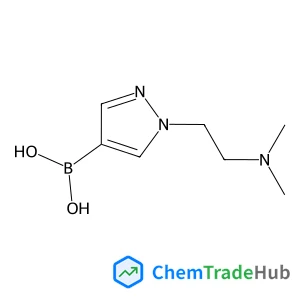
(1-(2-(Dimethylamino)ethyl)-1H-pyrazol-4-yl)boronic acid
CAS Number:
1086063-73-1
Molecular Formula:
C7H14BN3O2
![19-[Chloro(dideuterio)methyl]-19-deuterio-20,20-dideuteriooxyoctatriacontane-18,21-dione structure](https://static.chemtradehub.com/structs/124/1246818-85-8-6244.webp "19-[Chloro(dideuterio)methyl]-19-deuterio-20,20-dideuteriooxyoctatriacontane-18,21-dione structure")
19-[Chloro(dideuterio)methyl]-19-deuterio-20,20-dideuteriooxyoctatriacontane-18,21-dione
CAS Number:
1246818-85-8
Molecular Formula:
C39H75ClO4
Recommended Suppliers



Disclaimer
This page provides academic journal information for reference and research purposes only. We are not affiliated with any journal publishers and do not handle publication submissions. For publication-related inquiries, please contact the respective journal publishers directly.
If you notice any inaccuracies in the information displayed, please contact us at support@chemtradehub.com. We will promptly review and address your concerns.