












Poly(ester amide)s with pendant azobenzenes: multi-responsive self-immolative moieties for modulating polymer assemblies
Literature Information
Publication Date
2016-01-08
DOI
10.1039/C5PY01824B
Impact Factor
5.582
Authors
Andrew D. Wong, Alexander L. Prinzen
View Original
Abstract
Azobenzenes are well-known for their trans–cis photoisomerization, but it was recently demonstrated that azobenzene derivatives could also undergo reduction to trigger a 1,6-elimination and initiate depolymerization of a self-immolative polymer. Herein we explore the optimization of azobenzenes as reduction-sensitive moieties, and their incorporation into functional materials. A library of azobenzenes with electron-withdrawing groups was synthesized, and their rates of reduction by hydrazine were determined. Unexpectedly, a 2-Cl substituent increased the rate of reduction more than other electronegative or sterically-demanding substituents. Next, a new diester monomer containing the 2-Cl-azobenzene was synthesized and incorporated into a poly(ester amide) (PEA) backbone, which was then functionalized with PEO to afford an amphiphilic multi-responsive material. The photo- and reduction-sensitivity of the azobenzenes was then exploited to produce reversible and irreversible changes to the polymer nanoassemblies in water. Their responsiveness to light and/or hydrazine was studied by ultraviolet-visible (UV-Vis) spectroscopy, dynamic light scattering (DLS), and fluorescence spectroscopy of encapsulated nile red. Alternating irradiation with UV and visible light resulted in reversible trans–cis isomerization, which changed the polarity of the micelle core without disrupting the assemblies. Reduction by hydrazine resulted in the release of nile red from the micelle core, while residual assemblies were still detected by DLS, likely due to the presence of remaining hydrophobes. A combination of UV light and hydrazine resulted in the release of nile red and breakdown of the assemblies. These results suggest that the intrinsic responsiveness of azobenzene to both light and reductive stimuli can provide polymer assemblies that respond to one or more stimuli in unique and synergistic ways through a single multi-responsive unit.
Related Literature
Metal-free electrochemical synthesis of α-ketoamides via decarboxylative coupling of α-keto acids with isocyanides and water
Feng Zhao, Na Meng, Ting Sun, Jiangwei Wen, Xiaohui Zhao
2021-10-26
Research Article
DOI: 10.1039/D1QO01351C
Asymmetric organocatalytic synthesis of chiral 3,3-disubstituted oxindoles via a 1,6-conjugate addition reaction
Abdul Rahman, Qiaoxia Zhou, Xufeng Lin
2018-06-28
Paper
DOI: 10.1039/C8OB01169A
Switchable hydroxysulfonyloxylation and defluorination–decarboxylation sulfonylation of gem-difluoroalkenes with sodium sulfinate via aerobic oxidation
Xiang Liu, Jiatong Lin, Canzhan Zhuang, Jinling Zhong, Dan Song, Jiaji Zhao, Hua Cao
2021-09-03
Research Article
DOI: 10.1039/D1QO01005K
Peripheral cyclic β-amino acids balance the stability and edge-protection of β-sandwiches
Anasztázia Hetényi, Edit Wéber, Titanilla Szögi, Lívia Fülöp
2018-07-16
Paper
DOI: 10.1039/C8OB01322E
Phenolate anion-catalyzed direct activation of inert alkyl chlorides driven by visible light
Delian Wei, Xipan Li, Lei Shen, Yuzhen Ding, Kangjiang Liang, Chengfeng Xia
2021-09-17
Research Article
DOI: 10.1039/D1QO01128F
Synthesis of N-acylbenzimidazoles through [4 + 1] annulation of N-arylpivalimidamides with dioxazolones
Xia Song, Xinyuan Cai, Xinying Zhang, Xuesen Fan
2021-09-14
Research Article
DOI: 10.1039/D1QO01137E
Computational study of the mechanism of amide bond formation via CS2-releasing 1,3-acyl transfer
Yuan-Ye Jiang, Tian-Tian Liu, Xue Sun, Zhong-Yan Xu, Xia Fan, Ling Zhu, Siwei Bi
2018-07-25
Paper
DOI: 10.1039/C8OB01338A
Dibenzofuran-4,6-bis(oxazoline) (DBFOX). A novel trans-chelating bis(oxazoline) ligand for asymmetric reactions
Kennosuke Itoh, Mukund P. Sibi
2018-06-18
Review Article
DOI: 10.1039/C8OB01010B
Biomimetic total syntheses of chromane meroterpenoids, guadials B and C, guapsidial A and psiguajadial D
Dattatraya H. Dethe, Vijay Kumar B., Rakesh Maiti
2018-06-15
Communication
DOI: 10.1039/C8OB01092G
Grob-type fragmentation of an oxonium ylide generated from α-imino rhodium carbene
Tao Chen, Zhenxing Yan, Shengguo Duan, Ze-Feng Xu, Chuan-Ying Li
2021-09-19
Research Article
DOI: 10.1039/D1QO01226F
You might also like
Compound Q&A
What are the main uses of 4-Nitrophenyl phosphate disodium salt hexahydrate (CAS: 333338-18-4)?
4-Nitrophenyl phosphate disodium salt hexahydrate is primarily used as a substra...
333338-18-44-Nitrophenyl phosph...
Compound Q&A
What are the main uses of 2-(Trifluoromethyl)-1,3-oxazole-4-carboxylic Acid (CAS: 1060816-01-4)?
2-(Trifluoromethyl)-1,3-oxazole-4-carboxylic Acid (CAS: 1060816-01-4) is widely ...
1060816-01-42-(Trifluoromethyl)-...
Compound Q&A
How should 2-Fluoro-4-biphenylcarboxylic acid (CAS: 137045-30-8) be stored?
2-Fluoro-4-biphenylcarboxylic acid should be stored in a cool, dry place at room...
137045-30-82-Fluoro-4-biphenylc...
Compound Q&A
What industries use Prednisolone-21-Carboxylic Acid (CAS: 61549-70-0)?
Prednisolone-21-Carboxylic Acid is primarily used in the pharmaceutical industry...
61549-70-0Prednisolone-21-Carb...
Compound Q&A
How should 4-(Hydrazinomethyl)-1,2,3-benzenetriol (CAS: 3614-72-0) be stored?
4-(Hydrazinomethyl)-1,2,3-benzenetriol (CAS: 3614-72-0) should be stored in a co...
3614-72-04-(Hydrazinomethyl)-...
Compound Q&A
What industries use 4-Amino-1-methyl-1H-pyrazole-5-carboxylic acid hydrochloride (CAS: 92534-70-8)?
4-Amino-1-methyl-1H-pyrazole-5-carboxylic acid hydrochloride (CAS: 92534-70-8) i...
92534-70-84-Amino-1-methyl-1H-...
Compound Q&A
What regulatory guidelines apply to dehydropachymic acid (CAS: 77012-31-8)?
Dehydropachymic acid (CAS: 77012-31-8) is regulated by various agencies. It fall...
77012-31-8Dehydropachymic acid
Compound Q&A
What is the market or research trend for 6-[(2,2-Dimethylpropanoyl)amino]nicotinic acid (CAS: 898561-66-5)?
The market and research trends for 6-[(2,2-Dimethylpropanoyl)amino]nicotinic aci...
898561-66-56-[(2,2-Dimethylprop...
Compound Q&A
How should 1,10-Phenanthroline-2,9-dicarbaldehyde (CAS: 57709-62-3) be stored?
1,10-Phenanthroline-2,9-dicarbaldehyde should be stored in a cool, dry place awa...
57709-62-31,10-Phenanthroline-...
Compound Q&A
How is 5-Carbamoyl-11-oxo-10,11-dihydro-5H-dibenzo[b,f]azepin-10-yl acetate (CAS: 113952-21-9) typically synthesized?
5-Carbamoyl-11-oxo-10,11-dihydro-5H-dibenzo[b,f]azepin-10-yl acetate can be synt...
113952-21-95-Carbamoyl-11-oxo-1...
Source Journal
Polymer Chemistry

CiteScore:
8.6
Self-citation Rate:
7.3%
Articles per Year:
457
Polymer Chemistry welcomes submissions in all areas of polymer science that have a strong focus on macromolecular chemistry. Manuscripts may cover a broad range of fields, yet no direct application focus is required.
Recommended Compounds

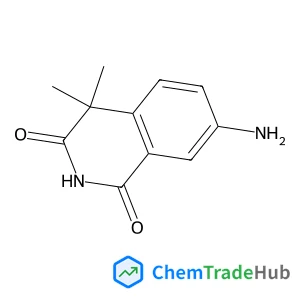
1,3(2H,4H)-Isoquinolinedione, 7-amino-4,4-dimethyl-
CAS Number:
14576-22-8
Molecular Formula:
C11H12N2O2
Recommended Suppliers



Disclaimer
This page provides academic journal information for reference and research purposes only. We are not affiliated with any journal publishers and do not handle publication submissions. For publication-related inquiries, please contact the respective journal publishers directly.
If you notice any inaccuracies in the information displayed, please contact us at support@chemtradehub.com. We will promptly review and address your concerns.