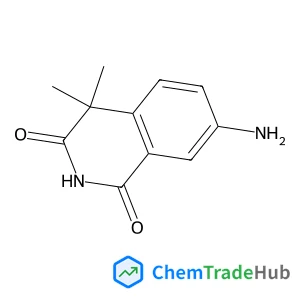
1,3(2H,4H)-Isoquinolinedione, 7-amino-4,4-dimethyl-
CAS Number:
14576-22-8
Molecular Formula:
C11H12N2O2
Hairong Wang, Jinlin He, Dongling Cao, Mingzu Zhang, Fei Li, Kam Chiu Tam, Peihong Ni
In this study, three PEGylated doxorubicin (DOX) prodrugs with acid-labile acetal and carbamate linkages have been prepared via the combination of Cu(I)-catalyzed Huisgen 1,3-dipolar cycloaddition of alkyne and azide (CuAAC) “click” reaction and ammonolysis reaction. The chemical structures of the prodrugs and the drug contents were characterized by 1H NMR, FT-IR and HPLC analyses. To avoid some side effects caused by the acidic degradation products from conventional hydrophobic polymers, DOX was directly linked to the PEG chain. These prodrugs could self-assemble into micelles in aqueous solution with DOX as the core and PEG chains as the corona. The dissociation of prodrug micelles was confirmed by monitoring the size change as a function of time through DLS analysis. Compared with free DOX, the pH-triggered DOX release of prodrugs exhibited a well-controlled and faster release behavior at pH 5.0 than at pH 7.4. In vitro cytotoxicity tests against HeLa cells by MTT assay demonstrated that these prodrugs displayed the desirable antitumor activity. The intracellular drug release was observed by a live cell imaging system at different DOX dosages. This work provides a strategy for the preparation of a new type of pH-cleavable and water-soluble antitumor prodrug for cancer chemotherapy.
Xianzhen Feng, Xinyu Zhuang, Grace Lui, I-Ming Hsing
DOI: 10.1039/D3AN00058C
Kristýna Dobšíková, Pavel Michal, Dita Spálovská, Josef Kapitán, Vladimír Setnička
DOI: 10.1039/D2AN02014A
Yong Du, Jochem Struppe, Barbara Perrone, Alia Hassan, Anna Codina, Yongchao Su
DOI: 10.1039/D2AN01903E
Nicolas Maïno, Arnaud Bertsch, Philippe Renaud
DOI: 10.1039/D2AN01779B
Jiawen Wu, Yeyu Wu, Rongxian Ma, Yuyi Zhou, Jinyue Shi, Mingxiang Li, Xuecai Tan, Kejing Huang
DOI: 10.1039/D3AN00146F
Diana Alves, Jitraporn Vongsvivut, Rosemary L. Sparrow, Bayden R. Wood, Gil Garnier
DOI: 10.1039/D2AN02001G
Rongxian Ma, Jiaxuan Jiang, Yanfei Ya, Yu Lin, Yuyi Zhou, Yeyu Wu, Xuecai Tan, KeJing Huang, Fangkai Du, Jingjuan Xu
DOI: 10.1039/D3AN00024A
Jiandan Chen, Hongying Liu, Chenwei Wang, Kai Fan, Lihua Li, Yuqing Zhang, Lu Fang, Zheng-Zhi Yin, Zhong Lü
DOI: 10.1039/D3AN00373F
Yongliang Dong, Jiali Zhai, Ziwei Zhang, Can Peng, Yunjing Zhang, Zipin Zhang
DOI: 10.1039/D2AN01859D
4-Nitrophenyl phosphate disodium salt hexahydrate is primarily used as a substra...
2-(Trifluoromethyl)-1,3-oxazole-4-carboxylic Acid (CAS: 1060816-01-4) is widely ...
2-Fluoro-4-biphenylcarboxylic acid should be stored in a cool, dry place at room...
Prednisolone-21-Carboxylic Acid is primarily used in the pharmaceutical industry...
4-(Hydrazinomethyl)-1,2,3-benzenetriol (CAS: 3614-72-0) should be stored in a co...
4-Amino-1-methyl-1H-pyrazole-5-carboxylic acid hydrochloride (CAS: 92534-70-8) i...
Dehydropachymic acid (CAS: 77012-31-8) is regulated by various agencies. It fall...
The market and research trends for 6-[(2,2-Dimethylpropanoyl)amino]nicotinic aci...
1,10-Phenanthroline-2,9-dicarbaldehyde should be stored in a cool, dry place awa...
5-Carbamoyl-11-oxo-10,11-dihydro-5H-dibenzo[b,f]azepin-10-yl acetate can be synt...

Polymer Chemistry welcomes submissions in all areas of polymer science that have a strong focus on macromolecular chemistry. Manuscripts may cover a broad range of fields, yet no direct application focus is required.
![S-[2,3-Bis(palmitoyloxy)propyl]-N-[(9H-fluoren-9-ylmethoxy)(hydroxy)methylene]cysteine structure](https://static.chemtradehub.com/structs/210/210532-98-2-f6a7.webp "S-[2,3-Bis(palmitoyloxy)propyl]-N-[(9H-fluoren-9-ylmethoxy)(hydroxy)methylene]cysteine structure")