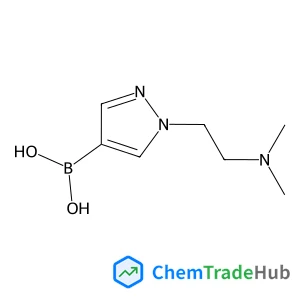
(1-(2-(Dimethylamino)ethyl)-1H-pyrazol-4-yl)boronic acid
CAS Number:
1086063-73-1
Molecular Formula:
C7H14BN3O2
Isabelle Bergonzi, Lionel Mercury, Patrick Simon, Frédéric Jamme, Kirill Shmulovich
Water–solid interactions at the macroscopic level (beyond tens of nanometers) are often viewed as the coexistence of two bulk phases with a sharp interface in many areas spanning from biology to (geo)chemistry and various technological fields (membranes, microfluidics, coatings, etc.). Here we present experimental evidence indicating that such a view may be a significant oversimplification. High-resolution infrared and Raman experiments were performed in a 60 × 20 μm2 quartz cavity, synthetically created and initially filled with demineralized water. The IR mapping (3 × 3 μm2 beam size) performed using the SOLEIL synchrotron radiation source displays two important features: (i) the presence of a dangling free-OH component, a signature of hydrophobic inner walls; (ii) a shift of the OH-stretching band which essentially makes the 3200 cm−1 sub-band predominate over the usual main component at around 3400 cm−1. Raman maps confirmed these signatures (though less marked than IR's) and afforded a refined spatial distribution of this interfacial signal. This spatial resolution, statistically treated, results in a puzzling image of a 1–3 μm thick marked-liquid layer along the entire liquid–solid interface. The common view is then challenged by this strong evidence that a μm-thick layer analogous to an interphase forms at the solid–liquid interface. The thermodynamic counterpart of the vibrational shifts amounts to around +1 kJ mol−1 at the interface with a rapidly decreasing signature towards the cavity centre, meaning that vicinal water may form a reactive layer, of micrometer thickness, expected to have an elevated melting point, a depressed boiling temperature, and enhanced solvent properties.

Journal of Chemical Sciences

Polycyclic Aromatic Compounds

Bioorganic & Medicinal Chemistry Letters

Journal of the Indian Institute of Science

Herald of the Russian Academy of Sciences

Critical Reviews in Solid State and Materials Sciences

Chinese Journal of Chemistry

Biocatalysis and Biotransformation

Main Group Chemistry

Electroanalysis
Kostiantyn O. Marichev, Michael P. Doyle
DOI: 10.1039/C9OB00478E
Changjiang Yu, Xingxing Ma, Qiuling Song
DOI: 10.1039/D0QO00775G
Rafea Naffa
DOI: 10.1039/D0QO00624F
Vijay Natarajan, Natesan Thirumalaivasan, Shu-Pao Wu, Velmathi Sivan
DOI: 10.1039/C9OB00143C
Muriel Albalat, Gérard Audran, Maxence Holzritter, Sylvain R. A. Marque, Nicolas Vanthuyne, Pierre Voisin
DOI: 10.1039/D0QO00559B
Yue Hou, Zhenhua Gao, Yong Sheng Zhao, Yongli Yan
DOI: 10.1039/D0QO00613K
Rajesh Kumar, Xiaofeng Zhang
DOI: 10.1039/D0QO00911C
Yan-Liang Lin, Yun-Ta Lee, Yi-Ting Huang
DOI: 10.1039/D0QO00858C
Hongxiang Xue, Mengzhun Guo, Chao Wang, Yuxuan Shen, Rupeng Qi, Yifei Wu, Zhaoqing Xu, Min Chang
DOI: 10.1039/D0QO00696C
2-(2-Chloroacetamido)-3-phenylpropanoic acid (CAS: 7765-11-9) is generally consi...
2-(Benzyloxy)-5-bromobenzoic acid can be handled safely if appropriate precautio...
(4-Methyl-1,2,5-oxadiazol-3-yl)methanamine hydrochloride is a chemical compound ...
2-(5-Hexylthiophen-2-yl)-4,4,5,5-tetramethyl-1,3,2-dioxaborolane (CAS: 917985-54...
While 4-(8-Methyl-9H-1,3-dioxolo[4,5-h][2,3]benzodiazepin-5-yl)benzenamine (CAS:...
The market for tert-butyl 3-hydroxy-4,5,7,8-tetrahydro-2H-pyrazolo[3,4-d]azepine...
Waste containing 3,5-Diamino-1H-pyrazole-4-carbonitrile (CAS: 6844-58-2) should ...
(6-Fluoro-3-pyridinyl)boronic acid can be synthesized through the reaction of 6-...
Dibenzyl carbonimidoylbiscarbamate (CAS: 10065-79-9) finds applications in vario...
The market for (beta,beta,2,3,4,5,6-~2~H_7_)Phenylalanine (CAS: 74228-83-4) is g...

Physical Chemistry Chemical Physics (PCCP) is an international journal co-owned by 19 physical chemistry and physics societies from around the world. This journal publishes original, cutting-edge research in physical chemistry, chemical physics and biophysical chemistry. To be suitable for publication in PCCP, articles must include significant innovation and/or insight into physical chemistry; this is the most important criterion that reviewers and Editors will judge against when evaluating submissions. The journal has a broad scope and welcomes contributions spanning experiment, theory, computation and data science. Topical coverage includes spectroscopy, dynamics, kinetics, statistical mechanics, thermodynamics, electrochemistry, catalysis, surface science, quantum mechanics, quantum computing and machine learning. Interdisciplinary research areas such as polymers and soft matter, materials, nanoscience, energy, surfaces/interfaces, and biophysical chemistry are welcomed if they demonstrate significant innovation and/or insight into physical chemistry. Joined experimental/theoretical studies are particularly appreciated when complementary and based on up-to-date approaches.
![{3-[Bis(4-hydroxyphenyl)methyl]-1-[2-(dimethylamino)ethyl]-1H-indol-2-yl}[4-(2-chlorophenyl)-1-piperazinyl]methanone structure](https://static.chemtradehub.com/structs/170/170365-25-0-e4d7.webp "{3-[Bis(4-hydroxyphenyl)methyl]-1-[2-(dimethylamino)ethyl]-1H-indol-2-yl}[4-(2-chlorophenyl)-1-piperazinyl]methanone structure")
![19-[Chloro(dideuterio)methyl]-19-deuterio-20,20-dideuteriooxyoctatriacontane-18,21-dione structure](https://static.chemtradehub.com/structs/124/1246818-85-8-6244.webp "19-[Chloro(dideuterio)methyl]-19-deuterio-20,20-dideuteriooxyoctatriacontane-18,21-dione structure")
![(1S)-1,5-Anhydro-2-O-alpha-L-arabinopyranosyl-1-[5-hydroxy-7-({6-O-[3-(4-hydroxy-3-methoxyphenyl)propanoyl]-beta-D-glucopyranosyl}oxy)-2-(4-hydroxyphenyl)-4-oxo-4H-chromen-6-yl]-D-glucitol structure](https://static.chemtradehub.com/structs/225/2252345-81-4-bcff.webp "(1S)-1,5-Anhydro-2-O-alpha-L-arabinopyranosyl-1-[5-hydroxy-7-({6-O-[3-(4-hydroxy-3-methoxyphenyl)propanoyl]-beta-D-glucopyranosyl}oxy)-2-(4-hydroxyphenyl)-4-oxo-4H-chromen-6-yl]-D-glucitol structure")