












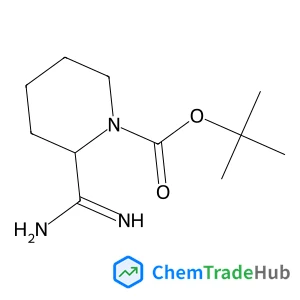
2-Methyl-2-propanyl 2-carbamimidoyl-1-piperidinecarboxylate
CAS Number:
1258640-98-0
Molecular Formula:
C11H21N3O2
Saori Noge
Solvation-induced vibrational frequency shifts and infrared (IR) intensity changes of the hydrogen- or halogen-bond accepting stretching modes, especially their dependence on the angular position of the hydrogen- or halogen-bond donating molecule, are examined theoretically. Calculations are carried out for some modes of hydrogen- or halogen-bonding molecular complexes, including the SO stretch of dimethyl sulfoxide-13C2⋯H2O, the CN stretch of acetonitrile⋯H2O, and the amide I′ mode of the N-methylacetamide-d1⋯BrNC 1 : 1 complex. It is shown that, in all the example cases dealt with in this study, the frequency shift depends rather strongly on the hydrogen- or halogen-bond angle (e.g., SO⋯H angle), with a larger low-frequency shift as the hydrogen or halogen bond becomes more bent, indicating the generality of the results obtained for the amide I′ mode of the N-methylacetamide-d1⋯2H2O 1 : 1 complex in a previous study. Contrary to our vague expectation, the frequency shift is not well correlated to the hydrogen- or halogen-bond distance or strength, but nevertheless, it is well reproduced by an electrostatic interaction model if it is carefully constructed by considering the scalar and vector components separately in a reasonable way. On the basis of this electrostatic interaction model, the reason why our vague expectation is not realized is clarified, and a unified understanding is achieved on the hydration-induced high-frequency shift of the CN stretch and the low-frequency shifts of the SO stretch and amide I′. With regard to the IR intensity, it is shown that, in some of the example cases, it also has rather strong angular position dependence. The mechanism of the IR intensity changes is estimated by analyzing the dipole derivative vector, especially its angular relation with the hydrogen or halogen bond.
Genki Sakata, Minoru Mizuhata
DOI: 10.1039/C7AN00067G
Huihui Mao, Guanghua Luo, Yuxia Zhan, Jun Zhang, Shuang Yao, Yang Yu
DOI: 10.1039/C8AN90083C
Miguela Martin, David Perez-Guaita, Dean W. Andrew, Bayden R. Wood
DOI: 10.1039/C6AN02075E
Xiang Xia, Ying Qian
DOI: 10.1039/C8AN01605D
Xuan-Xuan Chen, Yun-Bao Jiang
DOI: 10.1039/C7AN00439G
D. Willingham, E. E. Groopman, K. S. Grabowski, L. Sangely
DOI: 10.1039/C8AN01451E
Arash Hanifi, Uday Palukuru, Cushla McGoverin, Michael Shockley, Eliot Frank, Alan Grodzinsky, Richard G. Spencer, Nancy Pleshko
DOI: 10.1039/C6AN02167K
Jingwen Xiong, Zongzhi Li, Jihua Tan, Shaomin Ji, Jianwei Sun, Xianwei Li, Yanping Huo
DOI: 10.1039/C8AN00940F
M. R. Siddique, A. V. Rutter, K. Wehbe, G. Cinque, G. Bellisola
DOI: 10.1039/C6AN01914E
N-(4-Methoxybenzyl)-2-pyridinamine (CAS: 52818-63-0) is increasingly being used ...
When handling Ethyl 4-(2-chlorophenyl)-1,3-thiazole-2-carboxylate, appropriate p...
Diethyldiselane (CAS: 628-39-7) is classified under the Globally Harmonized Syst...
The market for oxocopper (CAS: 12053-18-8) is primarily driven by its use in cat...
The market for 5-{[(2-Methyl-2-propanyl)oxy]carbonyl}-5-azaspiro[2.4]heptane-7-c...
2-(1-Pyrrolidinyl)-4-pyridinamine is a chemical compound with the CAS number 359...
2-(3-Pyridinyl)-1-azabicyclo[2.2.2]octane (CAS: 91556-75-1) is a crystalline sol...
(S)-Alpha-allyl-proline hydrochloride is usually synthesized via a Wittig reacti...
3-Methyl-1,2-oxazole-5-carboxylic acid (CAS: 4857-42-5) is an organic compound w...
Lys-SMCC-DM1 is synthesized via a multi-step process involving the coupling of S...

Physical Chemistry Chemical Physics (PCCP) is an international journal co-owned by 19 physical chemistry and physics societies from around the world. This journal publishes original, cutting-edge research in physical chemistry, chemical physics and biophysical chemistry. To be suitable for publication in PCCP, articles must include significant innovation and/or insight into physical chemistry; this is the most important criterion that reviewers and Editors will judge against when evaluating submissions. The journal has a broad scope and welcomes contributions spanning experiment, theory, computation and data science. Topical coverage includes spectroscopy, dynamics, kinetics, statistical mechanics, thermodynamics, electrochemistry, catalysis, surface science, quantum mechanics, quantum computing and machine learning. Interdisciplinary research areas such as polymers and soft matter, materials, nanoscience, energy, surfaces/interfaces, and biophysical chemistry are welcomed if they demonstrate significant innovation and/or insight into physical chemistry. Joined experimental/theoretical studies are particularly appreciated when complementary and based on up-to-date approaches.
![N-{[(2-Methyl-2-propanyl)oxy]carbonyl}-L-methionylglycine structure](https://static.chemtradehub.com/structs/234/23446-03-9-e1e5.webp "N-{[(2-Methyl-2-propanyl)oxy]carbonyl}-L-methionylglycine structure")
![N-{15-[(2,5-Dioxo-1-pyrrolidinyl)oxy]-15-oxo-3,6,9,12-tetraoxapentadec-1-yl}-2-(2-propyn-1-yloxy)acetamide structure](https://static.chemtradehub.com/structs/210/2101206-92-0-2eb5.webp "N-{15-[(2,5-Dioxo-1-pyrrolidinyl)oxy]-15-oxo-3,6,9,12-tetraoxapentadec-1-yl}-2-(2-propyn-1-yloxy)acetamide structure")





