












Urea hydration from dielectric relaxation spectroscopy: old findings confirmed, new insights gained
Literature Information
Publication Date
2015-12-24
DOI
10.1039/C5CP07604H
Impact Factor
3.676
Authors
Vira Agieienko, Richard Buchner
View Original
Abstract
We report results on urea hydration obtained by dielectric relaxation spectroscopy (DRS) in a broad range of concentrations and temperatures. In particular, the effective hydration number and dipole moment of urea have been determined. The observed changes with composition and temperature were found to be insignificant and mainly caused by the changing number density of urea. Similarly, solute reorientation scaled simply with viscosity. In contrast, we find that water reorientation undergoes substantial changes in the presence of urea, resulting in two water fractions. The first corresponds to water molecules strongly bound to urea. These solvent molecules follow the reorientational dynamics of the solute. The second fraction exhibits only a minor increase of its relaxation time (in comparison with pure water) which is not linked to solution viscosity. Its activation energy decreases significantly with urea concentration, indicating a marked decrease of the number of H-bonds among the H2O molecules belonging to this fraction. Noncovalent interactions (NCI) analysis, capable to estimate the strength of the interactions within a cluster, shows that bound water molecules are most probably double-hydrogen bonded to urea via the oxygen atom of the carbonyl group and a cis-hydrogen atom. Due to the increased H-bond strength compared to the water dimer and the rigid position in the formed complex the reorientation of these bound H2O molecules is strongly impeded.
Related Literature
Polymerization of epoxide monomers promoted by tBuP4 phosphazene base: a comparative study of kinetic behavior
Valentin Puchelle, Haiqin Du, Nicolas Illy, Philippe Guégan
2020-05-06
Paper
DOI: 10.1039/D0PY00437E
Miniemulsion polymerization of styrene using carboxylated graphene quantum dots as surfactant
Le N. M. Dinh, Lakshmi N. Ramana, Vipul Agarwal, Per B. Zetterlund
2020-04-14
Paper
DOI: 10.1039/D0PY00404A
Development and disassembly of single and multiple acid-cleavable block copolymer nanoassemblies for drug delivery
Arman Moini Jazani, Jung Kwon Oh
2020-03-31
Review Article
DOI: 10.1039/D0PY00234H
Two-stage thiol-based click reactions for the preparation and adhesion of hydrogels
Wen Jing Yang, Wenya Xu, Xi Tao, Wen Wang, Yaqin Hu, Xue Li, En-Tang Kang, Lianhui Wang
2020-04-06
Paper
DOI: 10.1039/C9PY01503E
Thermally triggerable, anchoring block copolymers for use in aqueous inkjet printing
George E. Parkes, Helena J. Hutchins-Crawford, Claire Bourdin, Stuart Reynolds, Laura J. Leslie, Matthew J. Derry, Josephine L. Harries, Paul D. Topham
2020-03-25
Paper
DOI: 10.1039/D0PY00244E
Organocatalyzed ring opening polymerization of regio-isomeric lactones: reactivity and thermodynamics considerations
Marie A. F. Delgove, Aleksandra A. Wróblewska, Jules Stouten, Christian A. M. R. van Slagmaat, Jurrie Noordijk, Stefaan M. A. De Wildeman, Katrien V. Bernaerts
2020-05-05
Paper
DOI: 10.1039/C9PY01777A
Using the dynamic behavior of macrocyclic monomers with a bis(hindered amino)disulfide linker for the preparation of end-functionalized polymers
Hirogi Yokochi, Rikito Takashima, Hideyuki Otsuka
2020-04-14
Paper
DOI: 10.1039/D0PY00366B
You might also like
Compound Q&A
How should waste containing 6-Chloro-5-(2'-hydroxy-3'-methoxy-4-biphenylyl)-3-(3-methoxyphenyl)-1H-pyrrolo[3,2-d]pyrimidine-2,4(3H,5H)-dione (CAS: 1346607-05-3) be handled?
Waste containing 6-Chloro-5-(2'-hydroxy-3'-methoxy-4-biphenylyl)-3-(3-methoxyphe...
1346607-05-36-Chloro-5-(2'-hydro...
Compound Q&A
What are the main uses of (3alpha,5alpha)-3-Hydroxypregnane-11,20-dione (CAS: 23930-19-0)?
(3alpha,5alpha)-3-Hydroxypregnane-11,20-dione is primarily used in the pharmaceu...
23930-19-0(3alpha,5alpha)-3-Hy...
Compound Q&A
What is the market or research trend for 4-Amino-6-chloro-2-pyridinecarboxylic acid (CAS: 546141-56-4)?
The market for 4-Amino-6-chloro-2-pyridinecarboxylic acid (CAS: 546141-56-4) is ...
546141-56-44-Amino-6-chloro-2-p...
Compound Q&A
Are there alternatives to (2-Benzoylethyl)trimethylammonium chloride (CAS: 24472-88-6) in synthesis?
Alternatives to (2-Benzoylethyl)trimethylammonium chloride (CAS: 24472-88-6) in ...
24472-88-6(2-Benzoylethyl)trim...
Compound Q&A
Is N-[4-Nitro-3-(trifluoromethyl)phenyl]acetamide (CAS: 393-12-4) safe?
N-[4-Nitro-3-(trifluoromethyl)phenyl]acetamide (CAS: 393-12-4) is generally safe...
393-12-4N-[4-Nitro-3-(triflu...
Compound Q&A
Are there alternatives to [(4R,5R,6S)-5-hydroxy-10-imino-3,7-dioxa-1,9-diazatricyclo[6.4.0.02,6]dodeca-8,11-dien-4-yl]methyl dihydrogen phosphate (CAS: 39679-56-6) in synthesis?
Alternative reagents such as other phosphates or similar functional groups can b...
39679-56-6[(4R,5R,6S)-5-hydrox...
Compound Q&A
Are there alternatives to N,N'-Bis(3-aminopropyl)-1,3-propanediamine (CAS: 4605-14-5) in synthesis?
There are alternatives to N,N'-Bis(3-aminopropyl)-1,3-propanediamine (CAS: 4605-...
4605-14-5N,N'-Bis(3-aminoprop...
Compound Q&A
What precautions should be taken when handling Aluminium trihexadecanoate (CAS: 555-35-1)?
When handling Aluminium trihexadecanoate, it is important to use appropriate per...
555-35-1Aluminium trihexadec...
Compound Q&A
What is (1,1-Dioxido-3-oxo-1,2-benzothiazol-2(3H)-yl)acetic acid (CAS: 52188-11-1)?
(1,1-Dioxido-3-oxo-1,2-benzothiazol-2(3H)-yl)acetic acid is a chemical compound ...
52188-11-1(1,1-Dioxido-3-oxo-1...
Compound Q&A
Are there alternatives to 5,5-dimethyloxolan-2-one (CAS: 3123-97-5) in synthesis?
Several alternatives to 5,5-dimethyloxolan-2-one (CAS: 3123-97-5) can be used in...
3123-97-55,5-dimethyloxolan-2...
Source Journal
Physical Chemistry Chemical Physics

CiteScore:
5.5
Self-citation Rate:
10.3%
Articles per Year:
3036
Physical Chemistry Chemical Physics (PCCP) is an international journal co-owned by 19 physical chemistry and physics societies from around the world. This journal publishes original, cutting-edge research in physical chemistry, chemical physics and biophysical chemistry. To be suitable for publication in PCCP, articles must include significant innovation and/or insight into physical chemistry; this is the most important criterion that reviewers and Editors will judge against when evaluating submissions. The journal has a broad scope and welcomes contributions spanning experiment, theory, computation and data science. Topical coverage includes spectroscopy, dynamics, kinetics, statistical mechanics, thermodynamics, electrochemistry, catalysis, surface science, quantum mechanics, quantum computing and machine learning. Interdisciplinary research areas such as polymers and soft matter, materials, nanoscience, energy, surfaces/interfaces, and biophysical chemistry are welcomed if they demonstrate significant innovation and/or insight into physical chemistry. Joined experimental/theoretical studies are particularly appreciated when complementary and based on up-to-date approaches.
Recommended Compounds
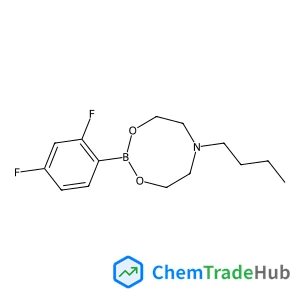
6-Butyl-2-(2,4-difluorophenyl)-1,3,6,2-dioxazaborocane
CAS Number:
1190988-98-7
Molecular Formula:
C14H20BF2NO2
Recommended Suppliers




Disclaimer
This page provides academic journal information for reference and research purposes only. We are not affiliated with any journal publishers and do not handle publication submissions. For publication-related inquiries, please contact the respective journal publishers directly.
If you notice any inaccuracies in the information displayed, please contact us at support@chemtradehub.com. We will promptly review and address your concerns.