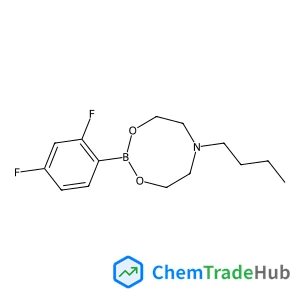
6-Butyl-2-(2,4-difluorophenyl)-1,3,6,2-dioxazaborocane
CAS Number:
1190988-98-7
Molecular Formula:
C14H20BF2NO2
Hirogi Yokochi, Rikito Takashima, Hideyuki Otsuka
Polymer topology transformations based on dynamic covalent chemistry (DCC) have attracted broad interest as the macroscopic properties of polymers can be freely changed in response to the polymer topology even after their synthesis. However, controlling the primary structures that accompany the topology transformation via DCC remains challenging. Herein, a method is presented that allows controlling functional end groups and molecular weight in DCC-based polymers using a combination of macrocyclic monomers and bifunctional acyclic compounds that contain bis(2,2,6,6-tetramethylpiperidin-1-yl)disulfide (BiTEMPS) moieties. The BiTEMPS moieties are stable at room temperature, but exchange disulfide bonds above 80 °C. Specifically, end-functionalized polymers were synthesized by simply heating a mixture of a macrocyclic compound with one BiTEMPS moiety and bifunctional acyclic BiTEMPS compounds as sources of repeat units and terminal groups, respectively. In the present method, various end-functionalized polymers including A–B–A type triblock copolymers with roughly controlled molecular weight were prepared by changing the chemical structures of the bifunctional BiTEMPS compounds and their feed ratio relative to the cyclic monomers.

Russian Journal of Applied Chemistry

Russian Journal of Organic Chemistry

Russian Journal of General Chemistry

Organic Process Research & Development

Russian Journal of Bioorganic Chemistry

Current Opinion in Colloid & Interface Science

Crystallography Reports

Drug Discovery Today

Journal of Saudi Chemical Society

Current Opinion in Solid State & Materials Science
Meidan Ye, Xiaoyue Gao, Xiaodan Hong, Qun Liu, Chunfeng He
DOI: 10.1039/C7SE00137A
Ye Shen, Yifan Pan, Zhenyu Cheng, Yen Wei, Guangjian Zeng, Liucheng Mao
DOI: 10.1039/C8SE00290H
Xiaoliang Wang, Yanguo Liu, Hongyan Han, Yanyan Zhao, Wuming Ma
DOI: 10.1039/C7SE00139H
Abuzar Taheri, Douglas R. MacFarlane, Cristina Pozo-Gonzalo, Jennifer M. Pringle
DOI: 10.1039/C8SE00224J
Zhaoning Song, Changlei Wang, Adam B. Phillips, Corey R. Grice, Dewei Zhao, Yue Yu, Cong Chen, Chongwen Li, Xinxing Yin, Randy J. Ellingson, Michael J. Heben, Yanfa Yan
DOI: 10.1039/C8SE00358K
Conor Rocks, Dilli Babu Padmanaban, Paul Maguire, Vladimir Svrcek, Davide Mariotti
DOI: 10.1039/C7SE00158D
Waste containing 6-Chloro-5-(2'-hydroxy-3'-methoxy-4-biphenylyl)-3-(3-methoxyphe...
(3alpha,5alpha)-3-Hydroxypregnane-11,20-dione is primarily used in the pharmaceu...
The market for 4-Amino-6-chloro-2-pyridinecarboxylic acid (CAS: 546141-56-4) is ...
Alternatives to (2-Benzoylethyl)trimethylammonium chloride (CAS: 24472-88-6) in ...
N-[4-Nitro-3-(trifluoromethyl)phenyl]acetamide (CAS: 393-12-4) is generally safe...
Alternative reagents such as other phosphates or similar functional groups can b...
There are alternatives to N,N'-Bis(3-aminopropyl)-1,3-propanediamine (CAS: 4605-...
When handling Aluminium trihexadecanoate, it is important to use appropriate per...
(1,1-Dioxido-3-oxo-1,2-benzothiazol-2(3H)-yl)acetic acid is a chemical compound ...
Several alternatives to 5,5-dimethyloxolan-2-one (CAS: 3123-97-5) can be used in...

Polymer Chemistry welcomes submissions in all areas of polymer science that have a strong focus on macromolecular chemistry. Manuscripts may cover a broad range of fields, yet no direct application focus is required.