












Visible light enhanced oxidant free dehydrogenation of aromatic alcohols using Au–Pd alloy nanoparticle catalysts
Literature Information
Publication Date
2013-10-17
DOI
10.1039/C3GC41866A
Impact Factor
10.182
Authors
Sarina Sarina, Sagala Bai, Yiming Huang, Chao Chen, Jianfeng Jia, Esa Jaatinen, Godwin A. Ayoko, Zhaorigetu Bao, Huaiyong Zhu
View Original
Abstract
We find that visible light irradiation of gold–palladium alloy nanoparticles supported on photocatalytically inert ZrO2 significantly enhances their catalytic activity for oxidant-free dehydrogenation of aromatic alcohols to the corresponding aldehydes at ambient temperatures. Dehydrogenation is also the dominant process in the selective oxidation of the alcohols to the corresponding aldehydes with molecular oxygen. The alloy nanoparticles strongly absorb light and exhibit superior catalytic and photocatalytic activity when compared to either pure palladium or gold nanoparticles. Analysis with a free electron gas model for the bulk alloy structure reveals that the alloying increases the surface charge heterogeneity on the alloy particle surface, which enhances the interaction between the alcohol molecules and the metal NPs. The increased surface charge heterogeneity of the alloy particles is confirmed with density function theory applied to small alloy clusters. Optimal catalytic activity was observed with a Au : Pd molar ratio of 1 : 186, which is in good agreement with the theoretical analysis. The rate-determining step of the dehydrogenation is hydrogen abstraction. The conduction electrons of the nanoparticles are photo-excited by the incident light giving them the necessary energy to be injected into the adsorbed alcohol molecules, promoting the hydrogen abstraction. The strong chemical adsorption of alcohol molecules facilitates this electron transfer. The results show that the alloy nanoparticles efficiently couple thermal and photonic energy sources to drive the dehydrogenation. These findings provide useful insight into the design of catalysts that utilize light for various organic syntheses at ambient temperatures.
Related Literature
Temperature dependence of the ultrafast vibrational echo spectroscopy of OD modes in liquid water from first principles simulations
Deepak Ojha, Amalendu Chandra
2019-02-25
Paper
DOI: 10.1039/C8CP07121G
Analysis of the interfacial characteristics of BiVO4/metal oxide heterostructures and its implication on their junction properties
Sebastián Murcia-López, Andreas Klein, Roel van de Krol, Teresa Andreu, Joan Ramón Morante, Thierry Toupance, Wolfram Jaegermann
2019-01-29
Paper
DOI: 10.1039/C8CP07483F
Tannic acid capped gold nanoparticles: capping agent chemistry controls the redox activity
Alex L. Suherman, Giorgia Zampardi, Hatem M. A. Amin, Neil P. Young, Richard G. Compton
2019-02-04
Paper
DOI: 10.1039/C9CP00056A
Design and characterization of novel polymorphs of single-layered tin-sulfide for direction-dependent thermoelectric applications using first-principles approaches
Bakhtiar Ul Haq, S. AlFaify, A. Laref
2019-01-28
Paper
DOI: 10.1039/C8CP07645F
Oxygen-functionalized TlTe buckled honeycomb from first-principles study
Qing Lu, Yi-Ming Wen, Zhao-Yi Zeng, Xiang-Rong Chen, Qi-Feng Chen
2019-02-12
Paper
DOI: 10.1039/C8CP07246A
Liquid–liquid phase separation and evaporation of a laser-trapped organic–organic airborne droplet using temporal spatial-resolved Raman spectroscopy
Aimable Kalume, Chuji Wang, Joshua Santarpia, Yong-Le Pan
2018-06-14
Paper
DOI: 10.1039/C8CP02372G
Theoretical study of the adsorption of hydrogen on cobalt clusters
Kevin García-Díez, Julio Fernández-Fernández, María J. López
2018-07-20
Paper
DOI: 10.1039/C8CP03048K
Laser and electron beam-induced formation of Ag/Cr structures on Ag2CrO4
Lemos P. S., Silva G. S., Roca R. A., Assis M., Torres-Mendieta R., Beltrán-Mir H., Mínguez-Vega G., Cordoncillo E., Andrés J., Longo E.
2019-02-07
Paper
DOI: 10.1039/C8CP07263A
Gold substrates of controlled roughness and electrokinetic properties formed by nanoparticle deposition
Maria Morga, Małgorzata Nattich-Rak, Magdalena Oćwieja, Zbigniew Adamczyk
2019-02-22
Paper
DOI: 10.1039/C9CP00440H
Quantitative analysis of 14N quadrupolar coupling using 1H detected 14N solid-state NMR
James A. Jarvis, Maria Concistre, Richard W. Bounds, Ilya Kuprov, Marina Carravetta, Philip T. F. Williamson
2019-02-27
Paper
DOI: 10.1039/C8CP06276E
You might also like
Compound Q&A
What precautions should be taken when handling 4-(2-Furylmethyl)thiomorpholine 1,1-dioxide (CAS: 79206-94-3)?
When handling 4-(2-Furylmethyl)thiomorpholine 1,1-dioxide (CAS: 79206-94-3), it ...
79206-94-34-(2-Furylmethyl)thi...
Compound Q&A
What precautions should be taken when handling 4-Chloro-N-[2-(4-morpholinyl)ethyl]benzamide (CAS: 71320-77-9)?
When handling 4-Chloro-N-[2-(4-morpholinyl)ethyl]benzamide (CAS: 71320-77-9), it...
71320-77-94-Chloro-N-[2-(4-mor...
Compound Q&A
How should waste containing 2-[2-(2-Methoxyethoxy)ethoxy]ethyl 4-methylbenzenesulfonate (CAS: 62921-74-8) be handled?
Waste containing this compound (CAS: 62921-74-8) should be handled according to ...
62921-74-82-[2-(2-Methoxyethox...
Compound Q&A
How should waste containing (S)-Methyl 2-amino-3-cyclohexylpropanoate be handled?
Waste containing (S)-Methyl 2-amino-3-cyclohexylpropanoate should be collected i...
40056-18-6(S)-Methyl 2-amino-3...
Compound Q&A
How is 5-({4-[(2S,4R)-4-Hydroxy-2-methyltetrahydro-2H-pyran-4-yl]-2-thienyl}sulfanyl)-1-methyl-1,3-dihydro-2H-indol-2-one (CAS: 166882-70-8) typically synthesized?
This compound can be synthesized using a multi-step process involving the conjug...
166882-70-85-({4-[(2S,4R)-4-Hyd...
Compound Q&A
Are there alternatives to (2E)-3-(3,4-Dichlorophenyl)acrylic acid (CAS: 7312-27-8) in synthesis?
There are several alternatives to (2E)-3-(3,4-Dichlorophenyl)acrylic acid in syn...
7312-27-8(2E)-3-(3,4-Dichloro...
Compound Q&A
How should Ethyl 6-(2-nitrophenyl)imidazo[2,1-b][1,3]thiazole-3-carboxylate (CAS: 925437-84-9) be stored?
Ethyl 6-(2-nitrophenyl)imidazo[2,1-b][1,3]thiazole-3-carboxylate (CAS: 925437-84...
925437-84-9Ethyl 6-(2-nitrophen...
Compound Q&A
How should waste containing 2-(1,3-Thiazol-2-yl)ethanamine (CAS: 18453-07-1) be handled?
Waste containing 2-(1,3-Thiazol-2-yl)ethanamine (CAS: 18453-07-1) should be coll...
18453-07-12-(1,3-Thiazol-2-yl)...
Compound Q&A
How is Methyl 5-iodo-2-methylbenzoate (CAS: 103440-54-6) typically synthesized?
Methyl 5-iodo-2-methylbenzoate can be synthesized through the iodination of meth...
103440-54-6Methyl 5-iodo-2-meth...
Compound Q&A
How is 5-Chloro[1,2,4]triazolo[1,5-a]pyridine (CAS: 1427399-34-5) typically synthesized?
5-Chloro[1,2,4]triazolo[1,5-a]pyridine is commonly synthesized via the condensat...
1427399-34-55-Chloro[1,2,4]triaz...
Source Journal
Green Chemistry

CiteScore:
16.1
Self-citation Rate:
7.5%
Articles per Year:
944
Green Chemistry provides a unique forum for the publication of innovative research on the development of alternative green and sustainable technologies. The scope of Green Chemistry is based on, but not limited to, the definition proposed by Anastas and Warner (Green Chemistry: Theory and Practice, P T Anastas and J C Warner, Oxford University Press, Oxford, 1998). Green chemistry is the utilisation of a set of principles that reduces or eliminates the use or generation of hazardous substances in the design, manufacture and application of chemical products. Green Chemistry is at the frontiers of this continuously-evolving interdisciplinary science and publishes research that attempts to reduce the environmental impact of the chemical enterprise by developing a technology base that is inherently non-toxic to living things and the environment. Submissions on all aspects of research relating to the endeavour are welcome. The journal publishes original and significant cutting-edge research that is likely to be of wide general appeal. To be published, work must present a significant advance in green chemistry. Papers must contain a comparison with existing methods and demonstrate advantages over those methods before publication can be considered. For more information please see this Editorial. Coverage includes the following, but is not limited to: Design (e.g. biomimicry, design for degradation/recycling/reduced toxicity…) Reagents & Feedstocks (e.g. renewables, CO2, solvents, auxiliary agents, waste utilization…) Synthesis (e.g. organic, inorganic, synthetic biology…) Catalysis (e.g. homogeneous, heterogeneous, enzyme, whole cell…) Process (e.g. process design, intensification, separations, recycling, efficiency…) Energy (e.g. renewable energy, fuels, photovoltaics, fuel cells, energy storage, energy carriers…) Applications (e.g. electronics, dyes, consumer products, coatings, pharmaceuticals, preservatives, building materials, chemicals for industry/agriculture/mining…) Impact (e.g. safety, metrics, LCA, sustainability, (eco)toxicology…) Green chemistry is, by definition, a continuously-evolving frontier. Therefore, the inclusion of a particular material or technology does not, of itself, guarantee that a paper is suitable for the journal. To be suitable, the novel advance should have the potential for reduced environmental impact relative to the state of the art. Green Chemistry does not normally deal with research associated with 'end-of-pipe' or remediation issues.
Recommended Compounds

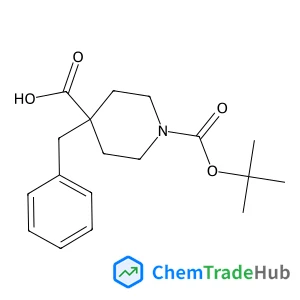
4-Benzyl-1-(tert-butoxycarbonyl)piperidine-4-carboxylic acid
CAS Number:
170838-87-6
Molecular Formula:
C18H25NO4
Recommended Suppliers





Disclaimer
This page provides academic journal information for reference and research purposes only. We are not affiliated with any journal publishers and do not handle publication submissions. For publication-related inquiries, please contact the respective journal publishers directly.
If you notice any inaccuracies in the information displayed, please contact us at support@chemtradehub.com. We will promptly review and address your concerns.