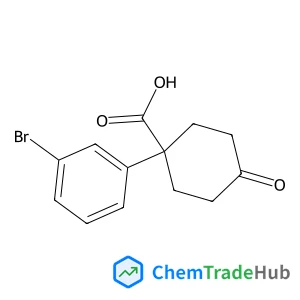
1-(3-Bromophenyl)-4-oxocyclohexanecarboxylic acid
CAS Number:
1385694-53-0
Molecular Formula:
C13H13BrO3
Thomas Murphy, Samantha K. Callear, Gregory G. Warr, Rob Atkin
The bulk nanostructure of 15 mol% propylammonium chloride (PACl) dissolved in propylammonium nitrate (PAN) and 15 mol% ethanolammonium chloride (EtACl) in ethanolammonium nitrate (EtAN) has been determined using neutron diffraction with empirical potential structure refinement fits. For both the PAN:PACl and EtAN:EtACl mixtures, data for three different scattering contrasts were simultaneously fit, and the structures determined and compared to that of the pure ionic liquids. Strong electrostatic interactions between chloride and cation charged groups, as well as the alcohol moiety of EtAN, lead to marked changes in local ion packing that alter the liquid structure. In PAN, the addition of chloride modifies but does not significantly disrupt the bicontinuous amphiphilic nanostructure of the IL. Tight packing of ammonium groups around chloride favours a gauche conformer for the cation which shrinks the apolar domains and brings the terminal methyls nearer the polar domains. The weakly-clustered nanostructure of EtAN, a consequence of the terminal hydroxyl, is overwhelmed by strong chloride–cation interactions. Ethanolammonium binds tightly to chloride in a monodentate fashion via either its alcohol or ammonium charge centre, or through both in a bidentate arrangement by adopting a gauche or eclipsed conformer.
Chang Guo, Bin Sun, Yuning Li
DOI: 10.1039/C4PY00372A
Wei Wu, Qiujing Zhang, Jiantao Wang, Miao Chen, Shuai Li, Zaifu Lin, Jianshu Li
DOI: 10.1039/C4PY00575A
Shuang Li, Xianyu Deng, Lei Feng, Xincheng Miao, Kuangyi Tang, Qianqian Li, Zhen Li
DOI: 10.1039/C6PY01733A
Vincent Ladmiral, Thierry Lannuzel, Fabrice Domingues Dos Santos, Bruno Améduri
DOI: 10.1039/C6PY01874B
Matthew D. Green, Abbygail A. Foster, Chad T. Greco, Raghunath Roy, Rachel M. Lehr, Thomas H. Epps, III, Millicent O. Sullivan
DOI: 10.1039/C4PY00638K
Marc Guerre, Mona Semsarilar, Franck Godiard, Bruno Améduri, Vincent Ladmiral
DOI: 10.1039/C6PY02203K
Chun Feng, Guolin Lu, Gang Sun, Xunwei Liu, Xiaoyu Huang
DOI: 10.1039/C4PY00772G
Kai Zhang, Jiyu Fan, Michael J. Monteiro, Zhongfan Jia
DOI: 10.1039/C7PY00151G
Jinying Peng, Chun Tian, Lifen Zhang, Zhenping Cheng, Xiulin Zhu
DOI: 10.1039/C6PY02133F
Jaipal Gupta, Daniel J. Keddie, Chaoying Wan, David M. Haddleton, Tony McNally
DOI: 10.1039/C6PY00522E
4-Amino-3-bromophenol (CAS: 74440-80-5) falls under the classification of a haza...
(17beta)-3-Oxoestr-4-en-17-yl acetate should be stored in a cool, dry place away...
2-[(2,2-Diethoxyethyl)disulfanyl]-1,1-diethoxyethane (CAS: 76505-71-0) is a colo...
The market and research for 1-(β-D-ribofuranosyl)-1H-imidazo[4,5-c]pyridin-4-ami...
Waste containing Conjugated Estrogen (CAS: 12126-59-9) should be collected and d...
The market for Bis(2,2,2-trifluoroethyl) (methoxycarbonylmethyl)phosphonate (CAS...
There are several alternatives to 3,4'-Di-O-methylellagic acid (CAS: 57499-59-9)...
2-Chloro-N,N-dimethylpyridin-4-amine (CAS: 59047-70-0) is regulated under the Gl...
Cerium(3+);oxygen(2-);vanadium(5+) (CAS: 13597-19-8) is a complex inorganic comp...
7-Chloro-1-iodoisoquinoline (CAS: 1203579-27-4) is generally considered safe whe...

Physical Chemistry Chemical Physics (PCCP) is an international journal co-owned by 19 physical chemistry and physics societies from around the world. This journal publishes original, cutting-edge research in physical chemistry, chemical physics and biophysical chemistry. To be suitable for publication in PCCP, articles must include significant innovation and/or insight into physical chemistry; this is the most important criterion that reviewers and Editors will judge against when evaluating submissions. The journal has a broad scope and welcomes contributions spanning experiment, theory, computation and data science. Topical coverage includes spectroscopy, dynamics, kinetics, statistical mechanics, thermodynamics, electrochemistry, catalysis, surface science, quantum mechanics, quantum computing and machine learning. Interdisciplinary research areas such as polymers and soft matter, materials, nanoscience, energy, surfaces/interfaces, and biophysical chemistry are welcomed if they demonstrate significant innovation and/or insight into physical chemistry. Joined experimental/theoretical studies are particularly appreciated when complementary and based on up-to-date approaches.
![9-Ethyl-3-{(E)-[ethyl(2-methylphenyl)hydrazono]methyl}-9H-carbazole structure](https://static.chemtradehub.com/structs/127/1274948-12-7-301f.webp "9-Ethyl-3-{(E)-[ethyl(2-methylphenyl)hydrazono]methyl}-9H-carbazole structure")