












On determining the height of the potential barrier at grain boundaries in ion-conducting oxides
Literature Information
Publication Date
2015-12-10
DOI
10.1039/C5CP06387F
Impact Factor
3.676
Authors
Sangtae Kim, Seong K. Kim, Sergey Khodorov, Joachim Maier, Igor Lubomirsky
View Original
Abstract
The validity and limitations of two quantitative approaches for estimating the height of the potential barrier at grain boundaries, Ψgb, in polycrystalline ionic conductors are examined both theoretically and experimentally. The linear diffusion model recently proposed by Kim and Lubomirsky determines Ψgb from the value of the power exponent of the current (Igb)–voltage (Ugb) relationship at the grain boundary, dln(Igb)/dln(Ugb), while the conventional approach calculates Ψgb from the ratio of the grain boundary resistivity to the grain core resistivity. The results of our theoretical analysis demonstrate that both approaches should yield consistent values for Ψgb if the ionic current through the grain boundary is limited exclusively by space charge. While the value of Ψgb obtained by the power law procedure is relatively insensitive to other causes of current obstruction, e.g. current constriction and/or local structural disorder, the resistivity ratio method, if not explicitly corrected for these additional limitations, results in a considerable overestimate of the grain boundary potential barrier. Hence, it is possible to distinguish between grain boundary resistance due to the presence of space charge and that due to additional sources by comparing the values of Ψgb determined using each of the two methods. Our theoretical analysis is confirmed experimentally with 3 mol% Gd-doped ceria with and without an additional source of current constriction across the grain boundary.
Related Literature
Electrochemical sensors for rapid diagnosis of pathogens in real time
Olja Simoska, Keith J. Stevenson
2019-10-07
Minireview
DOI: 10.1039/C9AN01747J
Yolk–shell structured Au@Ag@mSiO2 as a probe for sensing cysteine enantiomers and Cu2+ based on circular dichroism
Jing Wang, Xu Xu, Xiaolin Qiu, Shuaishuai Zhang, Yinxian Peng
2019-10-23
Paper
DOI: 10.1039/C9AN01541H
Surface-enhanced Raman spectroscopy (SERS) characterisation of abasic sites in DNA duplexes
Luca Guerrini
2019-11-05
Communication
DOI: 10.1039/C9AN02040C
Screening of DNA G-quadruplex stabilizing ligands by nano differential scanning fluorimetry
Bruno Pagano, Nunzia Iaccarino, Anna Di Porzio, Antonio Randazzo, Jussara Amato
2019-10-07
Communication
DOI: 10.1039/C9AN01463B
A two-photon fluorescent probe for bio-imaging of formaldehyde in living cells and tissues
Jun-Bin Li, Qian-Qian Wang, Lin Yuan, Yong-Xiang Wu, Xiao-Xiao Hu, Xiao-Bing Zhang, Weihong Tan
2016-04-14
Paper
DOI: 10.1039/C6AN00473C
Real-time monitoring of calcification process by Sporosarcina pasteurii biofilm
Dustin Harris, Jyothir Ganesh Ummadi, Andrew R. Thurber, Yvan Allau, Circe Verba, Frederick Colwell, Marta E. Torres, Dipankar Koley
2016-02-29
Paper
DOI: 10.1039/C6AN00007J
A fluorescent probe based on aggregation-induced emission for hydrogen sulfide-specific assaying in food and biological systems
Lingfeng Xu, Ling Ni, Lihe Sun, Fang Zeng, Shuizhu Wu
2019-09-27
Paper
DOI: 10.1039/C9AN01582E
A magnetic nanoparticle-based aptasensor for selective and sensitive determination of lysozyme with strongly scattering silver nanoparticles
Chun Mei Li, Lei Zhan, Lin Ling Zheng, Yuan Fang Li
2016-03-23
Paper
DOI: 10.1039/C6AN00489J
An ionic liquid composed of purely functional sensing molecules: a colorimetrically calcium responsive ionic liquid
Yusuke Niwa, Tatsumi Mizuta, Kenji Sueyoshi, Tatsuro Endo, Hideaki Hisamoto
2019-10-21
Communication
DOI: 10.1039/C9AN01769K
You might also like
Compound Q&A
How should waste containing 6-Chloro-5-(2'-hydroxy-3'-methoxy-4-biphenylyl)-3-(3-methoxyphenyl)-1H-pyrrolo[3,2-d]pyrimidine-2,4(3H,5H)-dione (CAS: 1346607-05-3) be handled?
Waste containing 6-Chloro-5-(2'-hydroxy-3'-methoxy-4-biphenylyl)-3-(3-methoxyphe...
1346607-05-36-Chloro-5-(2'-hydro...
Compound Q&A
What are the main uses of (3alpha,5alpha)-3-Hydroxypregnane-11,20-dione (CAS: 23930-19-0)?
(3alpha,5alpha)-3-Hydroxypregnane-11,20-dione is primarily used in the pharmaceu...
23930-19-0(3alpha,5alpha)-3-Hy...
Compound Q&A
What is the market or research trend for 4-Amino-6-chloro-2-pyridinecarboxylic acid (CAS: 546141-56-4)?
The market for 4-Amino-6-chloro-2-pyridinecarboxylic acid (CAS: 546141-56-4) is ...
546141-56-44-Amino-6-chloro-2-p...
Compound Q&A
Are there alternatives to (2-Benzoylethyl)trimethylammonium chloride (CAS: 24472-88-6) in synthesis?
Alternatives to (2-Benzoylethyl)trimethylammonium chloride (CAS: 24472-88-6) in ...
24472-88-6(2-Benzoylethyl)trim...
Compound Q&A
Is N-[4-Nitro-3-(trifluoromethyl)phenyl]acetamide (CAS: 393-12-4) safe?
N-[4-Nitro-3-(trifluoromethyl)phenyl]acetamide (CAS: 393-12-4) is generally safe...
393-12-4N-[4-Nitro-3-(triflu...
Compound Q&A
Are there alternatives to [(4R,5R,6S)-5-hydroxy-10-imino-3,7-dioxa-1,9-diazatricyclo[6.4.0.02,6]dodeca-8,11-dien-4-yl]methyl dihydrogen phosphate (CAS: 39679-56-6) in synthesis?
Alternative reagents such as other phosphates or similar functional groups can b...
39679-56-6[(4R,5R,6S)-5-hydrox...
Compound Q&A
Are there alternatives to N,N'-Bis(3-aminopropyl)-1,3-propanediamine (CAS: 4605-14-5) in synthesis?
There are alternatives to N,N'-Bis(3-aminopropyl)-1,3-propanediamine (CAS: 4605-...
4605-14-5N,N'-Bis(3-aminoprop...
Compound Q&A
What precautions should be taken when handling Aluminium trihexadecanoate (CAS: 555-35-1)?
When handling Aluminium trihexadecanoate, it is important to use appropriate per...
555-35-1Aluminium trihexadec...
Compound Q&A
What is (1,1-Dioxido-3-oxo-1,2-benzothiazol-2(3H)-yl)acetic acid (CAS: 52188-11-1)?
(1,1-Dioxido-3-oxo-1,2-benzothiazol-2(3H)-yl)acetic acid is a chemical compound ...
52188-11-1(1,1-Dioxido-3-oxo-1...
Compound Q&A
Are there alternatives to 5,5-dimethyloxolan-2-one (CAS: 3123-97-5) in synthesis?
Several alternatives to 5,5-dimethyloxolan-2-one (CAS: 3123-97-5) can be used in...
3123-97-55,5-dimethyloxolan-2...
Source Journal
Physical Chemistry Chemical Physics

CiteScore:
5.5
Self-citation Rate:
10.3%
Articles per Year:
3036
Physical Chemistry Chemical Physics (PCCP) is an international journal co-owned by 19 physical chemistry and physics societies from around the world. This journal publishes original, cutting-edge research in physical chemistry, chemical physics and biophysical chemistry. To be suitable for publication in PCCP, articles must include significant innovation and/or insight into physical chemistry; this is the most important criterion that reviewers and Editors will judge against when evaluating submissions. The journal has a broad scope and welcomes contributions spanning experiment, theory, computation and data science. Topical coverage includes spectroscopy, dynamics, kinetics, statistical mechanics, thermodynamics, electrochemistry, catalysis, surface science, quantum mechanics, quantum computing and machine learning. Interdisciplinary research areas such as polymers and soft matter, materials, nanoscience, energy, surfaces/interfaces, and biophysical chemistry are welcomed if they demonstrate significant innovation and/or insight into physical chemistry. Joined experimental/theoretical studies are particularly appreciated when complementary and based on up-to-date approaches.
Recommended Compounds

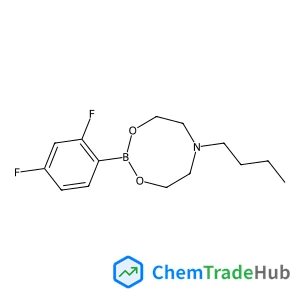
6-Butyl-2-(2,4-difluorophenyl)-1,3,6,2-dioxazaborocane
CAS Number:
1190988-98-7
Molecular Formula:
C14H20BF2NO2

Recommended Suppliers






Disclaimer
This page provides academic journal information for reference and research purposes only. We are not affiliated with any journal publishers and do not handle publication submissions. For publication-related inquiries, please contact the respective journal publishers directly.
If you notice any inaccuracies in the information displayed, please contact us at support@chemtradehub.com. We will promptly review and address your concerns.