


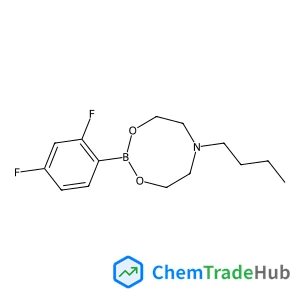
6-Butyl-2-(2,4-difluorophenyl)-1,3,6,2-dioxazaborocane
CAS Number:
1190988-98-7
Molecular Formula:
C14H20BF2NO2
Olja Simoska, Keith J. Stevenson
Microbial infections remain the principal cause for high morbidity and mortality rates. While approximately 1400 human pathogens have been recognized, the majority of healthcare-associated infectious diseases are caused by only a few opportunistic pathogens (e.g., Pseudomonas aeruginosa, Staphylococcus aureus, Escherichia coli), which are associated with increased antibiotic and antimicrobial resistance. Rapid detection, reliable identification and real-time monitoring of these pathogens remain not only a scientific problem but also a practical challenge of vast importance, especially in tailoring effective treatment strategies. Although the development of vaccinations and antibacterial drug treatments are the leading research, progress, and implementation of early warning, quantitative systems indicative of confirming pathogen presence are necessary. Over the years, various approaches, such as conventional culturing, straining, molecular methods (e.g., polymerase chain reaction and immunological assays), microscopy-based and mass spectrometry techniques, have been employed to identify and quantify pathogenic agents. While being sensitive in some cases, these procedures are costly, time-consuming, mostly qualitative, and are indirect detection methods. A great challenge is therefore to develop rapid, highly sensitive, specific devices with adequate figures of merit to corroborate the presence of microbes and enable dynamic real-time measurements of metabolism. As an alternative, electrochemical sensor platforms have been developed as powerful quantitative tools for label-free detection of infection-related biomarkers with high sensitivity. This minireview is focused on the latest electrochemical-based approaches for pathogen sensing, putting them into the context of standard sensing methods, such as cell culturing, mass spectrometry, and fluorescent-based approaches. Description of the latest, impactful electrochemical sensors for pathogen detection will be presented. Recent breakthroughs will be highlighted, including the use of micro- and nano-electrode arrays for real-time detection of bacteria in polymicrobial infections and microfluidic devices for pathogen separation analysis. We will conclude with perspectives and outlooks to understand shortcomings in designing future sensing schemes. The need for high sensitivity and selectivity, low-cost implementation, fast detection, and screening increases provides an impetus for further development in electrochemical detectors for microorganisms and biologically relevant targets.

Russian Journal of Bioorganic Chemistry

Journal of Saudi Chemical Society

Organic Process Research & Development

Drug Discovery Today

Current Opinion in Colloid & Interface Science

Russian Journal of Applied Chemistry

Chemical Communications

Russian Journal of Organic Chemistry

Journal of Natural Medicines

Russian Journal of General Chemistry
Pengli Zhu, Leicong Zhang, Fengrui Zhou, Xianwen liang, Tingxi Li, Qing Wang, Rong Sun
DOI: 10.1039/C7SE00214A
Sebastian Nybin Remello, Fazalurahman Kuttassery, Siby Mathew, Arun Thomas, Daisuke Yamamoto, Yu Nabetani, Keito Sano, Hiroshi Tachibana, Haruo Inoue
DOI: 10.1039/C8SE00102B
Xing Guo, Bingjuan Zhang, Zhenhua Lin, Jie Su, Zhou Yang, Chunfu Zhang, Jingjing Chang, Shengzhong (Frank) Liu, Yue Hao
DOI: 10.1039/C8SE00233A
Christian M. Wolff, José A. Márquez Prieto, Martin Stolterfoht, Pascal Becker, Thomas Unold, Bernd Rech, Dieter Neher
DOI: 10.1039/C8SE00509E
Chong-Yong Lee, Yong Zhao, Caiyun Wang, David R. G. Mitchell, Gordon G. Wallace
DOI: 10.1039/C7SE00069C
Devendra Tiwari, Tristan Koehler, Reiner Klenk, David J. Fermin
DOI: 10.1039/C7SE00150A
Xiaoliang Wang, Yanguo Liu, Hongyan Han, Yanyan Zhao, Wuming Ma
DOI: 10.1039/C7SE00139H
Eldho Edison, Srinivasan Madhavi
DOI: 10.1039/C8SE00381E
Waste containing 6-Chloro-5-(2'-hydroxy-3'-methoxy-4-biphenylyl)-3-(3-methoxyphe...
(3alpha,5alpha)-3-Hydroxypregnane-11,20-dione is primarily used in the pharmaceu...
The market for 4-Amino-6-chloro-2-pyridinecarboxylic acid (CAS: 546141-56-4) is ...
Alternatives to (2-Benzoylethyl)trimethylammonium chloride (CAS: 24472-88-6) in ...
N-[4-Nitro-3-(trifluoromethyl)phenyl]acetamide (CAS: 393-12-4) is generally safe...
Alternative reagents such as other phosphates or similar functional groups can b...
There are alternatives to N,N'-Bis(3-aminopropyl)-1,3-propanediamine (CAS: 4605-...
When handling Aluminium trihexadecanoate, it is important to use appropriate per...
(1,1-Dioxido-3-oxo-1,2-benzothiazol-2(3H)-yl)acetic acid is a chemical compound ...
Several alternatives to 5,5-dimethyloxolan-2-one (CAS: 3123-97-5) can be used in...

Analyst publishes analytical and bioanalytical research that reports premier fundamental discoveries and inventions, and the applications of those discoveries, unconfined by traditional discipline barriers.
![2-Methyl-2-propanyl (2E)-5-chloro-2-[3-methoxy-4-(4-methyl-1H-imidazol-1-yl)benzylidene]pentanoate structure](https://static.chemtradehub.com/structs/122/1225232-42-7-ee03.webp "2-Methyl-2-propanyl (2E)-5-chloro-2-[3-methoxy-4-(4-methyl-1H-imidazol-1-yl)benzylidene]pentanoate structure")
![Benzyl 2-{[(tert-butoxy)carbonyl]amino}acetate structure](https://static.chemtradehub.com/structs/542/54244-69-8-6399.webp "Benzyl 2-{[(tert-butoxy)carbonyl]amino}acetate structure")
![2-Methyl-2-propanyl [2-(2-oxa-6-azaspiro[3.3]hept-6-yl)ethyl]carbamate structure](https://static.chemtradehub.com/structs/141/1415562-38-7-c0a4.webp "2-Methyl-2-propanyl [2-(2-oxa-6-azaspiro[3.3]hept-6-yl)ethyl]carbamate structure")





