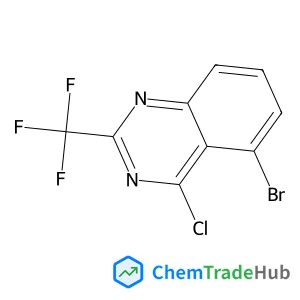
5-Bromo-4-chloro-2-(trifluoromethyl)quinazoline
CAS Number:
2089311-03-3
Molecular Formula:
C9H3BrClF3N2
Wan-Kuen Jo, Joon Yeob Lee, Thillai Sivakumar Natarajan
Novel, hierarchically nanostructured, redox-mediator-free, direct Z-scheme nanocomposite photocatalysts were synthesized via a facile hydrothermal method followed by wet-impregnation. The photocatalysts had a ZnIn2S4 marigold flower/Bi2WO6 flower-like (ZIS/BW) composition, which led to superior visible-light photocatalytic efficiency with excellent stability and reusability. The hierarchical marigold flower and flower-like morphologies of ZIS and BW were confirmed by FE-SEM and TEM analyses and further revealed that formation of the hierarchical marigold flower-like ZIS structure followed the formation of nanoparticles, growth of the ZIS petals, and self-assembly of these species. Powder X-ray diffraction and UV-visible diffuse reflectance spectroscopy analyses as well as the enhancement in the surface area and pore volume of the composite provide evidence of strong coupling between hierarchical BW and the ZIS nanostructures. The efficiency of the hierarchical direct Z-scheme photocatalysts for photocatalytic decomposition of metronidazole (MTZ) under visible-light irradiation was evaluated. The hierarchically nanostructured ZIS/BW nanocomposites with 50% loading of ZIS exhibited superior visible-light photocatalytic decomposition efficiency (PDE) compared to the composites with other percentages of ZIS and pristine BW. A probable mechanism for the enhanced photocatalytic efficiency of the ZIS/BW composite in MTZ degradation under visible irradiation was proposed. Radical quenching studies demonstrated that h+, ˙OH, and O2˙− are the primary reactive radicals involved, which confirms that the Z-scheme mechanism of transfer of charge carriers accounts for the higher photocatalytic activity. Kinetic analysis revealed that MTZ degradation follows pseudo-first-order kinetics and the reusability of the composite catalyst for up to four cycles confirms the excellent stability of the hierarchical structure. It is concluded that the hierarchical structure of the ZIS/BW photocatalyst, synergic effect, Z-scheme transfer of the charge carrier, high concentration of (˙OH) radical formation and the significant reduction in the charge carrier recombination account for the enhanced efficiency of the catalyst for photocatalytic decomposition of metronidazole by visible light under the present reaction conditions.
Nattawadee Panyain, Aurélien Godinat, Aditya Raymond Thawani, Sofía Lachiondo-Ortega, Katie Mason, Sarah Elkhalifa, Lisa M. Smith, Jeanine A. Harrigan
DOI: 10.1039/D1MD00218J
Yiwei Liu, Luyi Zhou, Ying Dong, Rui Wang, Ying Pan, Shuze Zhuang, Dong Liu, Jianqiang Liu
DOI: 10.1039/D0MD00416B
Quynh Ngoc Vu, Reginald Young, Haritha Krishna Sudhakar, Tianyi Gao, Tiancheng Huang, Yaw Sing Tan, Yu Heng Lau
DOI: 10.1039/D1MD00098E
Koushik Roy, Syamal Roy, Siddhartha Roy
DOI: 10.1039/D1MD00099C
Anmol Gulati, Charles S. Yeung, Blair Lapointe, Solomon D. Kattar, Hakan Gunaydin, Jack D. Scott, Kaleen K. Childers, Joey L. Methot, Vladimir Simov, Ravi Kurukulasuriya, Barbara Pio, Greg J. Morriello, Ping Liu, Haiqun Tang, Santhosh Neelamkavil, Harold B. Wood, Vanessa L. Rada, Michael J. Ardolino, Xin Cindy Yan, Rachel Palte, Karin Otte, Robert Faltus, Janice Woodhouse, Laxminarayan G. Hegde, Paul Ciaccio, Ellen C. Minnihan, Erin F. DiMauro, Matthew J. Fell, Peter H. Fuller, J. Michael Ellis
DOI: 10.1039/D1MD00097G
Hyunsoo Kim, Yoon Soo Hwang, Mingi Kim
DOI: 10.1039/D1MD00068C
Clément Bechtler, Christina Lamers
DOI: 10.1039/D1MD00083G
Kai-Lu Liu, Kongkai Zhu, Hua Zhang
DOI: 10.1039/D1MD00274K
Waste containing 6-Chloro-5-(2'-hydroxy-3'-methoxy-4-biphenylyl)-3-(3-methoxyphe...
(3alpha,5alpha)-3-Hydroxypregnane-11,20-dione is primarily used in the pharmaceu...
The market for 4-Amino-6-chloro-2-pyridinecarboxylic acid (CAS: 546141-56-4) is ...
Alternatives to (2-Benzoylethyl)trimethylammonium chloride (CAS: 24472-88-6) in ...
N-[4-Nitro-3-(trifluoromethyl)phenyl]acetamide (CAS: 393-12-4) is generally safe...
Alternative reagents such as other phosphates or similar functional groups can b...
There are alternatives to N,N'-Bis(3-aminopropyl)-1,3-propanediamine (CAS: 4605-...
When handling Aluminium trihexadecanoate, it is important to use appropriate per...
(1,1-Dioxido-3-oxo-1,2-benzothiazol-2(3H)-yl)acetic acid is a chemical compound ...
Several alternatives to 5,5-dimethyloxolan-2-one (CAS: 3123-97-5) can be used in...

Physical Chemistry Chemical Physics (PCCP) is an international journal co-owned by 19 physical chemistry and physics societies from around the world. This journal publishes original, cutting-edge research in physical chemistry, chemical physics and biophysical chemistry. To be suitable for publication in PCCP, articles must include significant innovation and/or insight into physical chemistry; this is the most important criterion that reviewers and Editors will judge against when evaluating submissions. The journal has a broad scope and welcomes contributions spanning experiment, theory, computation and data science. Topical coverage includes spectroscopy, dynamics, kinetics, statistical mechanics, thermodynamics, electrochemistry, catalysis, surface science, quantum mechanics, quantum computing and machine learning. Interdisciplinary research areas such as polymers and soft matter, materials, nanoscience, energy, surfaces/interfaces, and biophysical chemistry are welcomed if they demonstrate significant innovation and/or insight into physical chemistry. Joined experimental/theoretical studies are particularly appreciated when complementary and based on up-to-date approaches.