












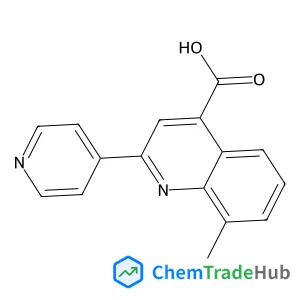
8-Methyl-2-pyridin-4-ylquinoline-4-carboxylic acid
CAS Number:
107027-42-9
Molecular Formula:
C16H12N2O2
Janet E. Del Bene, Ibon Alkorta, José Elguero
Ab initio MP2/aug′-cc-pVTZ calculations have been carried out to investigate the properties of complexes formed between H2XP, for X = F, Cl, NC, OH, CN, CCH, CH3, and H, and the possible bridging molecules HNNH, FNNH, and HNCHOH. H2XP:HNNH and H2XP:FNNH complexes are stabilized by P⋯N pnicogen bonds, except for H2(CH3)P:FNNH and H3P:FNNH which are stabilized by N–H⋯P hydrogen bonds. H2XP:HNCHOH complexes are stabilized by P⋯N pnicogen bonds and nonlinear O–H⋯P hydrogen bonds. For a fixed H2XP molecule, binding energies decrease in the order HNCHOH > HNNH > FNNH, except for the binding energies of H2(CH3)P and H3P with HNNH and FNNH. Binding energies of complexes with HNCHOH and HNNH increase as the P–N1 distance decreases, but binding energies of complexes with FNNH show little dependence on this distance. The large binding energies of H2XP:HNCHOH complexes arise from a cooperative effect involving electron-pair acceptance by P to form a pnicogen bond, and electron-pair donation by P to form a hydrogen bond. The dominant charge-transfer interaction in these complexes involves electron-pair donation by N across the pnicogen bond, except for complexes in which X is one of the more electropositive substituents, CCH, CH3, and H. For these, lone-pair donation by P across the hydrogen bond dominates. AIM and NBO data for these complexes are consistent with their bonding characteristics, showing molecular graphs with bond critical points and charge-transfer interactions associated with hydrogen and pnicogen bonds. EOM-CCSD spin–spin coupling constants 1pJ(P–N) across the pnicogen bond for each series of complexes correlate with the P–N distance. In contrast, 2hJ(O–P) values for complexes H2XP:HNCHOH do not correlate with the O–P distance, a consequence of the nonlinearity of these hydrogen bonds.
Ritabrita Goswami, Aarohi Gupta, Olga Bednova, Gaël Coulombe, Dipika Patel, Vincent M. Rotello
DOI: 10.1039/D1CS00269D
Conor J. Crawford
DOI: 10.1039/D3CS00321C
Yong Jiang, Zhong Liang, Qian Zhang, Yaping Du
DOI: 10.1039/D3CS00708A
Chenxi Duan, Chunming Cui
DOI: 10.1039/D3CS00791J
Xinlu Zheng, Ziwei Ye, Zeeshan Akmal, Chun He, Jinlong Zhang, Lingzhi Wang
DOI: 10.1039/D3CS00462G
Yifeng Tang, Jeremiah Y. Kim, Carman K. M. IP, Azadeh Bahmani, Qing Chen, Matthew G. Rosenberger, Aaron P. Esser-Kahn, Andrew L. Ferguson
DOI: 10.1039/D3SC03613H
Khoa Chung
DOI: 10.1039/D3SC02761A
Waste containing 6-Chloro-5-(2'-hydroxy-3'-methoxy-4-biphenylyl)-3-(3-methoxyphe...
(3alpha,5alpha)-3-Hydroxypregnane-11,20-dione is primarily used in the pharmaceu...
The market for 4-Amino-6-chloro-2-pyridinecarboxylic acid (CAS: 546141-56-4) is ...
Alternatives to (2-Benzoylethyl)trimethylammonium chloride (CAS: 24472-88-6) in ...
N-[4-Nitro-3-(trifluoromethyl)phenyl]acetamide (CAS: 393-12-4) is generally safe...
Alternative reagents such as other phosphates or similar functional groups can b...
There are alternatives to N,N'-Bis(3-aminopropyl)-1,3-propanediamine (CAS: 4605-...
When handling Aluminium trihexadecanoate, it is important to use appropriate per...
(1,1-Dioxido-3-oxo-1,2-benzothiazol-2(3H)-yl)acetic acid is a chemical compound ...
Several alternatives to 5,5-dimethyloxolan-2-one (CAS: 3123-97-5) can be used in...

Physical Chemistry Chemical Physics (PCCP) is an international journal co-owned by 19 physical chemistry and physics societies from around the world. This journal publishes original, cutting-edge research in physical chemistry, chemical physics and biophysical chemistry. To be suitable for publication in PCCP, articles must include significant innovation and/or insight into physical chemistry; this is the most important criterion that reviewers and Editors will judge against when evaluating submissions. The journal has a broad scope and welcomes contributions spanning experiment, theory, computation and data science. Topical coverage includes spectroscopy, dynamics, kinetics, statistical mechanics, thermodynamics, electrochemistry, catalysis, surface science, quantum mechanics, quantum computing and machine learning. Interdisciplinary research areas such as polymers and soft matter, materials, nanoscience, energy, surfaces/interfaces, and biophysical chemistry are welcomed if they demonstrate significant innovation and/or insight into physical chemistry. Joined experimental/theoretical studies are particularly appreciated when complementary and based on up-to-date approaches.
![2-Methyl-2-propanyl [2-(2-oxa-6-azaspiro[3.3]hept-6-yl)ethyl]carbamate structure](https://static.chemtradehub.com/structs/141/1415562-38-7-c0a4.webp "2-Methyl-2-propanyl [2-(2-oxa-6-azaspiro[3.3]hept-6-yl)ethyl]carbamate structure")
![2-Methyl-2-propanyl (2E)-5-chloro-2-[3-methoxy-4-(4-methyl-1H-imidazol-1-yl)benzylidene]pentanoate structure](https://static.chemtradehub.com/structs/122/1225232-42-7-ee03.webp "2-Methyl-2-propanyl (2E)-5-chloro-2-[3-methoxy-4-(4-methyl-1H-imidazol-1-yl)benzylidene]pentanoate structure")
-1,2-cyclohexanediamine structure](https://static.chemtradehub.com/structs/928/928769-12-4-a4f0.webp "N,N'-Bis[3-(2-methoxyphenyl)-2-hydroxybenzyl](1R,2R)-1,2-cyclohexanediamine structure")
![4-{[4-(Trifluoromethoxy)benzyl]oxy}benzonitrile structure](https://static.chemtradehub.com/structs/103/1036629-63-6-2172.webp "4-{[4-(Trifluoromethoxy)benzyl]oxy}benzonitrile structure")





