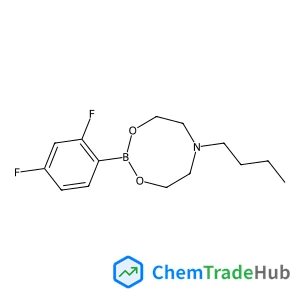
6-Butyl-2-(2,4-difluorophenyl)-1,3,6,2-dioxazaborocane
CAS Number:
1190988-98-7
Molecular Formula:
C14H20BF2NO2
Devis Di Tommaso
Bioactive glass ionomer cements (GICs), the reaction product of a fluoro–alumino–silicate glass and polyacrylic acid, have been in effective use in dentistry for over 40 years and more recently in orthopaedics and medical implantation. Their desirable properties have affirmed GIC's place in the medical materials community, yet are limited to non-load bearing applications due to the brittle nature of the hardened composite cement, thought to arise from the glass component and the interfaces it forms. Towards helping resolve the fundamental bases of the mechanical shortcomings of GICs, we report the 1st ever computational models of a GIC-relevant component. Ab initio molecular dynamics simulations were employed to generate and characterise three fluoro–alumino–silicate glasses of differing compositions with focus on resolving the atomic scale structural and dynamic contributions of aluminium, phosphorous and fluorine. Analyses of the glasses revealed rising F-content leading to the expansion of the glass network, compression of Al–F bonding, angular constraint at Al-pivots, localisation of alumino–phosphates and increased fluorine diffusion. Together, these changes to the structure, speciation and dynamics with raised fluorine content impart an overall rigidifying effect on the glass network, and suggest a predisposition to atomic-level inflexibility, which could manifest in the ionomer cements they form.
Reidun Aesoy, Sindre Støa, Viola Lekve, Stein Ove Døskeland, Lars Herfindal, Pål Rongved
DOI: 10.1039/D1MD00020A
Maximillian Taro William Lee, William Mahy, Mark David Rackham
DOI: 10.1039/D1MD00113B
Ronel Müller, Tiaan M. Gerwel, Magambo Phillip Kimuda, Özlem Tastan Bishop, Clinton G. L. Veale, Heinrich C. Hoppe
DOI: 10.1039/D1MD00237F
Tomris Coban, Cameron Robertson, Sianne Schwikkard, Richard Singer, Adam LeGresley
DOI: 10.1039/D0MD00428F
Lisa Barbaro, Gayathri Nagalingam, James A. Triccas, Jonathan B. Baell, Daniel L. Priebbenow
DOI: 10.1039/D1MD00063B
Bandi Siva, Sravanthi Vadlamudi, Surendar Reddy Bathula, Hashnu Dutta, K. Suresh Babu
DOI: 10.1039/D0MD00315H
Ivana Cacciatore, Hasan Turkez, Annalisa Di Rienzo, Michele Ciulla, Antonio Di Stefano
DOI: 10.1039/D1MD00177A
Waste containing 6-Chloro-5-(2'-hydroxy-3'-methoxy-4-biphenylyl)-3-(3-methoxyphe...
(3alpha,5alpha)-3-Hydroxypregnane-11,20-dione is primarily used in the pharmaceu...
The market for 4-Amino-6-chloro-2-pyridinecarboxylic acid (CAS: 546141-56-4) is ...
Alternatives to (2-Benzoylethyl)trimethylammonium chloride (CAS: 24472-88-6) in ...
N-[4-Nitro-3-(trifluoromethyl)phenyl]acetamide (CAS: 393-12-4) is generally safe...
Alternative reagents such as other phosphates or similar functional groups can b...
There are alternatives to N,N'-Bis(3-aminopropyl)-1,3-propanediamine (CAS: 4605-...
When handling Aluminium trihexadecanoate, it is important to use appropriate per...
(1,1-Dioxido-3-oxo-1,2-benzothiazol-2(3H)-yl)acetic acid is a chemical compound ...
Several alternatives to 5,5-dimethyloxolan-2-one (CAS: 3123-97-5) can be used in...

Physical Chemistry Chemical Physics (PCCP) is an international journal co-owned by 19 physical chemistry and physics societies from around the world. This journal publishes original, cutting-edge research in physical chemistry, chemical physics and biophysical chemistry. To be suitable for publication in PCCP, articles must include significant innovation and/or insight into physical chemistry; this is the most important criterion that reviewers and Editors will judge against when evaluating submissions. The journal has a broad scope and welcomes contributions spanning experiment, theory, computation and data science. Topical coverage includes spectroscopy, dynamics, kinetics, statistical mechanics, thermodynamics, electrochemistry, catalysis, surface science, quantum mechanics, quantum computing and machine learning. Interdisciplinary research areas such as polymers and soft matter, materials, nanoscience, energy, surfaces/interfaces, and biophysical chemistry are welcomed if they demonstrate significant innovation and/or insight into physical chemistry. Joined experimental/theoretical studies are particularly appreciated when complementary and based on up-to-date approaches.
![2-Methyl-2-propanyl [2-(2-oxa-6-azaspiro[3.3]hept-6-yl)ethyl]carbamate structure](https://static.chemtradehub.com/structs/141/1415562-38-7-c0a4.webp "2-Methyl-2-propanyl [2-(2-oxa-6-azaspiro[3.3]hept-6-yl)ethyl]carbamate structure")