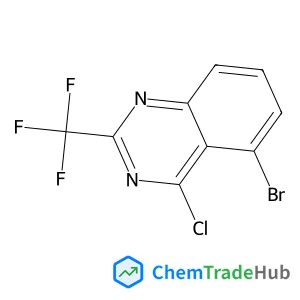
5-Bromo-4-chloro-2-(trifluoromethyl)quinazoline
CAS Number:
2089311-03-3
Molecular Formula:
C9H3BrClF3N2
Nikolai Manin, Olga Eliseeva, Alexey Dyshin, Arkadiy M. Kolker, Michael G. Kiselev
The thermodynamics of ion solvation in non-aqueous solvents remains of great significance for understanding cellular transport and ion homeostasis for the design of novel ion-selective materials and applications in molecular pharmacology. Molecular simulations play pivotal roles in connecting experimental measurements to the microscopic structures of liquids. One of the most useful and versatile mimetic systems for understanding biological ion transport is N-methyl-acetamide (NMA). A plethora of theoretical studies for ion solvation in NMA have appeared recently, but further progress is limited by two factors. One is an apparent lack of experimental data on solubility and thermodynamics of solvation for a broad panel of 1 : 1 salts over an appropriate temperature and concentration range. The second concern is more substantial and has to do with the limitations hardwired in the additive (fixed charge) approximations used for most of the existing force-fields. In this submission, we report on the experimental evaluation of LiCl solvation in NMA over a broad range of concentrations and temperatures and compare the results with those of MD simulations with several additive and one polarizable force-field (Drude). By comparing our simulations and experimental results to density functional theory computations, we discuss the limiting factors in existing potential functions. To evaluate the possible implications of explicit and implicit polarizability treatments on ion permeation across biological channels, we performed potential of mean force (PMF) computations for Li+ transport through a model narrow ion channel with additive and polarizable force-fields.
Isabel A. Thomlinson, Martin E. Levere, Catherine L. Lyall, Matthew G. Davidson
DOI: 10.1039/D0PY00475H
Xiang Deng
DOI: 10.1039/D0PY00134A
Talal F. Al-Azemi, Mickey Vinodh
DOI: 10.1039/D0PY00327A
Zi-Yuan Wang, Ze-Fan Yao, Yang Lu, Li Ding, Zi-Di Yu, Hao-Yang You, Xin-Yi Wang, Yang-Yang Zhou, Lin Zou, Jie-Yu Wang, Jian Pei
DOI: 10.1039/D0PY00456A
Tobias Haider, Oksana Suraeva, Miriam L. O'Duill, Julian Mars, Markus Mezger, Ingo Lieberwirth, Frederik R. Wurm
DOI: 10.1039/D0PY00272K
Yu Wang, Jiang-Bing Duan, Zhao-Xuan Liu, Tie-Qi Xu
DOI: 10.1039/D0PY00320D
Guilhem Coste, Jose E. Sanchez, Gail E. Fanucci, Brent S. Sumerlin
DOI: 10.1039/D0PY00383B
Xiaomin Zhu, Jian Zhang, Cheng Miao, Siyu Li, Youliang Zhao
DOI: 10.1039/D0PY00245C
Hua Zou, Shuxia Zhai
DOI: 10.1039/D0PY00394H
Waste containing 6-Chloro-5-(2'-hydroxy-3'-methoxy-4-biphenylyl)-3-(3-methoxyphe...
(3alpha,5alpha)-3-Hydroxypregnane-11,20-dione is primarily used in the pharmaceu...
The market for 4-Amino-6-chloro-2-pyridinecarboxylic acid (CAS: 546141-56-4) is ...
Alternatives to (2-Benzoylethyl)trimethylammonium chloride (CAS: 24472-88-6) in ...
N-[4-Nitro-3-(trifluoromethyl)phenyl]acetamide (CAS: 393-12-4) is generally safe...
Alternative reagents such as other phosphates or similar functional groups can b...
There are alternatives to N,N'-Bis(3-aminopropyl)-1,3-propanediamine (CAS: 4605-...
When handling Aluminium trihexadecanoate, it is important to use appropriate per...
(1,1-Dioxido-3-oxo-1,2-benzothiazol-2(3H)-yl)acetic acid is a chemical compound ...
Several alternatives to 5,5-dimethyloxolan-2-one (CAS: 3123-97-5) can be used in...

Physical Chemistry Chemical Physics (PCCP) is an international journal co-owned by 19 physical chemistry and physics societies from around the world. This journal publishes original, cutting-edge research in physical chemistry, chemical physics and biophysical chemistry. To be suitable for publication in PCCP, articles must include significant innovation and/or insight into physical chemistry; this is the most important criterion that reviewers and Editors will judge against when evaluating submissions. The journal has a broad scope and welcomes contributions spanning experiment, theory, computation and data science. Topical coverage includes spectroscopy, dynamics, kinetics, statistical mechanics, thermodynamics, electrochemistry, catalysis, surface science, quantum mechanics, quantum computing and machine learning. Interdisciplinary research areas such as polymers and soft matter, materials, nanoscience, energy, surfaces/interfaces, and biophysical chemistry are welcomed if they demonstrate significant innovation and/or insight into physical chemistry. Joined experimental/theoretical studies are particularly appreciated when complementary and based on up-to-date approaches.
![2-Methyl-2-propanyl [2-(2-oxa-6-azaspiro[3.3]hept-6-yl)ethyl]carbamate structure](https://static.chemtradehub.com/structs/141/1415562-38-7-c0a4.webp "2-Methyl-2-propanyl [2-(2-oxa-6-azaspiro[3.3]hept-6-yl)ethyl]carbamate structure")